

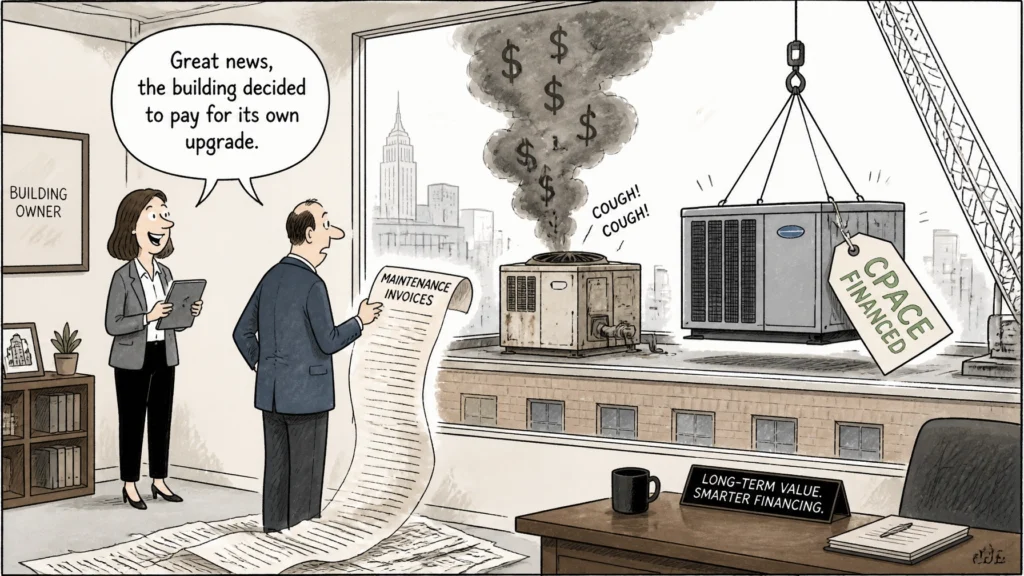
For many commercial property owners in Missouri, the HVAC system is a "silent partner" that only speaks up when it wants money. It starts with a service call for a frozen coil in July. Then, a compressor failure in August. By the time the fourth "emergency repair" invoice hits your desk, you realize you aren’t just maintaining a system: you’re on a financial treadmill.
This is the "death by a thousand cuts" of commercial building management. You know the HVAC replacement commercial building cost is looming, but the thought of a massive capital call or draining your reserves is enough to keep you in "patch and pray" mode.
But what if you could stop the bleeding without touching your balance sheet?
Missouri Clean Energy District (MCED) is Missouri’s statewide statutory PACE authority, serving communities across the state since 2011. Together with its nonprofit affiliate, Missouri Green Banc, the organizations have helped facilitate more than $2 billion in clean energy financing commitments and transactions through public-private partnerships.
In this "Solution Series" entry, we’ll look at how Missouri building owners are leveraging CPACE financing Missouri to replace failing systems while ensuring "the building pays for the upgrades."
The Maintenance Trap: Why "Patch and Pray" is Costing You More
Most property managers budget between $0.15 and $0.30 per square foot per year for routine HVAC maintenance. For a 50,000-square-foot office building, that’s a steady $15,000 annual baseline. However, as systems cross the 15-year mark, that "maintenance" often shifts into "reactive repair."
According to industry data, once a repair estimate exceeds 50% of the cost of a new unit, or when maintenance costs spike by more than 25% year-over-year, you are no longer maintaining an asset: you are subsidizing its obsolescence.
The hidden costs of deferring a full HVAC replacement include:
- Energy Waste: Older systems can consume 20-40% more energy than modern high-efficiency units.
- Tenant Churn: Discomfort leads to complaints, and persistent "hot/cold spots" are a leading reason for non-renewal.
- Operational Risk: An unscheduled system failure during a Missouri heatwave can shut down operations entirely, leading to lost revenue.

The Curiosity: What If the Building Paid for the Upgrade?
The biggest hurdle to a full system overhaul is capital. Traditional bank loans often require significant down payments, personal guarantees, and short repayment terms (3–7 years). This creates a cash-flow crunch that most owners want to avoid, leading to the "capital call" dilemma.
This is where CPACE financing Missouri (Commercial Property Assessed Clean Energy) changes the math.
Through Missouri Green Banc, building owners can access 100% upfront financing for energy-efficient upgrades. Because the financing is structured as a long-term special assessment on the property tax bill, the repayment term can extend up to 20 or even 30 years.
The logic is simple: The energy and maintenance savings generated by the new system are often greater than the annual financing payment.
In short: The building pays for the upgrades.
The Solution: Missouri Green Banc and the MCED Infrastructure
When you choose to finance through Missouri Green Banc, you aren't just getting a loan; you are plugging into Missouri’s clean energy finance infrastructure.
Since 2011, the Missouri Clean Energy District has served as the statutory backbone for PACE in the state. With over 300 member cities and counties, we provide a stable, institutional-grade platform for property owners, developers, and contractors.
Why Missouri Property Owners Trust Our Program:
- Statutory Authority: We have been Missouri's statewide authority since 2011, providing a transparent and consistent framework.
- Scale and Stability: With over $2 billion in transactions and commitments, our program is a proven financial tool for the private sector.
- No Capital Outlay: CPACE covers 100% of the HVAC replacement commercial building cost, including soft costs like engineering and permits.
- Non-Recourse & Off-Balance Sheet: The financing is tied to the property, not the owner, and typically transfers upon sale.

Data-Forward: A Comparison of "Maintain" vs. "Replace"
Let’s look at a hypothetical 40,000-square-foot commercial retail center in Missouri facing a failing rooftop unit (RTU) system.
| Metric | Scenario A: Continue Maintenance | Scenario B: CPACE Replacement |
|---|---|---|
| Upfront Capital Required | $0 | $0 (100% Financed) |
| Annual Maintenance/Repair | $12,000 (Rising) | $2,000 (Warranty Covered) |
| Annual Energy Cost | $45,000 | $31,500 (30% Savings) |
| Annual CPACE Payment | $0 | $18,000 |
| Total Annual Outflow | $57,000 | $51,500 |
| Immediate Cash Flow Gain | $0 | +$5,500 |
In Scenario B, the owner has a brand-new, reliable system, a 20-year fixed rate, and improved property value: all while spending $5,500 less per year than they were on the failing system. This is the essence of Property Assessed Clean Energy Missouri.
How to Get Started with Missouri Green Banc
If you are tired of the maintenance treadmill and want to explore a Missouri PACE program that works for your bottom line, the process is streamlined for the commercial sector.
- Project Assessment: Identify your aging HVAC, roofing, or lighting needs.
- Contractor Engagement: Work with your preferred contractor (or one of our certified partners) to get a quote for a high-efficiency replacement.
- Application: Apply for PACE financing Missouri through our online portal.
- Approval & Funding: Once approved, Missouri Green Banc facilitates the funding, the project begins, and the assessment is placed on the property.

Conclusion
The "hidden cost" of HVAC maintenance isn't just the invoices; it’s the lost opportunity, the constant stress of potential failure, and the inefficiency that drags down your Net Operating Income (NOI).
By leveraging Missouri's best PACE program, you can exit the maintenance trap, avoid a capital call, and let your building pay for its own transformation. Whether you are a property owner in St. Louis, Kansas City, or a rural Missouri community, Missouri Green Banc is here to provide the energy efficiency financing Missouri businesses need to thrive.
Stop patching. Start upgrading.
About Missouri Green Banc & MCED
Missouri Clean Energy District is Missouri's statewide statutory PACE authority, serving communities across the state since 2011. Together with its nonprofit affiliate, Missouri Green Banc, the organizations have helped facilitate more than $2 billion in clean energy financing commitments and transactions through public-private partnerships. We work with over 300 cities and counties to provide inclusive financing solutions for clean energy and building decarbonization projects.
