
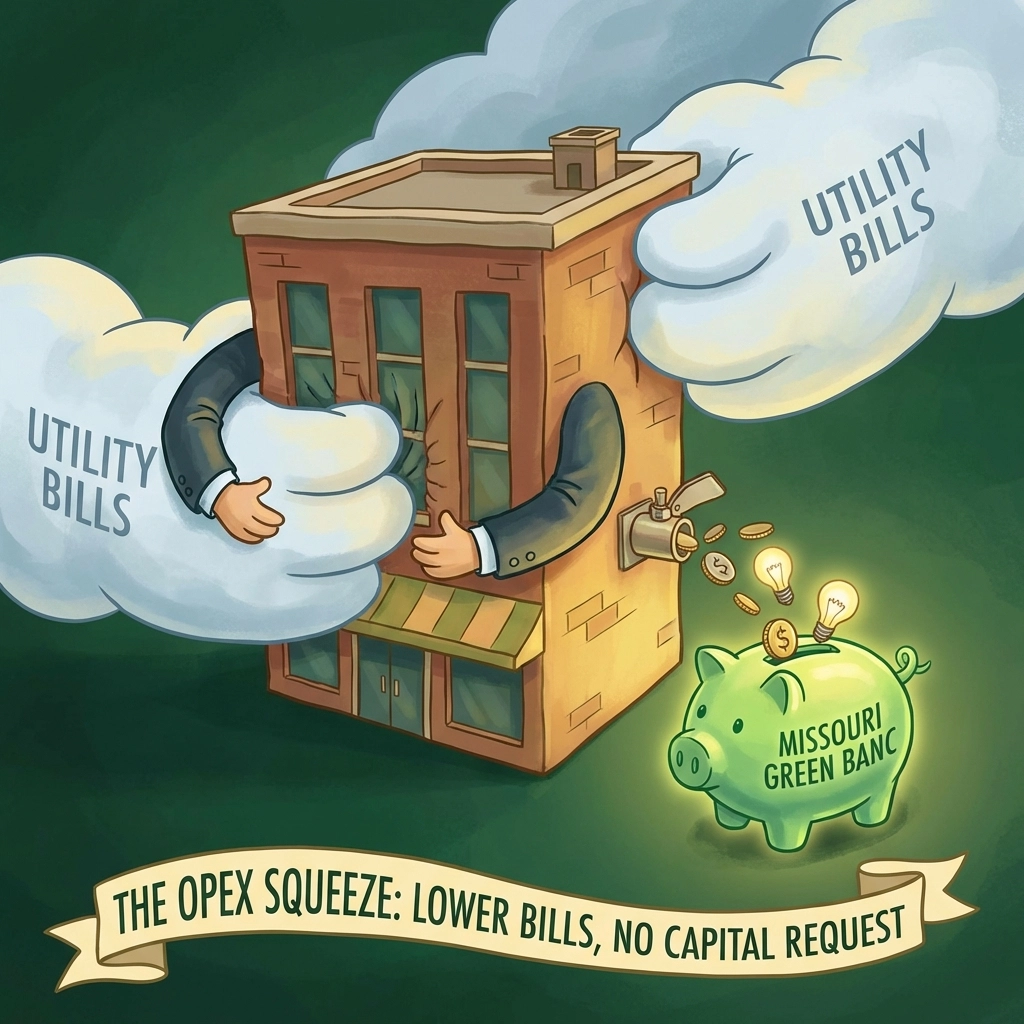
For property management firms across Missouri, the current economic landscape feels like a vice grip. On one side, utility rates continue to climb, driven by grid modernization costs and fluctuating fuel prices. On the other, ownership groups are tightening the reins on capital expenditures (CapEx), often viewing major building upgrades as a threat to liquidity or short-term returns.
This creates what industry veterans call the "OpEx Squeeze." Operational expenses are ballooning due to inefficient, aging HVAC systems and outdated lighting, yet the very projects that would solve these issues are stuck in a permanent state of "pending approval" because they require a massive upfront capital request.
The solution to unfreezing these essential upgrades lies in a structural shift in how Missouri buildings are financed. By leveraging CPACE financing through the Missouri Green Banc and Missouri Clean Energy District, property managers can bypass the traditional capital request process entirely, shifting the cost of modernization from a balance-sheet debt to a long-term property tax assessment.
The Bottleneck: Why Traditional Capital Requests Fail
In a typical commercial real estate environment, a property manager identifies a need: perhaps a 20-year-old chiller that is hemorrhaging electricity and requires constant repairs. The manager submits a capital request for $500,000.
To the owner or the board, that $500,000 represents a significant hit to the building’s cash reserves. Even if the project promises a five-year payback through energy savings, the immediate loss of liquidity often leads to a "no" or a "not this year." The result is a cycle of reactive maintenance: spending thousands on "band-aid" repairs that do nothing to lower the monthly utility bill.
This is where the Missouri Green Banc PACE program changes the math. Unlike a bank loan that requires a significant down payment and has a short five-to-seven-year term, Commercial PACE loans provide 100% upfront financing. The cost of the upgrade is amortized over the useful life of the equipment: often up to 20 or 25 years: and is repaid through an assessment on the property tax bill.

Shifting from CapEx to OpEx
The primary advantage for a property management firm using Property Assessed Clean Energy is the reclassification of the project. Because the financing is structured as a tax assessment rather than a corporate loan, it does not sit on the balance sheet as traditional debt.
This shift allows property managers to present the upgrade not as a "Capital Request," but as an operational adjustment. In many instances, the annual energy savings generated by a new HVAC system, LED lighting retrofit, or high-efficiency building envelope are greater than the annual PACE assessment.
When the savings exceed the payment, the project becomes "cash-flow positive" from day one. Instead of asking the owner for half a million dollars, the property manager is presenting a way to lower the net operating expenses of the building.
The Pass-Through Advantage in Triple-Net Leases
For properties with Triple-Net (NNN) leases, C-PACE offers a unique mechanism for cost recovery that traditional financing cannot match.
In a standard NNN lease, tenants are responsible for their share of operational expenses (OpEx), including property taxes and utilities. When a building owner takes out a traditional loan to install a high-efficiency roof, the owner pays for the roof, but the tenants receive the benefit of the lower utility bills. This "split incentive" is a major reason why many green building projects never get off the ground.
However, because CPACE financing is collected as a property tax assessment, it is categorized as an operating expense. This allows the building owner to pass the cost of the energy-saving upgrade through to the tenants: the same tenants who are seeing their monthly utility bills drop because of the new equipment.
This alignment of interests is the "holy grail" of property management. The building gets a brand-new asset, the owner preserves their capital, and the tenants enjoy a more comfortable, modern space with lower total occupancy costs.
Statutory Stability: The Power of the Missouri Clean Energy District
When choosing a partner for these upgrades, property managers must look for stability and scale. The Missouri Clean Energy District (MCED) stands as the first and largest PACE district in the state. With over 300 municipal members, MCED provides the statutory framework that makes these long-term assessments possible and secure.
Working through Missouri Green Banc in partnership with MCED ensures that the financing is backed by established state law. This reliability is crucial for professional advisors: CPAs, attorneys, and architects: who need to know that the financing structure will remain sound for the duration of the 20-year term.
The longevity of MCED means the process is streamlined. From the initial energy audit to the final funding through the fastpace-application-form, the path to lower OpEx is well-trodden and efficient.
Modernizing Without "Selling the Future"
A common concern for property managers is what happens if the building is sold before the PACE assessment is fully paid. With traditional financing, a loan usually must be paid off in full upon the sale of the property, which can complicate the closing.
C-PACE assessments, however, are tied to the property, not the owner. If the building is sold, the assessment simply transfers to the new owner, just like any other property tax obligation. The new owner takes over the lower utility bills and the remaining payments for the equipment. This "transferability" removes the risk of "over-investing" in a property that might be traded in the near future.

Strategic Steps for Property Managers
To break the "OpEx Squeeze," property management firms should move beyond simple behavioral changes like "turning off the lights" and look toward structural mechanical upgrades. While research shows that operational optimization is a good starting point, the heavy lifting of building decarbonization and cost reduction happens at the equipment level.
- Identify the "Pain Points": Which buildings in the portfolio have the highest utility intensity? Which HVAC systems are nearing the end of their lifecycle?
- Conduct a Preliminary Energy Assessment: Determine the potential for savings. Many energy improvement loans require a clear demonstration that the upgrades will reduce energy or water consumption.
- Evaluate the Capital Stack: Instead of waiting for a CapEx window to open, look at how a tax assessment fits into the current OpEx budget.
- Leverage Expertise: Use resources from Missouri Green Banc to model the cash flow of a C-PACE project.
A Permanent Hedge Against Rising Rates
The volatility of energy markets is a constant threat to a building’s Net Operating Income (NOI). By locking in fixed-rate Commercial PACE loans, property managers are effectively creating a hedge against future utility rate hikes.
A building that uses 30% less energy today will be significantly more insulated from a 10% utility rate increase tomorrow. This foresight not only protects the owner’s bottom line but also increases the overall market value of the asset. Modern, efficient buildings consistently command higher rents and experience lower vacancy rates than their "energy-leaking" counterparts.
Conclusion: Unfreezing the Future
The "Solution Series" highlights that the barriers to building modernization are rarely technical: they are almost always financial. The technology to lower utility bills exists today; the challenge has been finding a way to pay for it without draining capital reserves.
By utilizing Missouri's best PACE program, property managers can finally stop asking for capital and start delivering operational efficiency. It is a transition from a reactive "fix it when it breaks" mentality to a proactive, value-add strategy that benefits owners, tenants, and the community at large.
For those ready to move a project from the "pending" file to the "completed" file, the programs offered by Missouri Green Banc provide the necessary tools to navigate the OpEx squeeze and build a more resilient Missouri.
About Missouri Green Banc
Missouri Green Banc is a non-profit organization dedicated to providing inclusive, community-based clean energy solutions. By partnering with the Missouri Clean Energy District, we facilitate building decarbonization and energy efficiency through innovative financing models that support sustainable growth across the state.

