
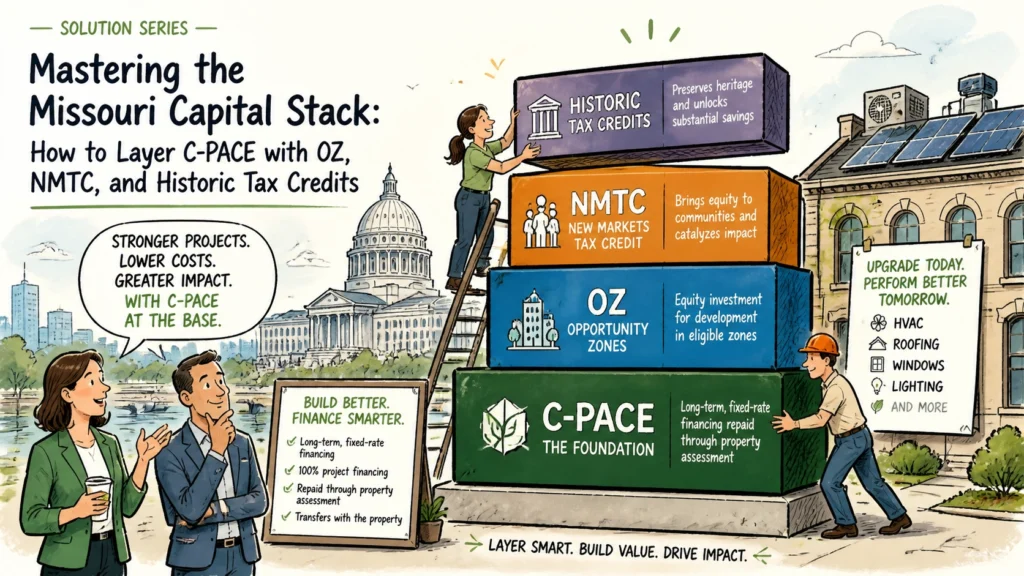
Missouri property developers are currently navigating a complex economic landscape. Between rising construction costs and a heightened focus on building decarbonization, the traditional methods of project financing often fall short of modern requirements. The challenge is no longer just about securing a loan; it is about building a sophisticated capital stack that ensures long-term viability and sustainability.
In this scenario, the developer is the hero of the story, striving to revitalize communities and modernize the state’s infrastructure. Missouri Green Banc serves as the guide, providing the tools and expertise necessary to navigate the complexities of clean energy financing. By mastering the Missouri capital stack: specifically the layering of C-PACE with Opportunity Zones, New Markets Tax Credits, and Historic Tax Credits: developers can achieve a unique financial synergy where the building pays for the upgrades.
The Foundation: The Power of C-PACE and the MCED Partnership
At the heart of a robust capital stack in Missouri is Commercial Property Assessed Clean Energy (C-PACE). CPACE financing Missouri has evolved from a niche alternative into a cornerstone of commercial real estate development. This is largely due to the strength of the Missouri Clean Energy District (MCED).
As the first and largest PACE program in the state, MCED boasts a partnership of over 300 municipal members. This statewide reach ensures that Missouri Green Banc can offer a seamless experience for developers looking to integrate Missouri's best PACE program into their projects. C-PACE is a non-dilutive capital source that covers up to 100% of the costs for energy efficiency, renewable energy, and water conservation upgrades.
Because C-PACE is structured as a long-term assessment on the property rather than a traditional corporate loan, it offers fixed-rate, long-term financing that typically spans 20 to 30 years. This aligns perfectly with the useful life of the upgrades themselves. When a developer utilizes C-PACE, the energy savings generated by the new systems often exceed the assessment payments. This is the essence of the tagline: the building pays for the upgrades.
Layer 1: Strategic Integration with Opportunity Zones (OZ)
For developers working in federally designated distressed communities, Opportunity Zones (OZ) provide a powerful equity incentive. The OZ program allows investors to reinvest capital gains into "Qualified Opportunity Funds," offering significant tax deferrals and potential tax-free appreciation after a 10-year holding period.
The synergy between OZ and Commercial PACE loans Missouri is found in the concept of "patient capital." Opportunity Zone projects require a long-term commitment, often a decade or more. C-PACE financing mirrors this timeline with its 20+ year amortization schedule. By layering C-PACE into an OZ project, developers can reduce the amount of high-cost equity required. This preserves the developer's ownership stake while ensuring the project meets modern sustainability standards.
Using C-PACE to fund the "green" portions of an OZ project: such as high-efficiency HVAC systems or solar arrays: improves the Net Operating Income (NOI). A higher NOI increases the asset's value, which is exactly what OZ investors want to see when they look toward their eventual tax-free exit.
Layer 2: Integrating New Markets Tax Credits (NMTC) for Mission-Driven Projects
For projects located in highly distressed census tracts, New Markets Tax Credits (NMTC) are a vital piece of the puzzle. The NMTC program is designed to stimulate investment in low-income communities by providing a 39% federal tax credit over seven years.
However, NMTC deals are notoriously complex and often leave a "gap" in the capital stack. Missouri Green Banc helps bridge this gap by positioning C-PACE as a complementary tool. While NMTCs focus on the overall economic impact and job creation of a project, C-PACE focuses on the physical building’s performance.
When layering these tools, C-PACE can act as the leverage debt or a gap-filler that supports the sustainability components of the project. This is particularly effective for mission-driven projects like community centers, healthcare facilities, or non-profit headquarters. Because Missouri Green Banc operates as a non-profit organization, its goals are naturally aligned with the mission-driven nature of NMTC projects.

Layer 3: Modernizing History with Historic Tax Credits (HTC)
Missouri is home to a wealth of historic architecture, particularly in cities like St. Louis and Kansas City, as well as in smaller rural hubs. Modernizing these structures is both a challenge and an opportunity. Missouri offers one of the most robust Historic Tax Credit (HTC) programs in the country, allowing for a 25% to 35% state tax credit on qualified rehabilitation expenditures, which can be stacked on top of the 20% federal HTC.
The struggle with historic renovations often lies in the "unseen" costs: outdated electrical grids, inefficient heating, and poor insulation. These are precisely the types of improvements that C-PACE is designed to fund. By layering Property Assessed Clean Energy with HTCs, developers can fund the modernization of a building's core infrastructure without depleting the equity needed for aesthetic and structural restoration.
A significant update to Missouri law in 2024 now allows non-profit entities to access state historic tax credits, further expanding the potential for collaborative, mission-driven renovations. When a historic building is retrofitted with modern, energy-efficient systems through C-PACE, it doesn't just preserve the past; it ensures the building's financial and environmental viability for the next century.
Building the Stack: A Practical Example
To understand how these layers function together, consider a hypothetical $20 million renovation of a historic warehouse in a Missouri Opportunity Zone that also qualifies for New Markets Tax Credits.
- Historic Tax Credits: Could cover approximately 45% of the qualified rehabilitation costs, providing a massive equity boost.
- New Markets Tax Credits: Could fill an additional 20-25% of the stack, focusing on the community impact and job creation.
- C-PACE (via MCED): Can fund 100% of the energy-related improvements (HVAC, windows, roofing, lighting). This might represent 15-20% of the total project cost.
- Developer Equity/OZ Investment: The remaining balance is covered by the developer or OZ investors.
By using this approach, the developer significantly reduces the need for traditional, high-interest mezzanine debt. The C-PACE portion is repaid over 20+ years via the property tax bill, and since the upgrades reduce utility costs, the project's cash flow remains strong. In this model, the building pays for the upgrades, allowing the developer to focus on the broader vision.
The Guide for Your Next Project
Navigating these various programs requires more than just a spreadsheet; it requires a partner who understands the Missouri landscape. Missouri Green Banc, in partnership with the Missouri Clean Energy District, provides the expertise to help developers identify which "puzzle pieces" fit their specific project.
Whether the goal is building decarbonization, increasing energy efficiency, or simply closing a difficult funding gap, the team at Missouri Green Banc is dedicated to sustainable building financing. The organization's not-for-profit model ensures that the focus remains on community impact and long-term success.
The transition to a clean energy economy is not just a regulatory requirement; it is a significant financial opportunity for those who know how to master the capital stack. By combining the immediate tax benefits of HTCs and NMTCs with the long-term, self-funding nature of C-PACE, Missouri developers can lead the way in creating resilient, efficient, and profitable properties.

Take the Next Step
Building a better Missouri starts with smarter financing. For developers ready to explore how C-PACE can enhance their current or future projects, Missouri Green Banc is ready to assist.
To learn more about apply for PACE financing or to discuss a specific project's capital stack, visit our programs page or reach out directly to the team.
Contact Information:
Email: info@missourigreenbanc.org
Website: missourigreenbanc.org
Contact Page: missourigreenbanc.org/contact
The future of Missouri real estate is green, and with the right capital stack, the building itself will lead the way.
