
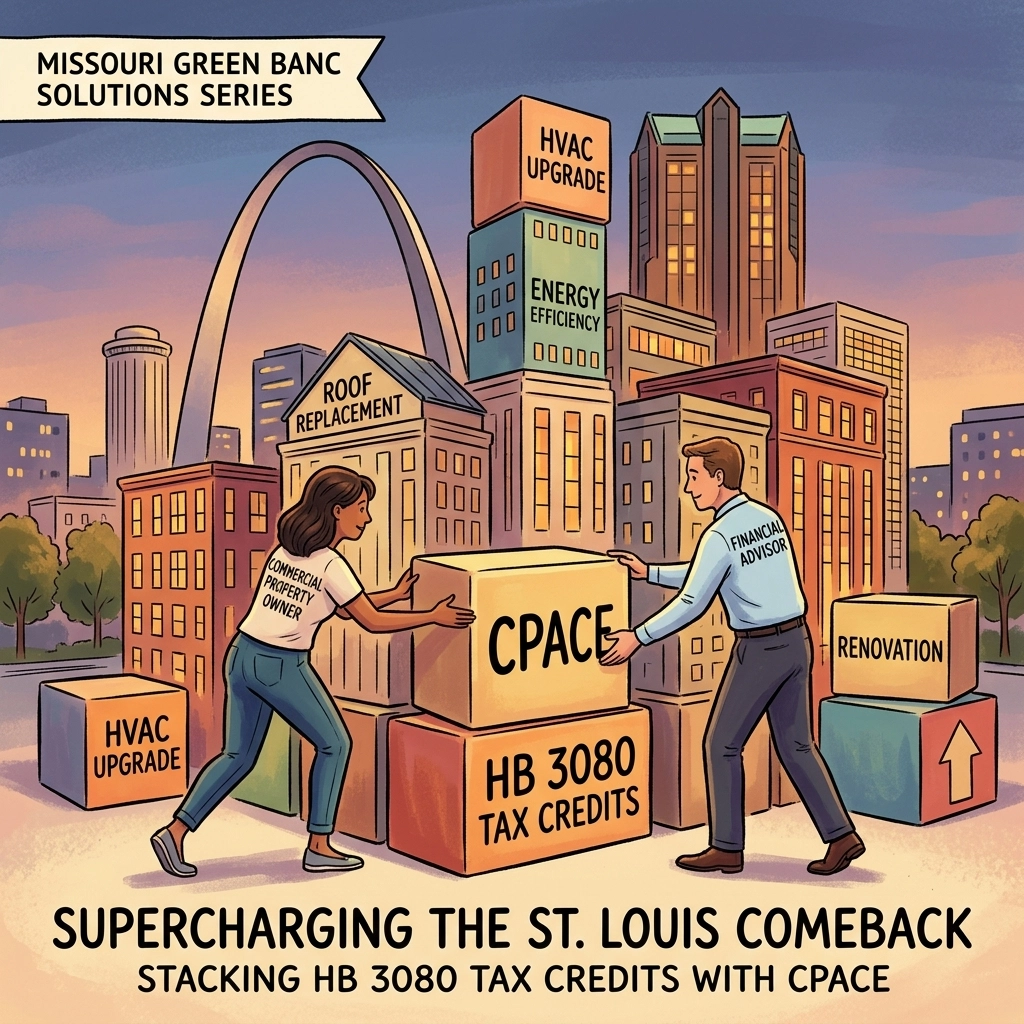
The skyline of St. Louis stands at the threshold of a historic transformation. For years, iconic structures like the AT&T Tower and the Railway Exchange Building have served as silent giants, awaiting the right economic catalyst to return to productivity. On May 15, 2026, that catalyst arrived with the passage of HB 3080. This landmark legislation, which expands Missouri Historic Tax Credits, specifically targets large-scale redevelopments, providing the financial horsepower needed to revitalize downtown St. Louis.
However, even with historic tax credits reaching new heights, a significant "capital gap" often remains in complex urban redevelopments. This is where CPACE financing and Missouri Green Banc becomes the essential partner. By stacking the incentives of HB 3080 with the specialized funding provided by the Missouri Green Banc (MGB), developers can unlock a powerful capital stack that makes the impossible, possible. At the heart of this strategy is a simple, transformative truth: The building pays for the upgrades.
Understanding the Impact of HB 3080
HB 3080 is more than just a legislative update; it is a signal to the national development community that Missouri is open for business. The bill restores and expands provisions that were previously stalled, offering up to $60 million in tax credits specifically for buildings exceeding 1 million square feet. In a city like St. Louis, where "mega-buildings" represent the largest hurdle to downtown revitalization, this is a game-changer.
By raising state historic tax credits for qualifying projects to approximately 35% of eligible rehabilitation costs, HB 3080 significantly reduces the amount of upfront equity a developer must bring to the table. When combined with the existing 20% federal historic tax credit, the subsidy stack can cover over half of a project’s qualified rehabilitation expenditures (QREs).
Yet, even with 50-55% of costs covered by credits, the remaining 45% must be financed in an environment of fluctuating interest rates and stringent lending requirements. This is where the synergy between state incentives and Missouri Green Banc PACE creates a path to success.

The Strategic Role of CPACE Financing Missouri
Commercial Property Assessed Clean Energy (CPACE) is a financing tool that allows property owners to secure long-term, fixed-rate capital for energy efficiency, water conservation, and renewable energy improvements. Unlike traditional bank loans, CPACE is repaid via a special assessment on the property tax bill.
For developers tackling the massive "mega-buildings" mentioned in HB 3080, CPACE serves as the perfect "gap filler." Large-scale historic redevelopments almost always require complete overhauls of mechanical, electrical, and plumbing (MEP) systems: all of which are prime candidates for energy upgrade funding.
Why CPACE is the Ideal "Stacking" Partner:
- Lower Equity Requirements: By utilizing CPACE for 15-30% of the total project cost, developers can significantly reduce the need for high-cost mezzanine debt or dilutive equity partners.
- Long-Term Fixed Rates: CPACE terms often extend to 20+ years, matching the useful life of the upgrades and providing predictable cash flow.
- Non-Recourse Financing: CPACE is secured by the property itself, not a personal guarantee from the developer.
- Compatibility with Tax Credits: Most CPACE-eligible improvements: such as high-efficiency HVAC, LED lighting, and advanced building envelopes: also qualify as QREs for historic tax credits. This "double-dipping" effectively allows the same dollar of expenditure to generate a tax credit while being financed by low-cost, long-term capital.

Framing the Capital Stack: A $100 Million Vision
To visualize how these tools work together, consider a hypothetical $100 million conversion of a historic downtown office tower into a mixed-use residential hub.
- Federal Historic Tax Credits: ~$15M in equity-like capital.
- Missouri State Historic Tax Credits (HB 3080): ~$25M-$30M in equity-like capital.
- MGB CPACE Financing: ~$20M-$25M in long-term, fixed-rate debt.
- Senior Debt & Sponsor Equity: The remaining gap is now manageable, often requiring as little as 10-15% true cash equity from the sponsor.
By integrating commercial energy financing early in the planning stages, the "Hero" of our story: the developer: is able to navigate the complexities of the capital stack with a clear "Guide." Missouri Green Banc acts as that guide, offering the expertise needed to align these various funding sources seamlessly.
Missouri Green Banc: The First and Largest Choice
When choosing a partner for Property Assessed Clean Energy in Missouri, experience matters. The Missouri Green Banc, in partnership with the Missouri Clean Energy District (MCED), operates the first and largest PACE program in the state. With a membership of over 300 municipalities, our program offers a standardized, reliable, and transparent process that senior lenders and tax credit investors trust.
Our mission as a non-profit organization is to facilitate building decarbonization projects in Missouri while driving economic growth. We understand that for a project to be sustainable, it must first be financially viable. By leveraging our programs, developers can ensure their projects meet modern efficiency standards without straining their balance sheets.
How the Building Pays for the Upgrades
The philosophy behind the Missouri PACE program is rooted in the concept of "neutral cash flow." When a building undergoes a deep energy retrofit: replacing 50-year-old chillers with modern heat pumps or installing high-performance windows: the reduction in utility expenses and maintenance costs is often substantial.
In many cases, the annual energy savings generated by these improvements meet or exceed the annual CPACE assessment payment. Essentially, the operational waste that was previously being paid to utility companies is redirected to pay for the new, high-value infrastructure. The building pays for the upgrades, allowing the owner to preserve capital for other aspects of the redevelopment, such as interior finishes or tenant amenities.
Navigating the Process with MGB
For developers ready to capitalize on the new HB 3080 tax credits, the time to engage with Missouri Green Banc is now. The process of applying for PACE financing is designed to move at the speed of business.
- Project Intake: Start by providing basic project details through our intake portal.
- Energy Audit & Engineering: Identify the eligible measures that will drive the most significant energy savings and tax credit value.
- Lender Consent: We work alongside your senior lender to ensure the CPACE assessment is structured for long-term stability.
- Funding: Capital is deployed to fund the energy retrofit financing needs, often providing a source of liquidity during the construction phase.

Conclusion: A Greener, More Prosperous St. Louis
The passage of HB 3080 represents a once-in-a-generation opportunity for St. Louis. By providing the legislative framework to tackle our largest architectural challenges, Missouri has set the stage for a dramatic urban comeback.
However, legislation is only the foundation. The actual construction of this future requires innovative financial tools that bridge the gap between vision and reality. By stacking Historic Tax Credits with CPACE financing, developers can create high-performing, resilient buildings that will anchor our community for the next century.
Missouri Green Banc remains committed to being the premier partner in this journey. Whether you are looking for low-interest PACE loans or seeking advice on how to finance renewable projects, our team is here to help you achieve your goals.
The tools are in place. The credits are available. The capital is ready. Let’s rebuild St. Louis together, knowing that with the right partnership, the building pays for the upgrades.
To learn more about how to integrate CPACE into your next project, visit our About MGB page or start your FastPACE application today.
