
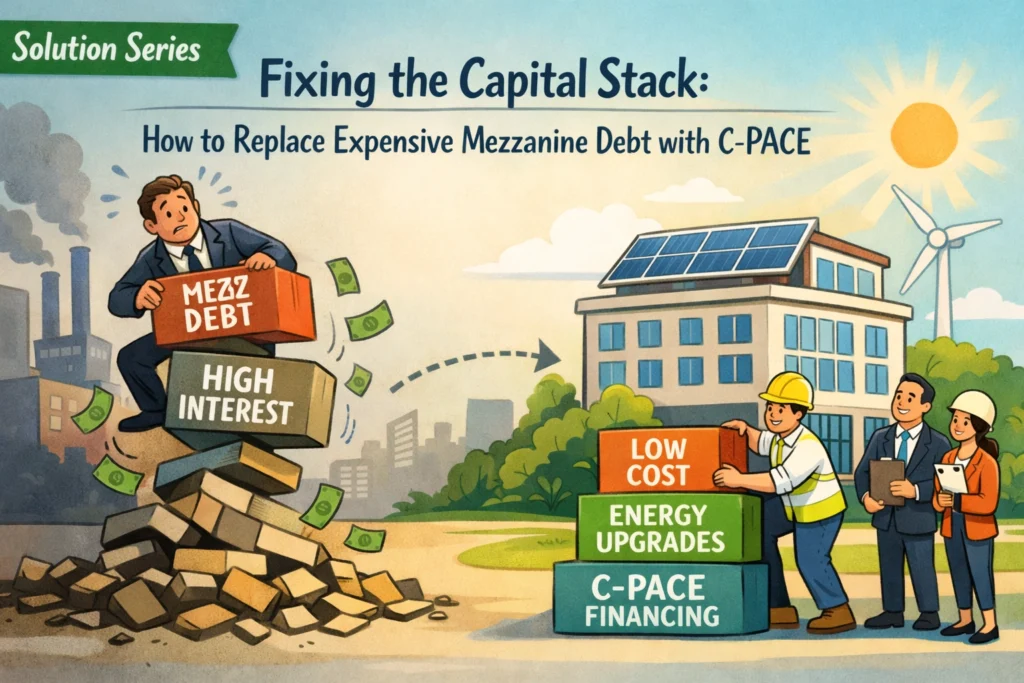
In commercial real estate development, the math is getting harder. Between rising interest rates, tightened lending standards from traditional banks, and the sheer cost of materials, the "gap" in the capital stack has become a chasm. Historically, developers have plugged this gap with mezzanine debt or preferred equity.
While these tools work, they are expensive. Mezzanine debt often carries double-digit interest rates and can require personal guarantees or complicated inter-creditor agreements that slow down a project.
There is a more efficient way to engineer your project’s financing. By utilizing CPACE financing through the Missouri Clean Energy District (MCED) and Missouri Green Banc, developers can replace high-cost capital with long-term, fixed-rate financing. The result? A significantly lower Weighted Average Cost of Capital (WACC) and a more viable project.
The Anatomy of the Capital Stack Problem
The traditional capital stack for a mid-to-large-scale development usually looks something like this:
- Senior Debt: 55% to 65% Loan-to-Cost (LTC). This is your lowest-cost capital, typically from a bank or insurance company.
- Mezzanine Debt / Preferred Equity: 10% to 20% LTC. This fills the gap between the senior loan and the developer's equity. It is expensive, often priced between 12% and 18%.
- Common Equity: 15% to 25% LTC. The most expensive capital, representing the developer's skin in the game and outside investors.
The problem today is that senior lenders are pulling back. Where a developer might have once secured 70% LTC, they are now seeing 55% or 60%. This forces more reliance on the "middle" of the stack: the mezzanine layer. When the cost of that middle layer spikes, the project's internal rate of return (IRR) takes a hit, often to the point where the numbers no longer pencil out.

Enter C-PACE: The "Mezzanine Killer"
Commercial Property Assessed Clean Energy (C-PACE) is a specialized financing tool that allows property owners to fund 100% of the upfront costs for energy efficiency, water conservation, and renewable energy improvements. In Missouri, this is made possible through the statutory framework of the Missouri Clean Energy District.
For a developer, C-PACE shouldn't be viewed through an "environmental" lens, but through a "financial engineering" lens. It functions as a non-recourse, fixed-rate alternative to mezzanine debt.
Why C-PACE Wins on the Math
- Cost of Capital: While mezzanine debt can hover in the mid-to-high teens, C-PACE is typically priced in the 7% to 9% range (market dependent).
- Term Length: Mezzanine debt is usually short-term, matching the construction loan (3–5 years). C-PACE terms can extend up to 30 years, matching the useful life of the equipment being financed.
- Non-Recourse: C-PACE is an assessment on the property, not a loan to the individual or the entity. It does not require personal guarantees, which is a massive advantage for developers looking to limit liability.
- Off-Balance Sheet Treatment: Depending on your accounting structure, C-PACE may be treated as an operating expense rather than debt, preserving the developer’s borrowing capacity for other projects.
Solving for WACC: A Hypothetical Comparison
Let’s look at the impact on the Weighted Average Cost of Capital (WACC) for a $20 million project.
Scenario A: Traditional Stack with Mezzanine
- Senior Debt ($12M): 6.5% interest
- Mezzanine Debt ($4M): 14% interest
- Equity ($4M): 20% target return
- WACC: 10.7%
Scenario B: Stack Optimized with CPACE Financing Missouri
In this scenario, we replace the mezzanine debt with C-PACE by identifying $4 million in eligible "green" costs: think HVAC systems, high-efficiency windows, roofing, and lighting.
- Senior Debt ($12M): 6.5% interest
- C-PACE ($4M): 8% interest
- Equity ($4M): 20% target return
- WACC: 9.5%
By simply swapping the mezzanine layer for C-PACE, the developer lowers the WACC by 120 basis points. On a $20 million project, that creates significant margin and improves the project's debt service coverage ratio (DSCR), making the senior lender more comfortable.
The Missouri Green Banc Advantage: Statutory Stability
The key to successfully integrating C-PACE into a capital stack is certainty. Developers need to know that the financing is stable, legally sound, and accepted by senior lenders.
Missouri Green Banc and the Missouri Clean Energy District provide the largest and most established Missouri PACE program. With over 300 municipal members across the state, MGB offers a level of statutory stability that "one-off" programs cannot match. This scale is critical when seeking senior lender consent.
Most senior lenders are initially wary of C-PACE because the assessment is senior to the mortgage in the payment hierarchy (though only for the delinquent amount). However, MGB's professional approach and standardized documentation make the consent process smoother. Senior lenders increasingly view C-PACE as a positive because it replaces expensive, high-risk mezzanine debt with stable, long-term capital that improves the physical value of their collateral.

Improving Project Viability via "FastPACE"
Time is the enemy of any development deal. Traditional mezzanine providers can be notoriously slow, requiring extensive underwriting of the developer's entire portfolio.
The Missouri's best PACE program is designed for speed. Through the FastPACE application form, developers can quickly determine project eligibility based on the building’s projected energy performance. Since the financing is based on the property's value and the eligibility of the improvements: rather than the developer’s personal credit score: the underwriting process is streamlined.
Retroactive Financing: Recovering Equity
Another unique "financial engineering" tool within the MGB framework is retroactive financing. If you have completed a project within the last 24 to 36 months (depending on specific local guidelines), you may be able to look back and pull C-PACE capital out of those improvements.
This allows developers to:
- Pay off an existing mezzanine loan early.
- Recapture equity to deploy into a new project.
- Increase liquidity during the stabilization phase of a building.
For more information on how this works, you can explore our programs page.
No "Green" Fluff: Just Better Numbers
While C-PACE technically funds energy-efficient upgrades, the primary driver for most developers is the impact on the bottom line. By replacing 15% interest debt with 8% interest debt, you aren't just "being sustainable": you are making a smarter business decision.
The improvements funded by C-PACE: high-efficiency HVAC, LED lighting, and advanced building envelopes: also lower the building's operating expenses (OpEx). Lower OpEx leads to higher Net Operating Income (NOI), which in turn increases the total valuation of the asset at the time of sale or refinance.
For a deeper look at how these upgrades hedge against market volatility, see our analysis on rising energy costs.
Conclusion: Engineering a Stronger Stack
In a high-interest-rate environment, the "business as usual" approach to the capital stack is a recipe for stalled projects and diminished returns. Developers who understand how to leverage Property Assessed Clean Energy Missouri are finding they can move projects forward while others are stuck waiting for rates to drop.
By replacing expensive mezzanine debt with fixed-rate, non-recourse C-PACE, you lower your WACC, protect your equity, and build a better-performing asset.
If you are currently looking at a "gap" in your project's financing, it’s time to run the numbers on C-PACE. Missouri Green Banc is here to provide the institutional-grade framework you need to get the deal done.
Ready to see how C-PACE fits into your stack?
- Learn more about MGB.
- Start your FastPACE application.
- Contact us for a capital stack analysis.
Missouri Green Banc is a non-profit organization dedicated to providing inclusive clean energy financing solutions across Missouri in partnership with the Missouri Clean Energy District.

