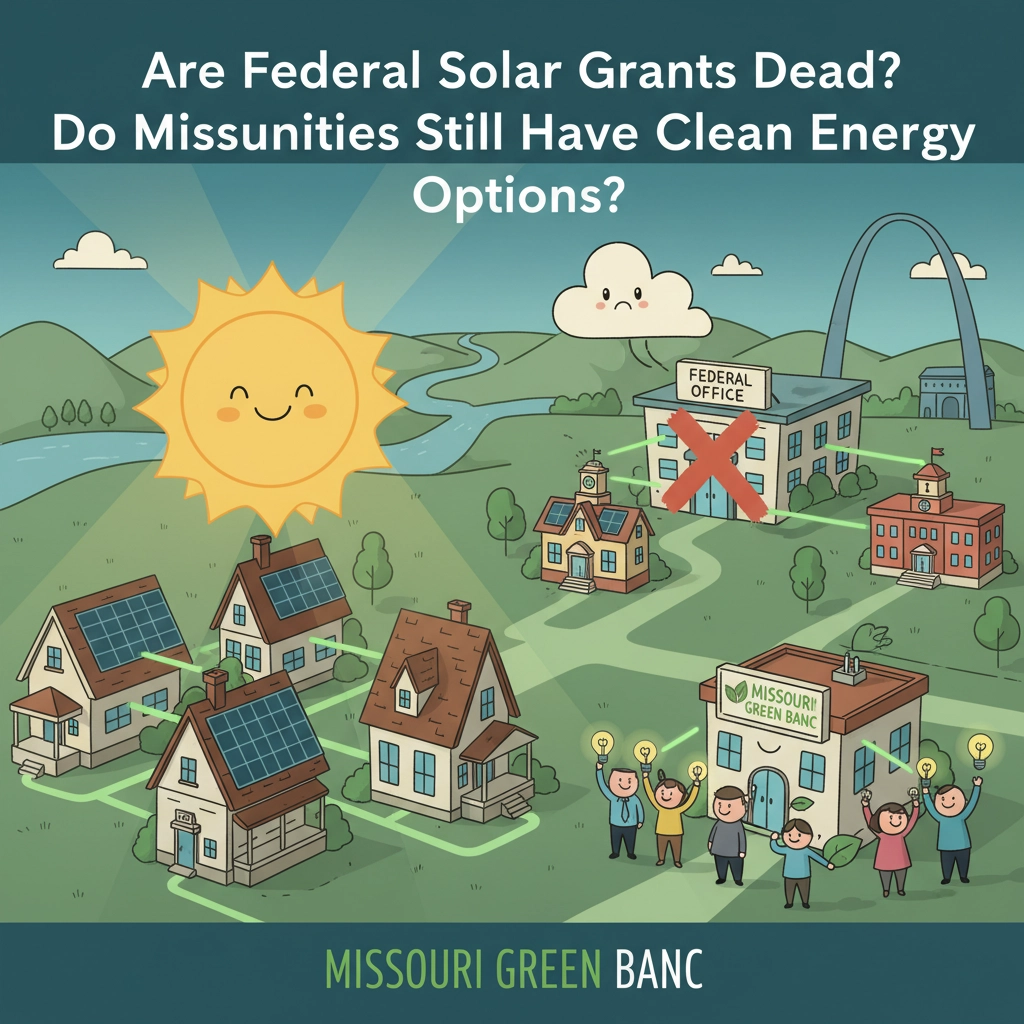
The landscape of federal clean energy incentives has shifted dramatically in 2025, leaving many Missouri communities wondering if their clean energy aspirations are still achievable. While headlines announce the end of major federal solar programs, the reality for Missouri developers, local governments, and property owners remains far more optimistic than initial concerns might suggest.
The Federal Solar Incentive Sunset
Federal solar incentives have indeed reached their conclusion. The 30% federal residential solar tax credit officially expires on December 31, 2025, marking the end of a program that has driven residential solar adoption for over a decade. This credit, which typically saved homeowners approximately $9,000 on solar installations, represented a significant financial incentive that made clean energy more accessible to millions of American families.
More dramatically, the Solar for All program: a $7 billion EPA grant initiative established under the Inflation Reduction Act: was terminated in August 2025. This program had been specifically designed to expand solar access to municipal utilities, multi-family housing developments, and low-income households nationwide. Its termination forced municipalities and nonprofit organizations across the country to abandon or redirect planned solar projects that had relied on this federal funding stream.

These federal program endings have created uncertainty in clean energy markets, but they have not eliminated the fundamental economic benefits that drive clean energy adoption. Missouri communities now face a different financing landscape: one that requires more strategic thinking but still offers substantial opportunities for clean energy development.
Missouri's Clean Energy Infrastructure Remains Strong
Despite federal program changes, Missouri has maintained and expanded its clean energy financing infrastructure. The state's approach to clean energy development has always emphasized local solutions and public-private partnerships, creating a foundation that remains robust even as federal incentives disappear.
Missouri offers a solar property tax exemption that allows property owners to increase their building values through clean energy installations without triggering additional property tax assessments. This state-level incentive provides long-term financial benefits that extend beyond the timeframe of federal tax credits, making it particularly valuable for commercial and industrial projects with longer payback periods.
Several Missouri utility companies continue operating rebate programs for clean energy installations. These utility incentives vary by service territory but can provide substantial upfront cost reductions for both residential and commercial projects. Columbia Water & Light, for example, continues offering rebates ranging from $375 to $625 per kilowatt for solar systems up to 10 kW capacity.
PACE Financing Fills the Federal Gap
Property Assessed Clean Energy (PACE) financing has emerged as Missouri's primary vehicle for clean energy development in the post-federal incentive era. The Missouri Clean Energy District, operated in partnership with Missouri Green Banc, now encompasses over 300 municipal members across the state, making it the first and largest PACE program in Missouri.

PACE financing addresses the fundamental challenge that federal incentive elimination creates: upfront capital requirements. Traditional solar installations require significant upfront investments that many property owners cannot afford, even with utility rebates and state tax exemptions. PACE financing eliminates this barrier by providing 100% upfront project funding that property owners repay through their annual property tax bills over 15-20 year terms.
The Missouri PACE program offers several advantages that become particularly important as federal incentives disappear:
No Personal Credit Requirements: PACE financing is secured by the property itself, not the property owner's personal credit history. This makes clean energy accessible to small businesses, nonprofits, and property owners who might not qualify for traditional commercial loans.
Transferable Obligations: PACE assessments transfer to new property owners upon sale, eliminating concerns about stranded investments that traditionally discourage clean energy development in properties that might be sold within the financing term.
Fixed-Rate Terms: PACE financing provides fixed interest rates over the entire repayment period, offering predictable cash flow management that helps property owners plan long-term operational budgets.
Renewable Energy RFP Opportunities Expand
Missouri communities are increasingly turning to renewable energy request for proposals (RFPs) to secure clean energy projects without relying on federal grants. Local governments, school districts, and municipal utilities are issuing RFPs that allow clean energy developers to propose comprehensive project financing and development packages.
These Missouri renewable energy RFPs often combine multiple funding sources, including PACE financing, utility incentives, and private investment capital. Developers who respond to these RFPs typically offer turnkey solutions that handle project financing, installation, maintenance, and performance guarantees, reducing complexity for municipal and institutional buyers.

The RFP approach allows Missouri communities to leverage competitive bidding to secure favorable clean energy project terms. Rather than relying on federal grant availability, communities can evaluate multiple financing and development proposals to identify solutions that best meet their specific needs and budget constraints.
Supporting Underserved Communities Through Inclusive Financing
Federal program elimination has created particular challenges for underserved communities that historically relied on grant funding to make clean energy affordable. Missouri Green Banc has responded by developing inclusive financing models that specifically address these communities' needs.
The Missouri PACE program includes provisions for nonprofit organizations, low-income housing developers, and community development financial institutions. These provisions ensure that clean energy benefits reach communities that might otherwise be excluded from market-rate financing options.
Missouri Green Banc also partners with community banks and credit unions to provide additional financing options for smaller projects. These partnerships combine local lending relationships with specialized clean energy project expertise, creating financing solutions that work for diverse community needs.
Practical Alternatives for Developers and Local Governments
Clean energy developers and local governments in Missouri can access several practical funding mechanisms that replace federal grant dependence:
Municipal Bond Financing: Local governments can issue municipal bonds to finance clean energy projects for public facilities. Missouri Green Banc provides technical assistance to help municipalities structure bond issuances that comply with state regulations and achieve favorable interest rates.
Public-Private Partnerships: Collaborative arrangements between municipalities and private developers can combine public financing capacity with private sector expertise. These partnerships often use PACE financing to fund private facility improvements while providing public benefits through reduced energy costs and environmental impacts.
Community Solar Programs: Initiatives like Missouri's three-year community solar pilot program enables multiple residents and businesses to share benefits from larger solar installations. This approach makes clean energy accessible to renters, property owners with unsuitable roofs, and organizations with limited capital budgets.
Energy Service Company (ESCO) Contracts: Performance-based contracts with energy service companies allow property owners to implement clean energy improvements with guaranteed energy savings. ESCO contracts can be combined with PACE financing to eliminate upfront costs while ensuring project performance.

Moving Forward Without Federal Dependence
The end of federal solar grants and tax credits marks a transition rather than a termination of clean energy opportunities in Missouri. Communities, developers, and property owners who adapt to the new financing landscape often discover that state-level and local financing options provide greater flexibility and stability than federal programs ever offered.
Missouri Green Banc continues expanding the Missouri PACE program to include additional municipalities and project types. Recent program enhancements include financing for energy storage systems, electric vehicle charging infrastructure, and comprehensive building decarbonization projects that combine multiple clean energy technologies.
The Missouri Clean Energy District's growth to over 300 municipal members demonstrates strong local government support for clean energy development that does not depend on federal policy changes. This foundation provides stability that allows long-term planning and investment in clean energy infrastructure across the state.
Property owners and developers interested in Missouri clean energy projects can access comprehensive information about PACE financing, utility incentives, and RFP opportunities through Missouri Green Banc's resources. The organization provides technical assistance, project evaluation, and financing guidance that helps navigate the post-federal incentive landscape successfully.
Federal solar grants may be ending, but Missouri communities possess robust, locally-controlled clean energy financing options that provide sustainable pathways to clean energy adoption. The transition requires adaptation, but the fundamental economics and environmental benefits that drive clean energy development remain as compelling as ever.
