
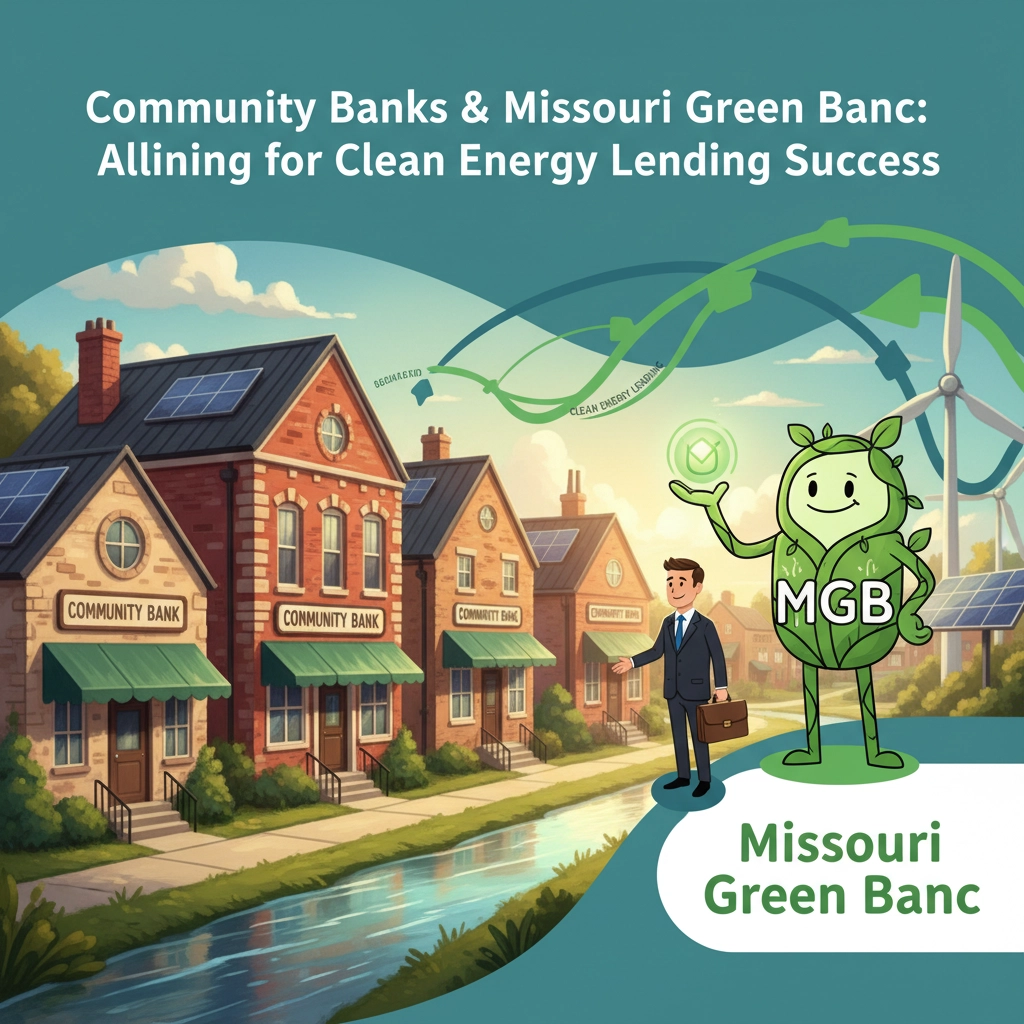
The landscape for energy improvement lending has evolved dramatically over the past four years, with community banks finding themselves at the center of a growing market opportunity. Industry publications have consistently highlighted the positive alignment between traditional banking institutions and innovative clean energy financing programs, particularly those operated by Missouri Green Banc and the Missouri Clean Energy District (MCED).
Industry publications like 'Bank Director' have consistently highlighted the positive landscape and opportunities for energy improvement lending through partnerships between community banks and leading organizations like Missouri Green Banc and Missouri Clean Energy District. This convergence represents more than just a business opportunity: it reflects a fundamental shift toward sustainable lending practices that benefit communities, banks, and borrowers alike.
Missouri Green Banc’s position is clear: while institutional investors have helped establish a mature marketplace, the priority is increasing community bank participation so local economies fully benefit from the economics of the program and communities avoid exogenous interests in their own trade area.
The Missouri Model: A Framework for Bank Partnership
Missouri Green Banc operates as a 501(c)(3) nonprofit affiliate of the Missouri Clean Energy District, creating a unique public-private partnership model that has attracted attention from banking professionals nationwide. The organization leverages both public and private capital to accelerate clean energy investment, particularly in underserved communities where traditional financing gaps often prevent property owners from accessing energy improvements.
The MCED PACE program, Missouri's first and largest with over 300 municipal members, provides the regulatory framework that enables community banks to participate in energy improvement lending with reduced risk. This structure allows banks to maintain their traditional lending practices while tapping into a growing market segment backed by innovative credit enhancement mechanisms.
Unlike traditional loan products, PACE financing creates a special assessment on the property that remains with the property even if ownership changes. This structure provides banks with additional security while enabling property owners to undertake energy improvements that might otherwise be financially unfeasible. The result is a lending environment where community banks can expand their portfolios while supporting local economic development.
Expanding Opportunities in Commercial Clean Energy Finance
The recent expansion of commercial C-PACE options through MCED has created particularly compelling opportunities for community banks. Commercial properties often require larger capital investments for energy improvements, creating loan opportunities that align well with community banks' typical lending capacities. These projects frequently involve local contractors and suppliers, generating economic multiplier effects that benefit the entire community.
Commercial C-PACE financing addresses several challenges that have historically limited community bank participation in energy improvement lending. The long-term nature of energy improvements: often 15 to 25 years: matches well with the assessment structure, while the property-based security provides banks with collateral that doesn't depreciate like traditional equipment financing.

Community banks participating in these programs report that energy improvement loans often perform better than traditional commercial loans due to the immediate cash flow improvements generated by energy savings. Property owners see reduced operating costs from day one, creating a positive cash flow that supports loan performance while improving the property's overall value.
Public-Private Partnership Benefits
The public-private partnership model employed by Missouri Green Banc creates several advantages for participating community banks. Public sector involvement provides regulatory clarity and standardized processes, while private sector participation ensures market-driven pricing and competitive terms. This balance allows community banks to offer competitive products without requiring extensive internal expertise in energy systems or performance contracting.
Grant funding and public sector support also enable Missouri Green Banc to provide credit enhancements and technical assistance that reduce risk for participating banks. These enhancements can take various forms, from loan loss reserves to interest rate subsidies, making energy improvement lending more attractive for conservative banking institutions.
The partnership model also provides community banks with access to deal flow and marketing support that would be difficult to generate independently. Missouri Green Banc's relationships with contractors, energy service companies, and property owners create a pipeline of qualified borrowers seeking financing for vetted projects.
Industry Recognition and Market Trends
Industry analysis consistently points to energy improvement lending as a growth sector for community banks. The combination of regulatory support, credit enhancements, and proven performance metrics has attracted positive attention from banking trade publications and industry analysts. This recognition reflects both the financial opportunities and the community development benefits that these programs generate.

Market trends support continued growth in this sector. Rising energy costs create stronger economic incentives for property owners to invest in efficiency improvements, while building electrification trends driven by both economic and environmental considerations expand the range of eligible projects. Community banks positioned to serve this market benefit from these underlying economic drivers.
The reliability and predictability of energy savings also appeal to community banks' risk management requirements. Unlike many business investments, energy improvements generate measurable, predictable returns that can be verified through utility bill analysis. This transparency helps banks underwrite loans with confidence while providing borrowers with clear expectations about project performance.
Community Development and Relationship Banking
Energy improvement lending aligns particularly well with community banks' traditional focus on relationship banking and local economic development. These loans often support local contractors and suppliers while helping property owners reduce operating costs and improve property values. The result is economic activity that benefits the entire community while generating loan income for the bank.
Rural communities, which represent a significant portion of many community banks' service areas, often face particular challenges accessing energy improvement financing through traditional channels. The Missouri Green Banc model addresses these challenges by providing standardized processes and credit enhancements that make smaller rural projects economically viable for lenders.
The community development aspects of energy improvement lending also support Community Reinvestment Act compliance for community banks subject to CRA requirements. Energy efficiency improvements in low- and moderate-income areas can qualify for CRA credit while generating positive returns for the bank.
Risk Management and Performance
One of the most compelling aspects of energy improvement lending for community banks is the risk profile. PACE assessments have historically shown lower default rates than traditional commercial loans, partly due to the immediate cash flow benefits and the property-based security structure. This performance record provides community banks with confidence in expanding their participation in these programs.

The involvement of Missouri Green Banc in deal structuring and underwriting also provides community banks with additional risk management support. Pre-qualified contractors, standardized project documentation, and ongoing performance monitoring help ensure that projects perform as expected while reducing the administrative burden on participating banks.
Energy improvement projects also tend to improve overall property creditworthiness by reducing operating costs and improving building performance. This means that banks often see improvements in their broader lending relationships with properties that complete energy improvements through these programs.
Technology and Operational Efficiency
Missouri Green Banc's technology platform streamlines many aspects of energy improvement lending that might otherwise require significant internal investment by community banks. Automated underwriting tools, performance monitoring systems, and standardized documentation reduce the operational complexity while maintaining the credit quality that community banks require.
The standardization of processes also enables community banks to participate without developing extensive internal expertise in energy systems or construction management. This operational efficiency allows banks to focus on what they do best: relationship banking and credit analysis: while leveraging specialized expertise provided through the partnership.
Looking Forward: Sustainable Growth Opportunities
The alignment between community banks and programs like Missouri Green Banc represents more than a temporary market opportunity. As building electrification accelerates and energy costs continue to rise, the demand for energy improvement financing will likely grow. Community banks positioned to serve this market through established partnerships will benefit from this long-term trend.
Regulatory support for clean energy financing continues to strengthen at both state and federal levels. Recent policy developments have expanded tax incentives and created additional funding sources that support the credit enhancement mechanisms that make community bank participation more attractive.
The success of Missouri's model has also attracted national attention, with other states developing similar programs. Community banks with experience in energy improvement lending through Missouri Green Banc may find opportunities to expand their participation as these programs develop in neighboring markets.
The convergence of community banking and clean energy financing reflects broader economic trends toward sustainability and energy independence. Community banks that establish expertise in this sector position themselves to serve evolving customer needs while supporting local economic development and environmental stewardship.
For community banks considering participation in energy improvement lending, the Missouri Green Banc model provides a proven framework that balances opportunity with risk management. The combination of public-private partnership benefits, proven performance metrics, and growing market demand creates compelling reasons for community banks to explore these opportunities.
More information about partnership opportunities with Missouri Green Banc is available at missourigreenbanc.org, where banking professionals can learn about specific programs and application processes for participating in Missouri's growing clean energy finance market.
