
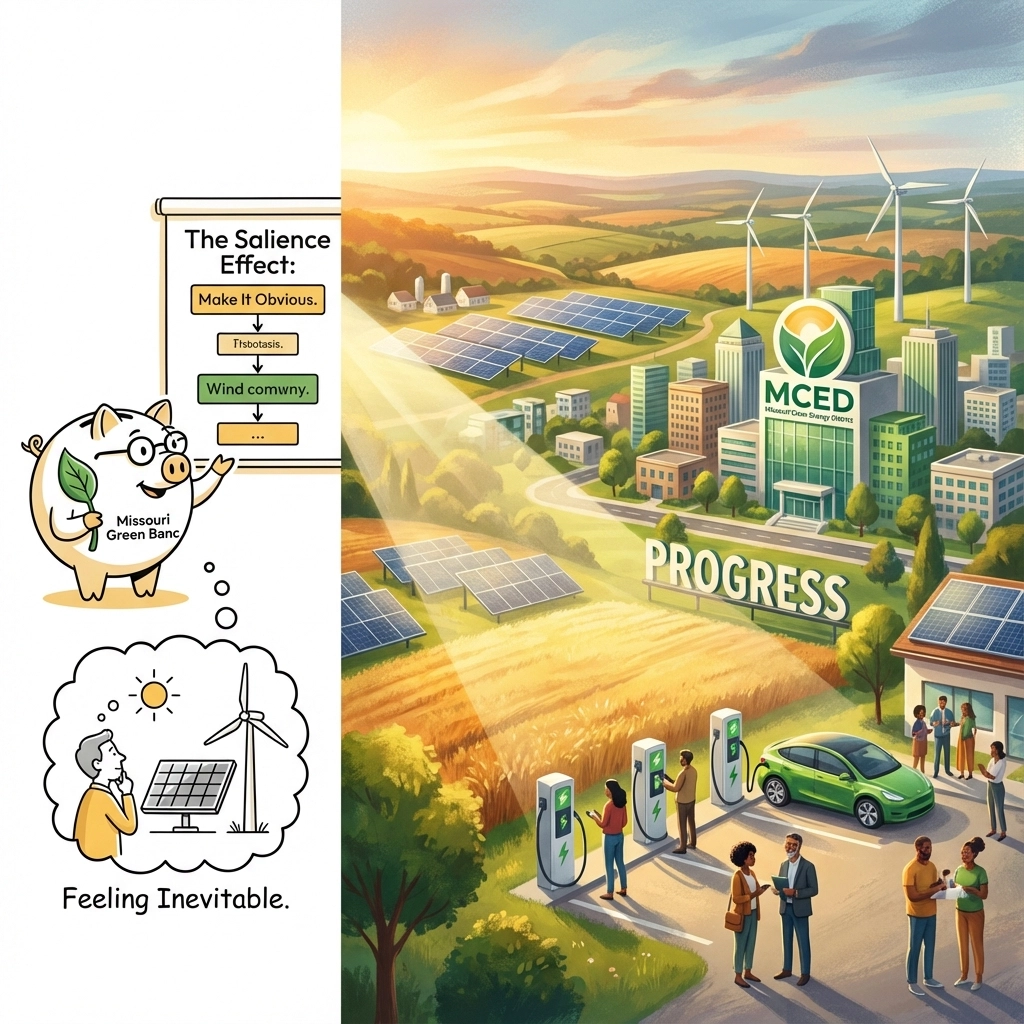
Environmental progress often stalls not because people don't care, but because it feels too complex, too political, or too risky. What if the key to unlocking widespread climate action isn't bigger explanations or louder advocacy, but smaller changes in how people perceive their options?
Missouri Green Banc and the Missouri Clean Energy District (MCED) have discovered something powerful: when you make environmental progress feel inevitable, profitable, and socially endorsed, people simply choose it. They've created what behavioral experts call a "salience engine": a mechanism that doesn't just offer financing, but reshapes how property owners think about buildings, money, and responsibility.
The Small Handle, Not the Big Blade
Most environmental initiatives ask people to embrace a cause. Missouri's PACE program asks for something much simpler: "You don't need to believe anything. You just need a building."
This reframe is revolutionary. Instead of positioning CPACE financing as environmental activism, it becomes normal commercial housekeeping. Property owners aren't joining a movement: they're making a routine business decision that happens to benefit the planet.
The Missouri Clean Energy District, with over 300 municipal members representing Missouri's first and largest PACE program, provides the public authority that makes this possible. When local governments endorse Property Assessed Clean Energy financing, they send a clear signal: this isn't experimental: it's standard practice.
Making the Inevitable Feel Easy
Once a building owner completes their first PACE project, something interesting happens. Sustainability stops being something they might do and becomes something they already do. Future energy upgrades feel incremental, not radical. ESG conversations become easier. Tenants, lenders, and insurers follow.
This is the salience effect in action. Commercial PACE loans don't just fund individual projects: they create a new identity for building owners. They become people who invest in efficiency, who think long-term, who make smart financial decisions that happen to help the environment.
The Missouri PACE program functions as infrastructure for other green efforts. PACE upgrades often make solar installations pencil out. Efficiency improvements make electrification viable. Lower operating costs create budget space for resilience investments. Public reporting makes grants and incentives accessible.
Economic Self-Interest as Environmental Virtue
The most reliable environmental behavior is behavior that improves the balance sheet. Missouri Green Banc has built this insight into every aspect of their approach to energy efficiency financing.
Rather than asking property owners to sacrifice for the planet, CPACE financing positions environmental upgrades as shrewd financial moves. Lower utility bills, increased property values, improved tenant satisfaction, and reduced maintenance costs: these aren't nice side benefits, they're the primary reasons to participate.

This alignment of profit and purpose creates durable behavior change. When energy improvement loans deliver both environmental and financial returns, building owners don't need constant motivation to participate. The results motivate themselves.
The Legitimacy Transfer Effect
Missouri Green Banc and MCED don't just provide capital: they lend social permission. This partnership between public authority and private finance creates a unique form of credibility that neither could achieve alone.
MCED serves as the public signal, using governmental backing to legitimize participation and de-risk decision-making. Missouri Green Banc acts as the capital translator, converting global sustainability goals into local finance that protects local balance sheets.
Together, they make action both possible and permissible. Property owners don't have to pioneer unproven technology or navigate complex policies. They can follow a clear, established path that careful, prudent operators are already using.
Missouri Pride and Local Solutions
"This is how Missouri modernizes: without waiting for Washington." This message resonates because it combines environmental progress with regional self-reliance. The Missouri Clean Energy District represents local authority solving local problems with local capital.
Community clean energy projects benefit from this approach because they're grounded in familiar institutions. Local governments set policy. Community banks provide relationship-based service. Building owners invest in assets they know and control.
This local character makes renewable energy funding feel accessible rather than imposed. Property owners aren't adopting distant corporate initiatives: they're participating in community development that happens to advance environmental goals.
The Infrastructure for Change
The most successful environmental policies don't feel like environmental policies. They feel like infrastructure: reliable, professional, and slightly boring. Missouri Green Banc and MCED have achieved this quality by focusing on systematic rather than inspirational change.
Building decarbonization succeeds when it becomes routine rather than revolutionary. Property owners need clean energy incentives that integrate with existing business processes, not programs that require new forms of commitment or expertise.
PACE loans work because they simplify rather than complicate. Instead of researching grants, negotiating with multiple vendors, and managing complex timelines, property owners can access a single financing solution that covers equipment, installation, and soft costs.
Making Participation Feel Inevitable
Behavioral science teaches us that people follow trends more than principles. When property owners hear that "most serious building owners eventually do this" or "this is becoming standard practice," participation feels inevitable rather than optional.
The Missouri PACE program has created this momentum by focusing on credible messengers: conservative operators, community bankers, and local accountants who emphasize prudence over passion. These voices signal that PACE energy upgrades represent careful decision-making, not environmental activism.
This approach works because it meets people where they are. Property owners who might resist sustainability messaging respond positively to efficiency messaging. Business owners who question environmental policies support economic development policies.
The Spear Tip Strategy
Missouri Green Banc and MCED don't try to solve climate change directly. Instead, they function as the tip of the spear: the small, sharp point that enables larger forces to follow.
By making the first sustainability upgrade feel manageable and profitable, they create conditions for more ambitious projects. By establishing relationships with property owners and building trust with lenders, they lay groundwork for future innovations.
This positioning as enabler rather than solution allows them to build broad coalitions. Environmental groups appreciate the carbon reductions. Business groups appreciate the economic development. Fiscal conservatives appreciate the public-private partnership model that minimizes government risk while maximizing private investment.
Relief from Complexity
Climate change is vast, but sustainable building financing is manageable. Sustainability can feel political, but energy efficiency financing feels technical. Change feels risky, but PACE financing feels routine.
Missouri Green Banc and MCED succeed by offering relief from complexity rather than adding to it. They've created systems that make energy retrofit financing as straightforward as any other commercial loan, but with better terms and additional benefits.
Property owners don't need to become sustainability experts or climate activists. They need to run profitable buildings and make smart investments. When those two goals align, environmental progress becomes inevitable.
The salience effect reveals that small changes in perception can unlock disproportionate behavior change. Missouri Green Banc and the Missouri Clean Energy District have created a system that makes environmental progress feel inevitable, profitable, and socially endorsed.
Ready to see how Missouri's PACE program can work for your building? Learn more about Commercial PACE loans and energy efficiency financing options at Missouri Green Banc.
