
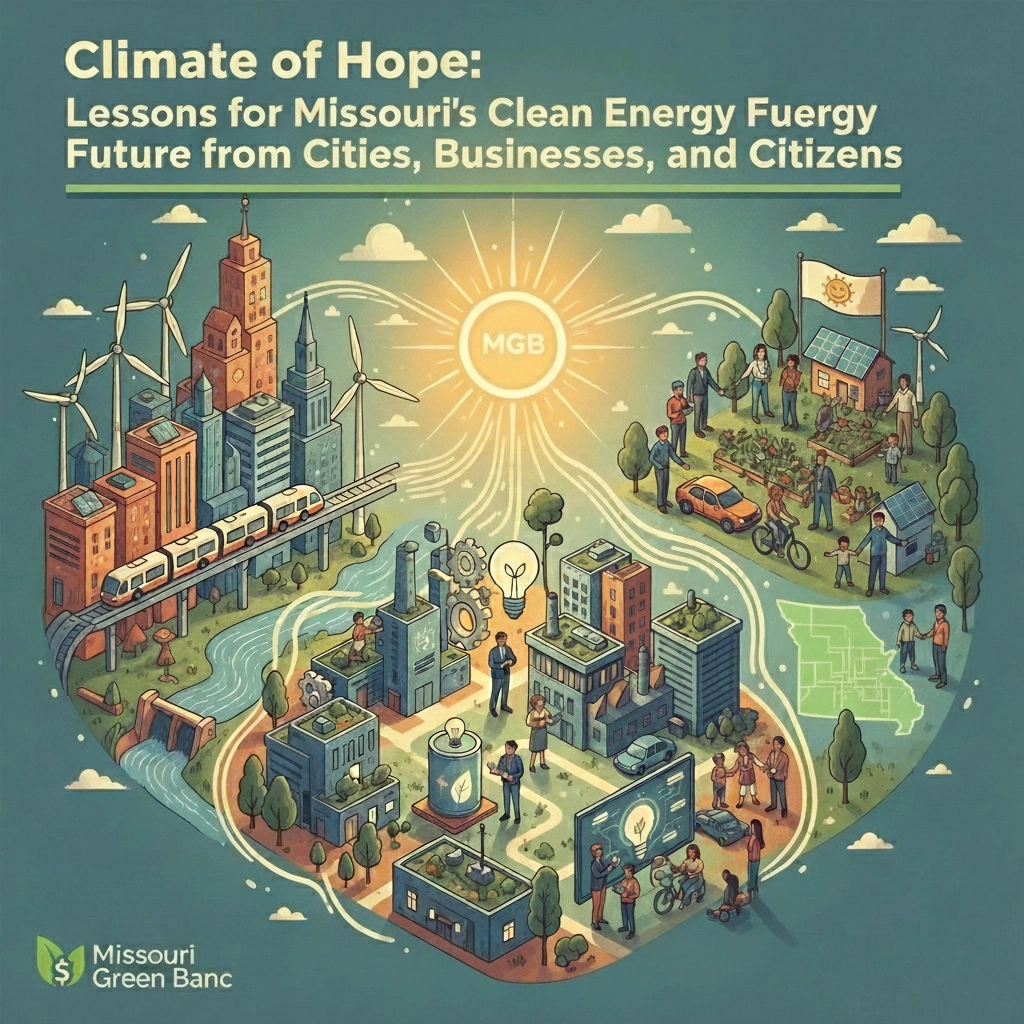
Michael Bloomberg's "Climate of Hope" presents a transformative framework that challenges conventional approaches to climate action. Rather than waiting for federal mandates or global agreements, his work demonstrates how cities, businesses, and citizens can lead the charge toward sustainable energy solutions through collaborative, bottom-up initiatives. For Missouri, these principles offer a roadmap that builds on existing progress while accelerating the state's clean energy transformation.
The Bottom-Up Revolution in Climate Action
The central thesis of "Climate of Hope" fundamentally shifts the narrative around climate solutions. Bloomberg and Pope argue that meaningful progress emerges from local action rather than top-down policy implementation. Cities become laboratories for innovation, businesses drive market transformation, and citizens create demand for sustainable alternatives.
This approach recognizes that each community faces unique challenges requiring tailored solutions. A rural Missouri farming community developing agricultural solar installations faces different considerations than urban St. Louis implementing energy efficiency retrofits in commercial buildings. The book's framework emphasizes that effective climate action requires understanding local contexts, stakeholder needs, and available resources.

The authors document numerous examples where municipal leadership, private sector innovation, and citizen engagement converged to create lasting change. These case studies demonstrate that collaborative efforts often achieve greater impact than isolated initiatives, particularly when they align economic incentives with environmental goals.
Missouri's Clean Energy Foundation
Missouri has already embraced several core principles from "Climate of Hope" through strategic policy development and stakeholder engagement. The state established its renewable energy trajectory in 2008 when voters approved Proposition C, creating a Renewable Energy Standard requiring utilities to source 15% of annual retail sales from eligible renewable technologies by 2021. This citizen-driven initiative made Missouri the third state to implement such standards through ballot measures.
The state's Net Metering Standard, implemented in 2007, exemplifies the problem-specific solutions approach advocated in "Climate of Hope." By enabling residential and small business customers to generate their own clean energy and receive credit for excess production, Missouri created market conditions that support distributed energy resources while maintaining grid stability.
Property Assessed Clean Energy (PACE) financing represents another alignment with Bloomberg's framework. Missouri's Clean Energy District operates the state's first and largest PACE program, serving over 300 municipal members. This financing mechanism removes traditional barriers to clean energy adoption by allowing property owners to fund improvements through special assessments, with costs recovered through property tax payments over extended terms.
Utility Transformation Through Collaborative Pressure
Ameren Missouri's evolution demonstrates how the "Climate of Hope" model creates momentum for large-scale change. Previously among the nation's most coal-dependent utilities, Ameren has transformed into a wind energy leader while expanding solar and storage capabilities. The utility now targets 50% carbon dioxide emission reductions by 2030, 85% by 2040, and net-zero emissions by 2050.
This transformation reflects the collaborative pressure described in "Climate of Hope," where citizen advocacy, regulatory frameworks, and market forces converge to drive institutional change. Missouri's integrated resource planning requirements mandate that utilities map their energy strategies over 20-year periods, creating transparency that enables stakeholder engagement and accountability.
The Missouri Energy Efficiency Investment Act (MEEIA) further demonstrates collaborative approach effectiveness. By establishing frameworks for utility investment in efficiency programs, the legislation creates pathways for reducing energy consumption while maintaining economic viability for both utilities and customers.
Municipal Leadership and Citizen Engagement
Cities across Missouri are implementing the bottom-up leadership model that "Climate of Hope" champions. Columbia's utilities department achieved 23% renewable energy sourcing in 2024, demonstrating how municipal action can accelerate clean energy adoption beyond state requirements.
These municipal initiatives create demonstration effects that influence broader adoption patterns. When cities successfully implement renewable energy projects or efficiency programs, they provide replicable models for other communities while building public confidence in clean energy solutions.

The collaborative framework extends to financing innovations that support widespread adoption. Missouri Green Banc's approach aligns with "Climate of Hope" principles by creating financial mechanisms that enable businesses, institutions, and communities to access clean energy investments without traditional lending barriers.
Addressing Implementation Challenges
Despite significant progress, Missouri faces implementation challenges that "Climate of Hope" principles can help address. The state ranks 30th nationally in energy efficiency measures, indicating substantial opportunity for improvement through targeted initiatives.
Bloomberg emphasizes that sustained progress requires continuous advocacy and stakeholder engagement. Missouri's clean energy trajectory depends on maintaining momentum through utility accountability, policy consistency, and citizen participation. The collaborative model prevents backsliding by creating multiple stakeholders invested in continued progress.
Regional variations across Missouri require the problem-specific solutions approach that "Climate of Hope" advocates. Rural agricultural communities benefit from solar installations and energy storage systems that reduce operational costs while improving grid resilience. Urban areas focus on building efficiency retrofits and distributed energy resources that reduce peak demand while creating local jobs.
Economic Development Through Clean Energy
The "Climate of Hope" framework emphasizes economic benefits that emerge from clean energy transitions. Missouri's experience validates this approach through job creation, reduced energy costs, and improved business competitiveness.
Clean energy financing programs create local economic multiplier effects by keeping energy dollars within communities rather than exporting them to distant fossil fuel producers. Missouri Green Banc financing programs specifically support local contractors, engineers, and installers while improving property values and reducing operating expenses.
Manufacturing facilities, commercial operations, and nonprofit institutions across Missouri are discovering that energy efficiency improvements and renewable energy installations reduce operational costs while enhancing operational resilience. These economic benefits create additional stakeholders supporting continued clean energy expansion.
Future Opportunities Through Collaboration
Missouri's clean energy future requires expanding the collaborative model that "Climate of Hope" describes. This involves strengthening partnerships between municipalities, utilities, businesses, and citizen organizations while creating financing mechanisms that support widespread adoption.
The state's PACE program expansion demonstrates how collaborative frameworks can scale successful models. By serving over 300 municipal members, Missouri's Clean Energy District creates economies of scale that reduce project costs while simplifying implementation processes for participating communities.
Technology integration offers additional opportunities for collaborative advancement. Smart grid systems, energy storage, and demand response programs require coordination between utilities, technology providers, and end users. The "Climate of Hope" model provides frameworks for managing these complex stakeholder relationships.
Building Resilient Communities
Beyond environmental benefits, Missouri's clean energy transformation builds community resilience through distributed resources and reduced energy costs. Bloomberg argues that climate solutions should strengthen communities while addressing environmental challenges.
Local energy generation reduces vulnerability to supply disruptions while keeping energy expenditures within regional economies. Energy efficiency improvements reduce costs for businesses and households, creating additional resources for community development and economic growth.
The collaborative approach ensures that clean energy benefits reach diverse communities rather than concentrating in affluent areas. PACE financing, in particular, enables property owners across income levels to access clean energy improvements that might otherwise remain financially inaccessible.
Missouri's implementation of "Climate of Hope" principles demonstrates that bottom-up climate action can achieve meaningful results while building political support for continued progress. Through collaborative engagement between cities, businesses, and citizens, the state continues advancing its clean energy transformation while creating replicable models for other regions pursuing similar goals.
This approach positions Missouri as a leader in demonstrating how local action can drive national climate progress through practical, economically viable solutions that strengthen communities while protecting environmental resources.