
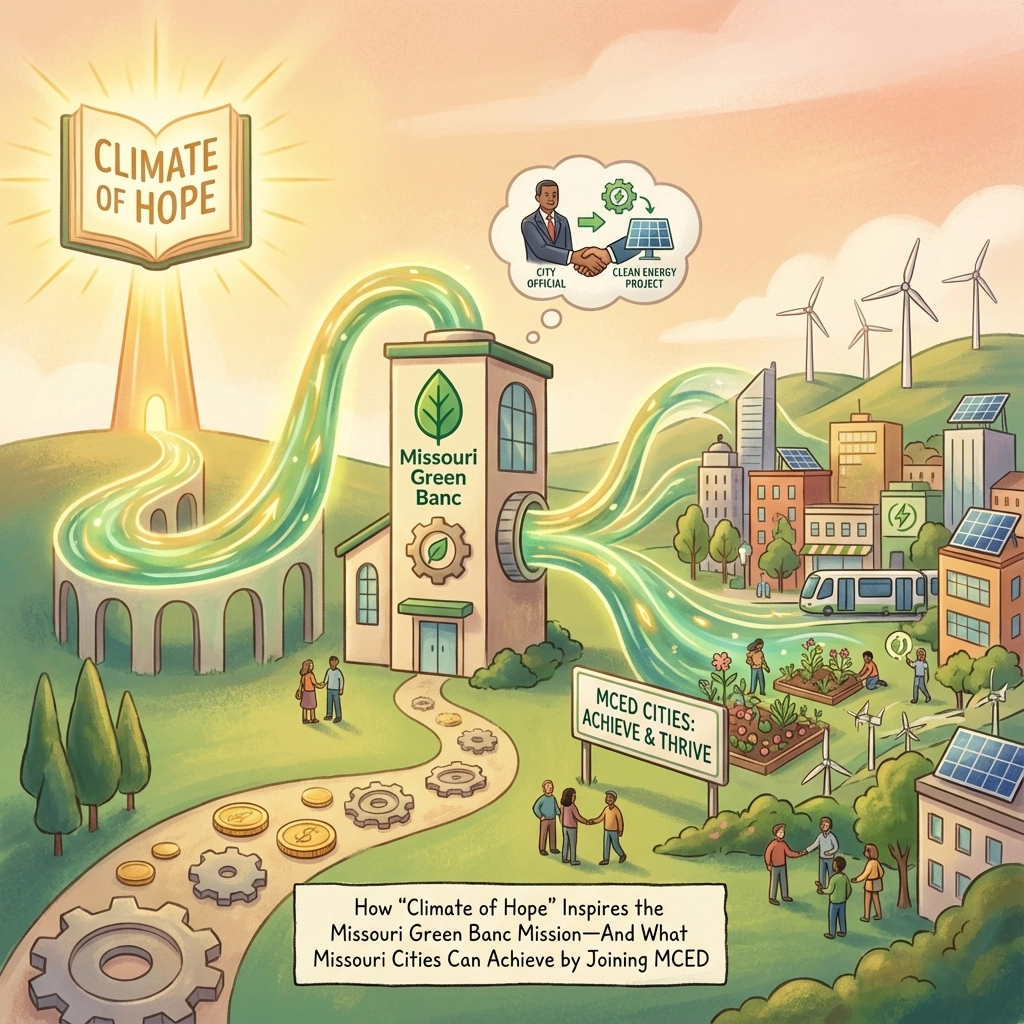
When Michael Bloomberg and Carl Pope published "Climate of Hope: How Cities, Businesses, and Citizens Can Save the Planet," they outlined a pragmatic roadmap for addressing climate change through collaboration, innovation, and smart capital deployment. Their vision resonates deeply with the work of Missouri Green Banc and its affiliate, the Missouri Clean Energy District (MCED), which has become Missouri's largest and most successful PACE program serving over 350 jurisdictions across the state.
The parallels between Bloomberg and Pope's framework and Missouri Green Banc's mission are striking: both emphasize the power of local action, the importance of public-private partnerships, and the need for innovative financing mechanisms that make clean energy accessible to all communities.
The Power of Collaborative Climate Action
Bloomberg and Pope argue that meaningful climate progress happens when cities, businesses, foundations, and citizens work together rather than waiting for top-down federal mandates. This collaborative approach forms the foundation of Missouri Green Banc's strategy as a 501(c)(3) nonprofit organization.
Missouri Green Banc has built partnerships with private foundations, institutional investors, and community banks to create a comprehensive financing ecosystem for clean energy projects. These relationships exemplify what "Climate of Hope" describes as essential collaborative networks that can rapidly deploy capital where traditional markets fail to reach.

The book emphasizes that private foundations play a crucial role in bridging funding gaps and supporting innovative approaches to climate solutions. Missouri Green Banc has successfully leveraged foundation partnerships to expand access to Property Assessed Clean Energy financing, particularly in underserved rural and urban communities that traditional lenders often overlook.
Private foundations bring more than just capital: they provide credibility, expertise, and networks that amplify the impact of clean energy investments. When foundations align their climate and equity objectives with Missouri Green Banc's mission, they create powerful leverage for community transformation. This alignment has enabled MCED to become the first and largest PACE program in Missouri, demonstrating how collaborative funding models can achieve scale and impact.
Municipal Membership: Unlocking Community-Wide Benefits
Bloomberg and Pope highlight how cities serve as laboratories for climate innovation, testing solutions that can be scaled across regions and nations. Missouri municipalities that join the Missouri Clean Energy District gain access to proven financing tools and technical assistance that transform their communities' energy landscape.
MCED membership provides municipalities with comprehensive CPACE financing Missouri options that enable property owners to finance energy efficiency improvements, renewable energy installations, and building decarbonization projects through their property tax bills. This innovative financing mechanism removes traditional barriers like high upfront costs and credit constraints that often prevent communities from accessing clean energy benefits.
Member municipalities report significant benefits from their MCED partnership. Local governments can promote economic development by making their jurisdictions more attractive to businesses seeking sustainable building options. The Missouri PACE program enables commercial property owners to upgrade their facilities without traditional loan requirements, improving local building stock while creating jobs and reducing energy costs.

The ripple effects extend throughout the community. When businesses reduce their energy expenses through PACE-financed improvements, they can reinvest savings into growth, hiring, and community development. Municipalities also benefit from increased property values and tax revenues as buildings become more efficient and valuable.
MCED's technical assistance helps municipal staff navigate the complexities of clean energy financing, ensuring that local leaders can effectively promote and support PACE projects in their communities. This support includes training on program mechanics, marketing assistance, and ongoing consultation to maximize program impact.
Cool Capitalism and Local Lender Participation
Part VI of "Climate of Hope," titled "Cool Capitalism, How We Invest," provides a framework that directly relates to Missouri Green Banc's approach to engaging local financial institutions. Bloomberg and Pope argue that capitalism can be redirected toward climate solutions when properly structured incentives align private interests with public benefits.
This philosophy underlies Missouri Green Banc's strategy of partnering with community banks and credit unions throughout the state. These local lenders understand their communities' needs and have strong incentives to support projects that strengthen local economies and property values.
The Community Reinvestment Act (CRA) creates additional incentives for local lenders to participate in clean energy financing. CRA regulations require banks to demonstrate their commitment to serving the credit needs of their communities, particularly low- and moderate-income areas. Energy efficiency financing for Missouri projects that reduce utility costs for residents and businesses directly support CRA objectives by improving community economic conditions.

Missouri Green Banc structures its partnerships to help local lenders meet CRA requirements while generating reasonable returns on their investments. This alignment creates what Bloomberg and Pope describe as "cool capitalism": market-driven solutions that generate profits while addressing climate challenges.
Community banks and credit unions bring invaluable local knowledge and relationships to the clean energy financing ecosystem. They understand regional economic conditions, know local property owners personally, and have established trust within their communities. These relationships enable more effective outreach and education about renewable energy funding Missouri opportunities.
The partnership model also distributes risk across multiple institutions while creating economies of scale that reduce transaction costs. Local lenders can participate in larger projects through partnerships with Missouri Green Banc while maintaining their focus on serving local customers and communities.
Building Decarbonization Through Smart Finance
Bloomberg and Pope emphasize the critical importance of building decarbonization in achieving climate goals. Buildings account for approximately 40% of global carbon emissions, making energy efficiency improvements and renewable energy installations essential for meaningful progress.
Missouri Green Banc's PACE program addresses this challenge by making building decarbonization projects financially accessible to property owners across the state. The program's structure removes traditional barriers that prevent building improvements, including high upfront costs, short payback periods required by conventional loans, and credit constraints that exclude many property owners.
Commercial PACE loans in Missouri enable property owners to finance comprehensive building improvements that might otherwise be financially impossible. These projects often include multiple measures such as HVAC upgrades, insulation improvements, window replacements, and solar installations that work together to dramatically reduce energy consumption and carbon emissions.
The long-term financing structure aligns with the useful life of energy improvements, ensuring that annual payments are typically offset by energy savings. This approach makes projects cash-flow positive from day one while delivering long-term environmental and economic benefits to building owners and their communities.
Innovation in Action: Real-World Impact
The practical application of Bloomberg and Pope's principles through Missouri Green Banc demonstrates how collaborative approaches can achieve meaningful climate progress. MCED has successfully completed numerous projects across the state, from rural communities to urban centers, proving that inclusive financing models can work in diverse economic and geographic contexts.
Energy improvement loans Missouri facilitated through MCED have enabled churches, schools, nonprofits, and businesses to reduce their operating costs while improving building comfort and performance. These improvements free up resources that organizations can redirect toward their core missions, creating multiplier effects throughout their communities.

The program's impact extends beyond individual buildings to create market transformation. As more property owners experience the benefits of PACE financing, demand for clean energy incentives across Missouri grows, supporting the development of local contractor capacity and supply chains. This market development creates jobs and economic opportunities while building the infrastructure needed for continued clean energy deployment.
A Model for National Replication
Bloomberg and Pope argue that successful local innovations should be studied and replicated to maximize their impact. Missouri Green Banc's collaborative approach provides a model that other states can adapt to their specific conditions and needs.
The key elements of this model include: strong public-private partnerships that leverage both foundation and private capital; comprehensive municipal engagement that builds local capacity and support; innovative use of existing regulations like CRA to align incentives; and focus on inclusive financing that serves communities often overlooked by traditional markets.
These elements work together to create sustainable funding mechanisms that can operate at scale while maintaining focus on community benefits and environmental impact. The Missouri Green Banc PACE program demonstrates that collaborative approaches can achieve both financial sustainability and meaningful climate progress.
Moving Forward Together
"Climate of Hope" concludes with a call for continued collaboration and innovation in addressing climate challenges. Missouri Green Banc embodies this vision by creating partnerships that leverage diverse resources and expertise to accelerate clean energy deployment across the state.
For Missouri municipalities considering MCED membership, the benefits are clear: access to proven financing tools, technical assistance for program implementation, partnership with established networks of contractors and service providers, and alignment with a mission-driven organization committed to community benefit.
The collaborative model pioneered by Missouri Green Banc offers hope for communities across the nation seeking practical solutions to climate challenges. By combining Bloomberg and Pope's insights with local innovation and commitment, Missouri is building a replicable model for clean energy financing that serves communities while enhancing the economics of the built environment and protecting the planet.
Through continued collaboration between municipalities, foundations, local lenders, and community stakeholders, Missouri Green Banc and MCED will continue expanding access to clean energy financing that transforms buildings, strengthens communities, and creates a more sustainable future for all Missourians.