
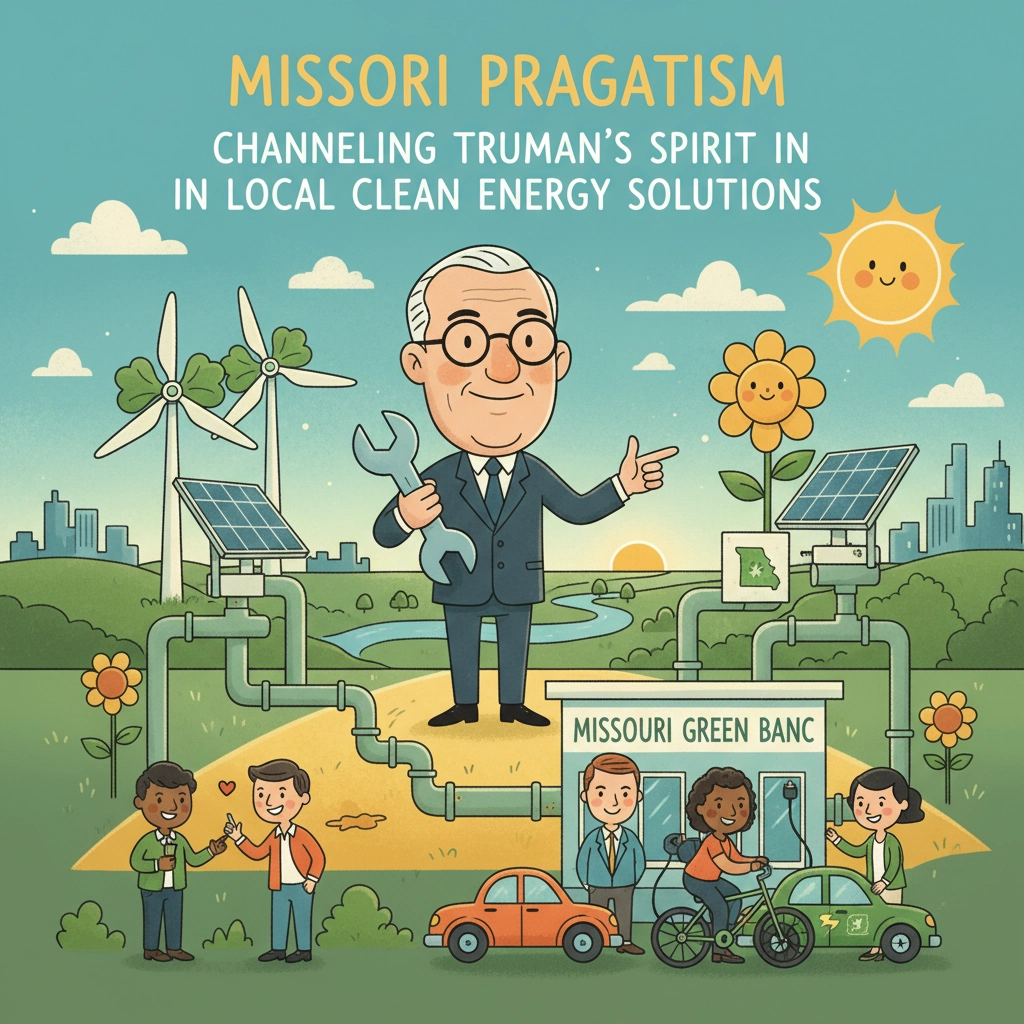
In the pages of "Year of Decisions," Harry S. Truman reveals the mindset that guided America through some of its most challenging moments. The 33rd President, Missouri's own, approached complex problems with characteristic directness: identify the issue, gather the facts, make the decision, and move forward. This no-nonsense philosophy wasn't just presidential doctrine: it was distinctly Missourian, rooted in a tradition of practical problem-solving that continues to shape the Show-Me State today.
That same spirit of pragmatic action drives Missouri Green Banc's approach to clean energy financing. Like Truman's steady hand during tumultuous times, Missouri Green Banc serves as a reliable partner for local banks, governments and private foundations, cutting through complexity to deliver tangible solutions that communities can see, measure, and build upon.
The Missouri Way: Practical Solutions Over Political Theater
Truman once said, "I never gave them hell. I just told the truth, and they thought it was hell." This commitment to straight talk over rhetoric mirrors how Missouri Green Banc approaches clean energy financing today. While national energy debates often get mired in political positioning, Missouri communities focus on what works: practical financing mechanisms that help businesses upgrade their HVAC systems, enable community facilities to install solar arrays, and support the environment by reducing energy waste.
The Missouri Clean Energy District's PACE (Property Assessed Clean Energy) program exemplifies this pragmatic approach. As the first and largest PACE program in Missouri, serving over 300 municipal members, it operates like a well-oiled machine: no fanfare, just results. Property owners invest in energy improvements, municipalities facilitate the financing, and communities benefit from increased property values and reduced energy consumption.

Building Bridges, Not Walls: The Collaborative Imperative
Just as Truman understood that effective governance required building coalitions across party lines, Missouri Green Banc recognizes that sustainable energy solutions emerge from collaboration, not competition. The organization functions like a bridge-builder, connecting diverse stakeholders around shared goals rather than divisive rhetoric.
Local governments bring regulatory expertise and community trust. Private foundations contribute financial support and strategic vision. Community banks provide capital and customer guidance. Property owners provide the real estate and energy demand. Missouri Green Banc serves as the conductor of this orchestra, ensuring each instrument plays its part in harmony with the whole.
This collaborative model recently yielded significant results when St. Louis partnered with Missouri Green Banc to secure national grants for clean energy investments. The initiative focuses on practical outcomes: municipal solar installations that reduce taxpayer costs, and programs specifically designed to benefit low-income residents. No political grandstanding: just measurable improvements in community resilience and affordability.
Efficiency as Ethics: The Truman Doctrine Applied
Truman's approach to governance was fundamentally ethical: use public resources efficiently, serve the common good, and maintain transparency in all dealings. These principles translate directly to modern clean energy finance, where inefficiency isn't just wasteful: it's a barrier to the clean energy transition that communities desperately need.
Missouri Green Banc embodies this efficiency-as-ethics philosophy through its streamlined approach to project development. Rather than creating bureaucratic mazes, the organization develops clear pathways for energy investments. Property owners know exactly what improvements qualify for financing. Contractors understand the approval process. Municipalities can easily integrate PACE financing into their economic development strategies.

Local Solutions for Local Challenges
Truman's Missouri roots shaped his understanding that effective solutions often emerge from local knowledge rather than distant bureaucracies. This insight resonates strongly with Missouri Green Banc's emphasis on community-based clean energy development.
Consider how different communities face different energy challenges. Rural areas might prioritize agricultural facility upgrades and energy-efficient lighting. Urban municipalities often focus on large-scale solar installations and commercial building retrofits. Suburban communities frequently emphasize multifamily or retail facility energy efficiency programs and electric vehicle infrastructure.
Missouri Green Banc's programs adapt to these varied needs like water finding its level: naturally and efficiently. The PACE financing structure provides flexibility for property owners while maintaining standardized underwriting criteria that protect all stakeholders. Private foundations can target their investments toward specific community outcomes while leveraging broader market mechanisms.
The Steady Hand: Long-term Vision with Short-term Action
Truman's leadership during the post-war period demonstrated how to balance immediate necessities with long-term strategic thinking. He understood that our country required both urgent action and patient institution-building. Missouri Green Banc applies this same balance to clean energy development, addressing immediate financing needs while building the infrastructure for sustained growth.
The organization's partnership approach creates what economists call "network effects": each successful project makes the next one easier to execute. A business district that successfully finances energy improvements through PACE becomes a reference point for neighboring districts. A municipal solar installation demonstrates feasibility for other communities considering similar investments.

Practical Metrics, Measurable Outcomes
Truman famously kept a sign on his desk reading "The Buck Stops Here," emphasizing personal accountability for results. Missouri Green Banc maintains this results-oriented approach by focusing on concrete, measurable outcomes rather than abstract promises.
Energy savings can be calculated in kilowatt-hours and dollars. Property value improvements show up in valuations and appraisals. Job creation occurs in visible, countable installations and retrofits. Carbon emission reductions can be quantified and verified. These metrics matter because they demonstrate real progress toward shared goals.
Local governments appreciate this focus on measurable outcomes because it aligns with their fiduciary responsibilities to taxpayers. Private foundations value quantifiable impact because it validates their investment strategies. Property owners benefit from predictable returns on their energy investments.
The Path Forward: Missouri's Clean Energy Legacy
Truman understood that lasting change requires institutions that outlive individual leaders or political moments. Missouri Green Banc operates with this same institutional perspective, building financing mechanisms and partnerships designed to serve communities for decades.
The organization's work creates what urban planners call "infrastructure lock-in": positive feedback loops that make clean energy investments increasingly attractive over time. As more properties participate in PACE financing, lenders become more comfortable with the mechanism. As more contractors gain experience with energy efficiency projects, installation costs decrease and quality improves.
This institutional approach means Missouri's clean energy development doesn't depend on political winds or individual champions. Like the rural electric cooperatives that brought electricity to Missouri farms in the 1930s, today's clean energy financing mechanisms become part of the state's essential infrastructure.
Missouri Green Banc continues this tradition of practical institution-building, creating tools that communities can rely on regardless of changing political circumstances. The organization's success lies not in dramatic announcements or political theater, but in the steady accumulation of successful projects, satisfied customers, and strengthened communities.
Just as Truman's decisions during his presidency created lasting frameworks for American prosperity and security, Missouri Green Banc's current work establishes the financial infrastructure for Missouri's clean energy future. The Show-Me State's approach remains unchanged: focus on what works, measure the results, and build something that lasts.
In Truman's spirit, Missouri communities continue to demonstrate that the most effective solutions often emerge from practical collaboration rather than ideological positioning. Clean energy financing works because it serves everyone's interests: property owners reduce costs, communities increase resilience, and the environment benefits from reduced emissions.
The buck stops with results, and the Missouri Green Banc is delivering them one practical partnership at a time.