
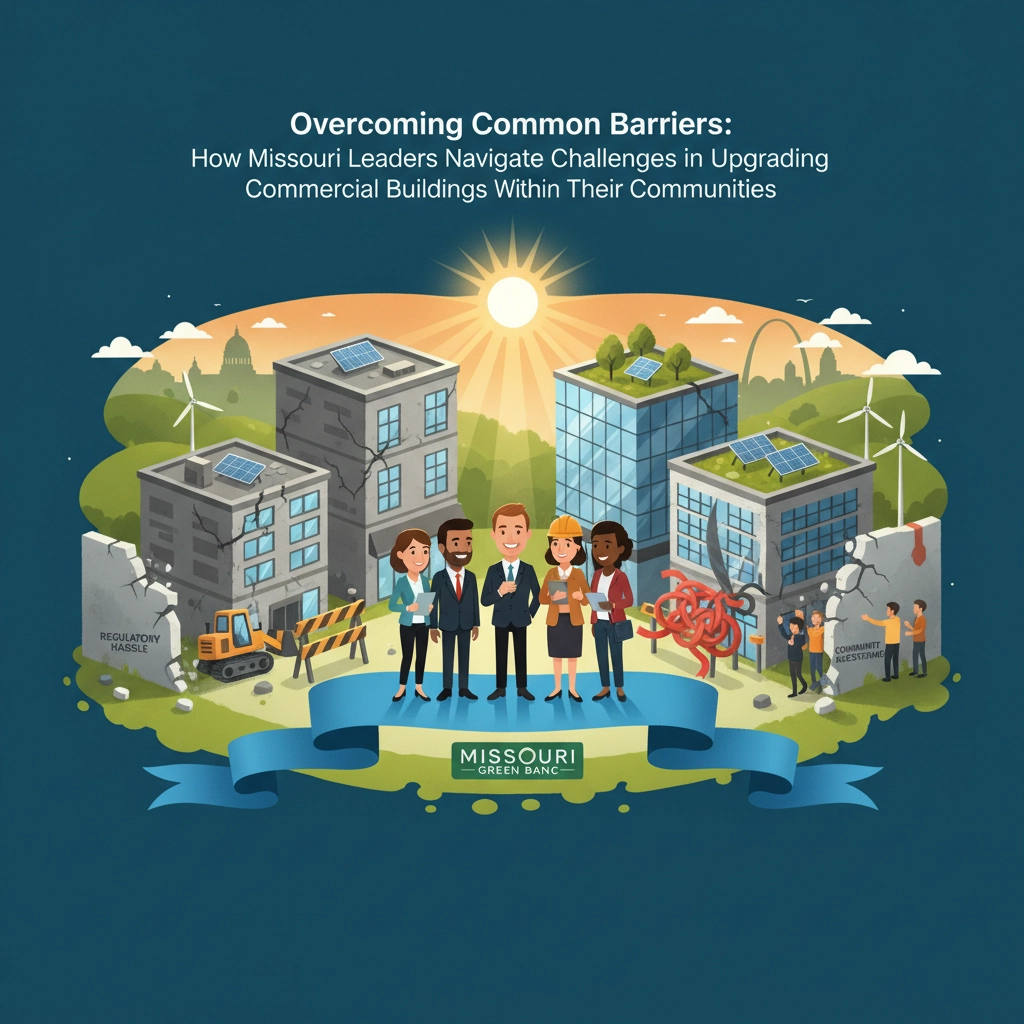
Missouri's commercial buildings represent both tremendous opportunity and significant challenges for community leaders. These structures account for 23.14% of the state's total energy consumption, with more than 44% dedicated to heating, cooling, and ventilation systems. For mayors, county officials, and city council members across Missouri, upgrading these buildings isn't just about energy savings: it's about economic development, community resilience, and creating healthier environments for businesses and residents alike.
Yet despite clear benefits, many Missouri communities struggle to move commercial building upgrade projects from concept to completion. Economic pressures, aging infrastructure, and complex financing landscapes create substantial barriers. However, innovative leaders across the state have developed practical strategies to overcome these obstacles, often with support from organizations like Missouri Green Banc and the Missouri Clean Energy District (MCED).
Understanding the Primary Barriers
Funding Gaps and Financial Complexity
The most significant barrier facing Missouri communities involves financing commercial building upgrades. Small commercial buildings: which comprise the majority of Missouri's building stock: present particularly challenging investment scenarios. Property owners face high upfront costs combined with uncertainty about projected returns on efficiency improvements. Traditional lending often proves inadequate for smaller-scale projects, while building owners struggle to understand and trust predicted retrofit outcomes.
Administrative complexity compounds these financial challenges. Processing multiple small loans requires substantial overhead, making many conventional financing options economically unfeasible for community-scale projects.
Organizational Inertia and Expertise Gaps
Many building owners and managers lack experience with energy efficiency projects, creating organizational inertia around upgrades. Frequent management turnover in commercial properties further complicates long-term planning efforts. Additionally, establishing energy benchmarking and reporting as standard business practices remains challenging, as both property managers and local regulators are often new to these processes.
Technical expertise represents another significant gap. Communities may lack access to qualified contractors familiar with modern efficiency technologies, or property owners may feel overwhelmed by the complexity of upgrade options and compliance requirements.
Regulatory and Policy Challenges
While some Missouri communities have embraced progressive building codes and performance standards, regulatory frameworks can create barriers in other areas. Inconsistent standards across jurisdictions complicate regional coordination efforts. In some cases, market participants have actively resisted new energy codes, citing increased equipment costs and installation complexity.
Utility company policies also create obstacles. Despite state efforts to encourage efficiency investments, some utilities have reduced spending on efficiency programs, misaligning financial incentives with community sustainability goals.

Proven Solutions from Missouri Communities
Property Assessed Clean Energy (PACE) Financing
The Missouri Clean Energy District has emerged as the state's leading solution for overcoming financing barriers. As Missouri's first and largest PACE program with over 300 municipal members, MCED enables property owners to finance efficiency, renewable energy, and resilience improvements through property tax assessments. This innovative approach allows building owners to spread costs over time while transferring financing obligations to future property owners if buildings change hands.
Kansas City, St. Louis, Springfield, and Columbia among hundreds of others have successfully implemented PACE financing for both residential and commercial properties, enabling funding for heating and cooling systems, lighting improvements, solar installations, water pumps, and insulation projects. This flexible financing mechanism addresses the small-loan complexity issue while providing predictable, long-term payment structures.
Building Performance Standards with Flexibility
Forward-thinking Missouri communities have implemented building performance standards that set energy-use intensity limits per square foot while allowing property owners flexibility in compliance methods. These policies provide clear targets while enabling building owners to choose from comprehensive energy-efficiency retrofits, HVAC system replacements, or other efficiency measures based on their specific circumstances and financial capabilities.
Local governments supporting these standards often provide free technical assistance and offer menus of compliance options, reducing the expertise gap barrier. Penalty structures direct non-compliance revenues toward additional decarbonization efforts, creating positive feedback loops for community-wide improvements.
Energy Efficiency Competitions and Incentive Programs
Several Missouri municipalities have established annual energy-reduction challenges for commercial buildings, partnering with organizations like the Building Owners and Managers Association (BOMA) to encourage voluntary participation. These competitions create peer pressure for efficiency improvements while building community awareness around energy performance.
Utility-based programs have demonstrated tangible results across Missouri. Ameren Missouri's BizSavers program exemplifies successful utility partnerships, with HVAC upgrades alone saving commercial customers nearly 30 million kilowatt-hours of electricity and delivering over $2.9 million in savings since July 2024.

Strategic Partnership Approaches
Public-Private Collaboration Models
Missouri communities have found success through partnerships with private sector organizations that offer guaranteed pricing and expert project management. These collaborations help municipalities achieve efficiency goals while managing costs and risks, particularly important for communities operating under tight budgetary constraints.
Such partnerships address both the expertise gap and financial risk concerns by providing technical knowledge and performance guarantees. Local governments can pursue infrastructure improvements without assuming full responsibility for project outcomes or technical implementation details.
Regional Coordination and Resource Sharing
Successful Missouri communities increasingly coordinate efforts across jurisdictional boundaries, sharing best practices and leveraging collective purchasing power. Regional approaches help smaller communities access expertise and financing options that might be unavailable individually.
The Missouri Clean Energy District's statewide approach exemplifies effective regional coordination, enabling communities of all sizes to participate in sophisticated financing mechanisms while sharing administrative costs and technical resources.
Available Resources and Support Systems
Missouri Clean Energy District (MCED)
MCED provides comprehensive support for commercial building upgrade financing across Missouri's participating communities. The district offers technical assistance, project development support, and flexible financing terms that address traditional barriers to efficiency investments. Learn more about joining MCED and how it can benefit your community's commercial building upgrade efforts.
Missouri Green Banc
Missouri Green Banc serves as a crucial partner for communities pursuing comprehensive building upgrade strategies. The organization provides financing solutions, technical expertise, and policy guidance to help local leaders navigate complex upgrade projects while maximizing community benefits.
Federal and State Grant Opportunities
Multiple federal and state programs provide grant funding and tax incentives for commercial building efficiency projects. Missouri communities can leverage these resources to reduce upfront costs and improve project economics for property owners.
Utility Rebate Programs
Major Missouri utilities offer rebate programs for commercial efficiency improvements, providing immediate cost reductions that improve project feasibility. These programs complement PACE financing and other tools to create comprehensive support packages for building upgrades.
Moving Forward: Practical Next Steps
Missouri communities ready to address commercial building upgrade barriers should begin by assessing local needs and identifying key stakeholders. Successful projects typically involve early engagement with property owners, utility companies, and financing partners to develop comprehensive support strategies.
Communities considering PACE financing should evaluate MCED membership benefits and requirements. The district's established infrastructure and broad participation provide proven frameworks for implementing effective commercial building upgrade programs.
Building collaborative relationships with neighboring communities, utility companies, and private sector partners creates stronger foundations for long-term success. Shared resources and coordinated approaches help overcome individual community limitations while building regional expertise and capacity.
The path forward requires pragmatic approaches that address real barriers while building on proven successes. Missouri communities have demonstrated that commercial building upgrade challenges are surmountable through strategic partnerships, innovative financing, and sustained commitment to community improvement.
For communities ready to begin this important work, Missouri Green Banc and MCED stand ready to provide guidance, resources, and support. Contact Missouri Green Banc to discuss how these proven strategies can work in your community and help your commercial buildings contribute to a more sustainable, economically vibrant Missouri future.