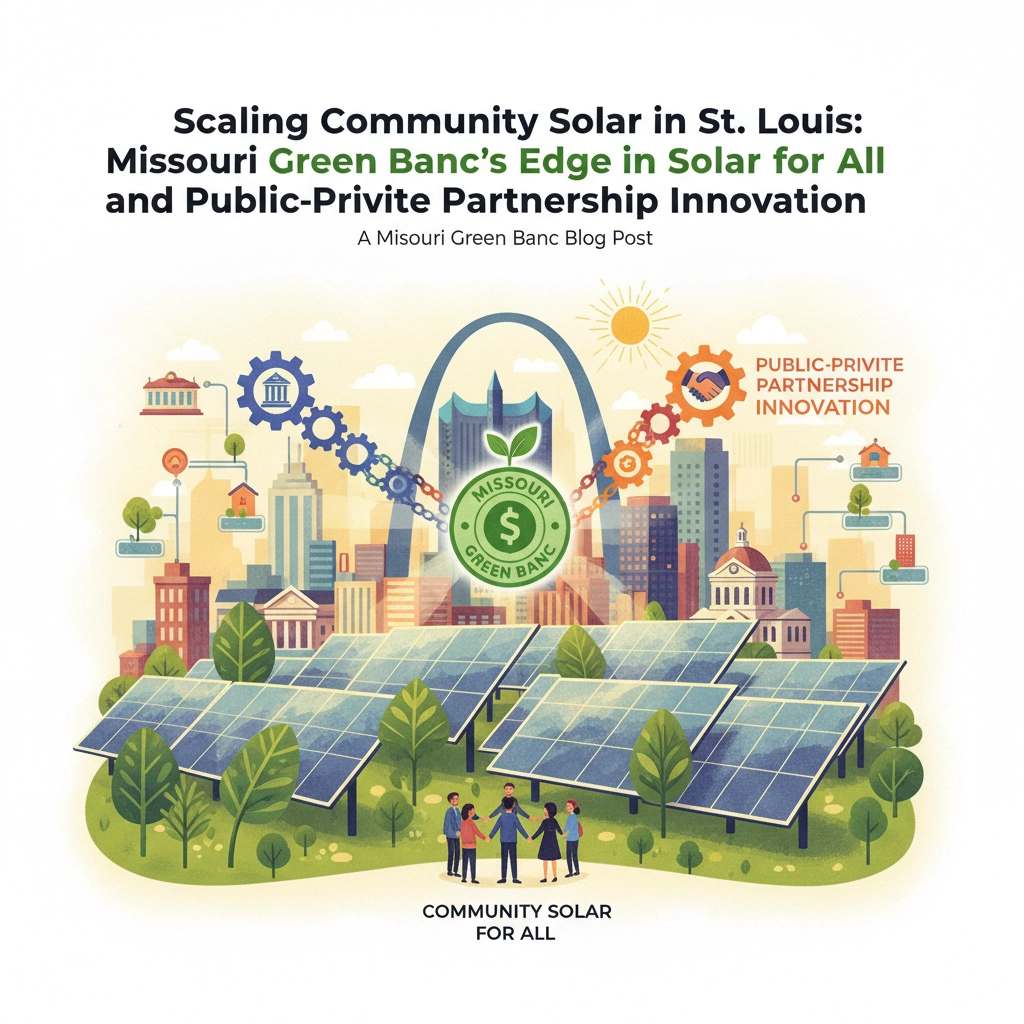
Missouri Green Banc has secured a pivotal role in transforming St. Louis’s clean energy landscape through strategic partnerships and innovative financing solutions. The organization’s selection by the Municipal Investment Fund to receive grant funding for technical assistance in developing public-private partnerships represents a significant milestone in scaling community solar deployment across underserved communities.
This funding, supported by an EPA National Clean Investment Fund grant and administered by the Coalition for Green Capital under ICLEI oversight, positions Missouri Green Banc as a key architect of sustainable energy infrastructure. The initiative demonstrates how specialized technical assistance can bridge the gap between federal funding opportunities and effective community-level implementation.
Strategic Selection and Partnership Framework
The Municipal Investment Fund’s decision to support Missouri Green Banc reflects the organization’s demonstrated expertise in clean energy finance and community engagement. This competitive selection process evaluated applicants based on their technical capacity, community relationships, and ability to design replicable public-private partnership models.
Missouri Green Banc’s approach centers on creating finance-ready clean energy project pipelines that attract both public investment and private capital. Rather than simply distributing funds, the technical assistance focuses on developing structured planning processes, community engagement frameworks, and financial packaging standards that make solar, and energy improvement projects viable for diverse stakeholder groups.

The partnership framework emphasizes collaboration between municipal authorities, community organizations, and private sector partners. This multi-stakeholder approach ensures that solar deployment strategies address local priorities while maintaining financial sustainability and scalability across different community contexts.
NCIF: Catalyzing Community Solar Deployment
The EPA’s National Clean Investment Fund initiative represents a transformative opportunity to expand energy improvement access across traditionally underserved markets. St. Louis’s participation in this program, supported by Missouri Green Banc’s technical assistance, creates pathways for solar deployment that prioritize communities with high energy cost burdens.
Community energy improvement projects offer particular advantages for urban neighborhoods where the built environment may face technical or financial constraints. This approach will enable multiple property owners to benefit from clean energy generation without requiring substantial upfront investments.
Missouri Green Banc’s technical assistance focuses on developing community solar models that integrate with existing housing programs and economic development initiatives. This approach ensures that solar and energy improvement deployment becomes part of comprehensive community improvement strategies rather than isolated energy projects.
The organization’s expertise in structuring financing for underserved markets proves essential in designing community programs that achieve both social equity goals and financial sustainability. Technical assistance activities include feasibility analysis, stakeholder engagement protocols, and financial modeling that demonstrates long-term viability to potential funders and partners.
Public-Private Partnership Development
The core of Missouri Green Banc’s technical assistance involves designing public-private partnerships that leverage complementary strengths across sectors. Municipal governments contribute policy support, land access, and community relationships, while private partners provide technical expertise, capital, and operational capabilities.

Public-private partnerships require careful attention to risk allocation, revenue sharing, and performance standards. Missouri Green Banc’s technical assistance helps structure these partnerships to ensure that public benefits align with private sector incentives while maintaining transparency and accountability to community stakeholders.
The development process includes comprehensive stakeholder mapping to identify potential partners across sectors. This includes community development financial institutions, local contractors, technology providers, and energy service companies capable of contributing specialized capabilities to community solar projects.
Financial structuring represents a critical component of partnership development. Missouri Green Banc applies its expertise in blended financing to create capital stacks that combine federal funding, municipal resources, and private investment in optimal proportions for different project types and community contexts.
Missouri Green Banc’s Competitive Advantages
Missouri Green Banc brings distinctive capabilities to community development that differentiate its approach from conventional project development models. The organization’s nonprofit status enables it to prioritize community benefit alongside financial returns, creating flexibility in project design and stakeholder engagement.
The organization’s affiliation with the Missouri Clean Energy District provides access to established intergovernmental relationships with over 300 cities and counties across the state. This infrastructure enables rapid scaling of successful models while maintaining local customization based on community-specific priorities and constraints.
Missouri Green Banc’s experience with Commercial PACE (C-PACE) financing creates additional opportunities for integrating solar and energy improvement deployment with broader building improvement initiatives. This expertise enables comprehensive energy solutions that address multiple community needs through coordinated financing mechanisms.
The organization’s focus on underserved markets has developed specialized capabilities in community engagement and flexible financing terms that accommodate diverse income levels and credit profiles. These capabilities prove essential in ensuring that community programs achieve meaningful participation across demographic groups.
Innovation in Community-Centered Design
Technical assistance activities prioritize community input throughout the design and implementation process. Missouri Green Banc facilitates stakeholder engagement sessions that gather community priorities, identify potential barriers, and develop solutions that reflect local needs and preferences.

Community-centered design principles ensure that energy improvement projects create multiple benefits beyond energy generation. These may include workforce development opportunities, local economic development, and environmental improvements that enhance neighborhood livability and property values.
The organization’s technical assistance includes development of community benefit measurement frameworks that track social, economic, and environmental outcomes. This data collection enables continuous improvement and provides documentation of community impact for funders and stakeholders.
Innovation extends to project financing models that accommodate community ownership structures and cooperative development approaches. Missouri Green Banc’s expertise in alternative ownership models creates pathways for community wealth building through shared solar asset development.
Market Development and Scaling Strategies
The technical assistance program emphasizes creating replicable models that can expand across multiple communities and market contexts. Missouri Green Banc’s approach focuses on developing standardized processes and tools that reduce transaction costs while maintaining flexibility for local adaptation.
Market development activities include building local capacity among community organizations, contractors, and financial institutions. This capacity building ensures that communities develop internal expertise to manage and expand solar and energy improvement project deployment beyond initial project phases.
The organization’s technical assistance creates pathways for accessing additional funding sources beyond the initial EPA grant. This includes developing relationships with foundation funders, impact investors, financial institutions, and federal programs that support ongoing clean energy infrastructure development.
Scaling strategies incorporate lessons learned from initial projects to refine approaches and improve effectiveness over time. Missouri Green Banc’s commitment to continuous improvement ensures that each project phase contributes to enhanced capabilities and expanded impact across the organization’s service territory.
Economic Development and Community Benefits
Community solar and energy improvement project deployment through public-private partnerships creates multiple economic development opportunities that extend beyond direct energy savings. Projects generate local employment during construction and ongoing operations while building community capacity in clean energy technologies.

Missouri Green Banc’s technical assistance includes analysis of local economic impacts and strategies for maximizing community economic benefits. This includes identifying opportunities for local contractor participation, workforce development programs, and community ownership structures that retain wealth within neighborhoods.
The organization’s approach emphasizes building long-term community assets rather than extractive development models. Community projects designed with appropriate ownership and governance structures create ongoing revenue streams that support local economic development initiatives.
Technical assistance activities include connecting energy improvement project development with broader economic development strategies. This integration ensures that clean energy projects contribute to comprehensive community improvement efforts and support local economic resilience.
Building Sustainable Implementation Capacity
Missouri Green Banc’s selection for this technical assistance role reflects its commitment to building lasting implementation capacity rather than providing temporary project development services. The organization’s approach focuses on transferring knowledge and capabilities to community partners to ensure long-term sustainability.
Capacity building activities include training local organizations in project development, financial analysis, and stakeholder engagement techniques. This knowledge transfer enables communities to identify and develop additional clean energy opportunities using internal resources and expertise.
The technical assistance program creates documentation and tools that support replication across different communities and contexts. Missouri Green Banc’s systematic approach to knowledge capture ensures that successful strategies become available to broader networks of community organizations and municipal partners.
Sustainable implementation requires ongoing support systems that connect communities with resources, expertise, and funding opportunities. Missouri Green Banc’s role extends beyond initial project development to include facilitating peer learning networks and connecting communities with relevant technical assistance and funding sources.
Through this comprehensive approach to technical assistance and public-private partnership development, Missouri Green Banc demonstrates how specialized expertise can catalyze energy improvement project deployment that serves multiple community priorities while building sustainable clean energy infrastructure. The organization’s selection by the Municipal Investment Fund validates this approach and creates opportunities for expanding impact across Missouri’s diverse communities.