
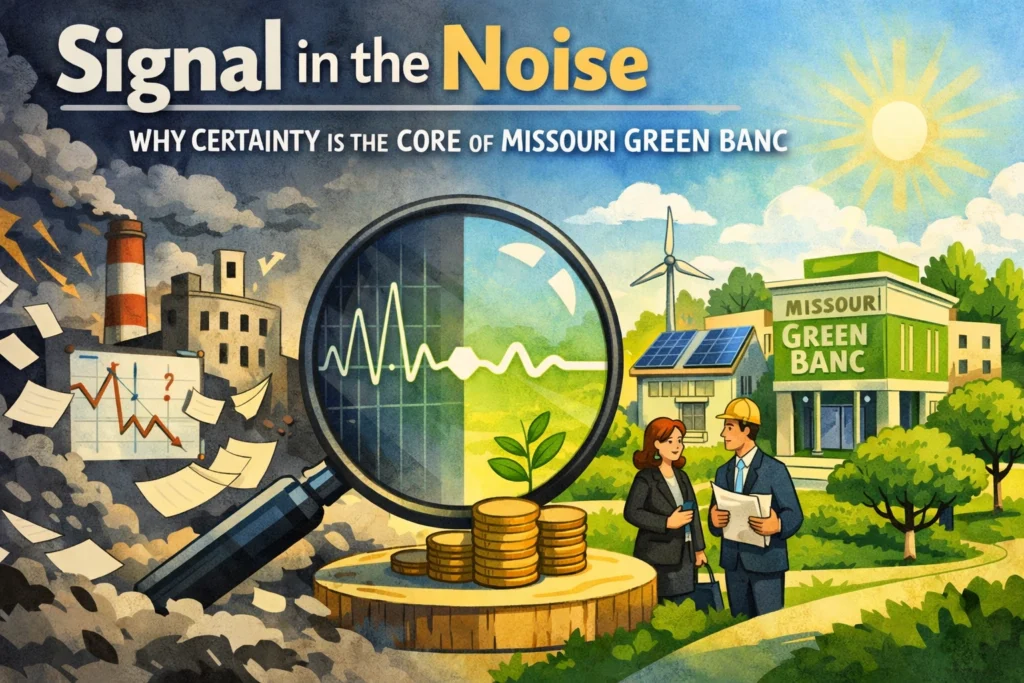
In the current landscape of commercial real estate and energy infrastructure, the primary challenge is no longer a lack of data. On the contrary, the modern marketplace is defined by a relentless surplus of data points, projections, and promotional narratives. To navigate this environment, one must recognize a fundamental structural reality: Information is abundant; certainty is scarce.
For property owners and developers in the state of Missouri, the noise surrounding clean energy financing can be deafening. Between shifting interest rates, evolving federal tax credits, and a proliferation of private lending products, the path toward building decarbonization often feels obscured by complexity. In this context, Missouri Green Banc (MGB) and the Missouri Clean Energy District (MCED) function as the "signal": the steady, predictable frequency that separates objective fact from market volatility.
The Information Paradox in Clean Energy Financing
The proliferation of "green" financial products has created a knowledge crisis for many decision-makers. When every voice in the market claims to offer the ultimate "truth" regarding return on investment or energy savings, the truth itself becomes the hardest thing to hear. This is the information paradox: the more data that is produced, the less agreement there is about what is real.
For a property owner considering a major retrofit or a new construction project, the "noise" often takes the form of aggressive marketing from unproven financial entities or complex debt structures that carry hidden long-term risks. In a marketplace of stories, reality often has the weakest marketing. Missouri Green Banc operates on the opposite principle. By prioritizing structural stability over narrative flair, MGB provides the certainty required for large-scale, long-term capital improvements.

The Statutory Signal: Stability by Design
Trust is not an emotion; it is a structural outcome. The certainty provided by Missouri Green Banc is rooted in its unique legal and organizational framework. As a non-profit organization working in tandem with the Missouri Clean Energy District, MGB operates under a clear statutory mandate. This is the "gold standard" of the Missouri PACE program.
Unlike private equity-backed firms that may exit a market during an economic downturn, the Missouri Clean Energy District is a permanent political subdivision of the state. It was created to serve a specific public purpose: to facilitate energy efficiency and renewable energy upgrades through CPACE financing Missouri.
This statutory authority serves as the "signal" because it is immutable. It provides a level of institutional permanence that private-sector alternatives cannot replicate. When a property owner engages with MGB, they are not just entering a transaction; they are aligning with a statewide framework supported by over 300 municipal members. This collective scale creates a "safe harbor" for capital, ensuring that the financing remains stable over the 20- or 30-year life of the assessment.
More Data, Less Truth: Navigating the Complexity
The adage "More data. Less truth" applies directly to the evaluation of energy retrofits. A property owner may receive five different energy audits with five different sets of projected savings. In such a scenario, the "noise" makes it impossible to move forward. Missouri Green Banc resolves this by acting as a disinterested third party that validates the viability of projects through the Missouri PACE program.
MGB does not profit from the sale of equipment or the execution of construction. Its role is strictly administrative and facilitative. By stripping away the layers of salesmanship, MGB allows property owners to see the raw facts of their project. This objective oversight is what transforms a "hopeful projection" into a "bankable reality."

The Strength of 300+ Municipalities
Certainty is often a function of scale and consensus. The Missouri Clean Energy District is not a localized pilot program; it is the first and largest PACE program in Missouri. Its strength is derived from its membership: more than 300 cities and counties across the state have joined the district, creating a unified regulatory environment for CPACE financing Missouri.
This broad municipal adoption serves several critical functions:
- Uniformity: It ensures that the process for filing a PACE assessment is consistent across different jurisdictions, reducing administrative friction.
- Validation: The fact that hundreds of local governments have vetted and approved the MCED framework provides a layer of institutional trust that individual lenders cannot offer.
- Durability: The sheer size of the district makes it a resilient entity, capable of weathering market shifts that might destabilize smaller, fragmented programs.
For more information on the structural differences between statutory entities and private administrators, readers can explore the analysis of the source vs. the administrator.
CPACE as a Hedge Against Market Noise
In an era of fluctuating interest rates and tightening credit markets, CPACE financing Missouri offers a rare form of financial certainty. Traditional bank loans are often subject to "noise" such as five-year call options, personal guarantees, and floating rates. In contrast, the Missouri PACE program provides:
- Fixed Rates: The interest rate is locked in at the start of the project and does not change.
- Long-Term Amortization: Terms can extend up to 20 to 25 years, matching the useful life of the equipment.
- Non-Recourse Structure: The financing is tied to the property, not the individual owner, protecting personal assets and preserving borrowing capacity for other needs.
This structure is designed to be "durable and tight." It removes the variables that typically cause sleepless nights for developers. By fixing the cost of capital over a long horizon, MGB helps owners move from a state of reactive stress to a state of proactive management. This is the "Easy Button" for Missouri clean energy.

The Signal of "Missouri Grit"
Trust is ultimately built through performance. Missouri Green Banc’s commitment to "Missouri grit" means that the organization focuses on the hard, practical work of building stronger towns and more resilient buildings. This isn't about the moralizing language of environmentalism; it is about the structural necessity of energy efficiency.
When a building's operating costs are reduced through high-efficiency HVAC systems, solar arrays, or building envelope improvements, the underlying asset becomes more valuable and more stable. MGB facilitates this transition not because it is a "story" to tell, but because it is an objective improvement to the state’s infrastructure.
By focusing on building strong towns, MGB reinforces the idea that clean energy is not a luxury, but a fundamental component of a modern, competitive economy.
Conclusion: Finding Your Safe Harbor
"Information is abundant; certainty is scarce."
In the years ahead, the volume of data regarding energy transition and real estate finance will only increase. The challenge for property owners will not be finding information, but finding a reliable signal within the noise. Missouri Green Banc and the Missouri Clean Energy District represent that signal.
Through statutory authority, municipal consensus, and a commitment to transparent, non-profit administration, MGB provides the certainty that allows Missourians to invest in their properties with confidence. In a marketplace of framed narratives, MGB remains a source of clear, unvarnished reality.
For those seeking to separate the signal from the noise and begin a project, the FastPACE application form provides a direct path toward certainty. To learn more about the organization's history and its role as a statewide leader, visit the About MGB page.
Missouri Green Banc: The Signal in the Noise.