
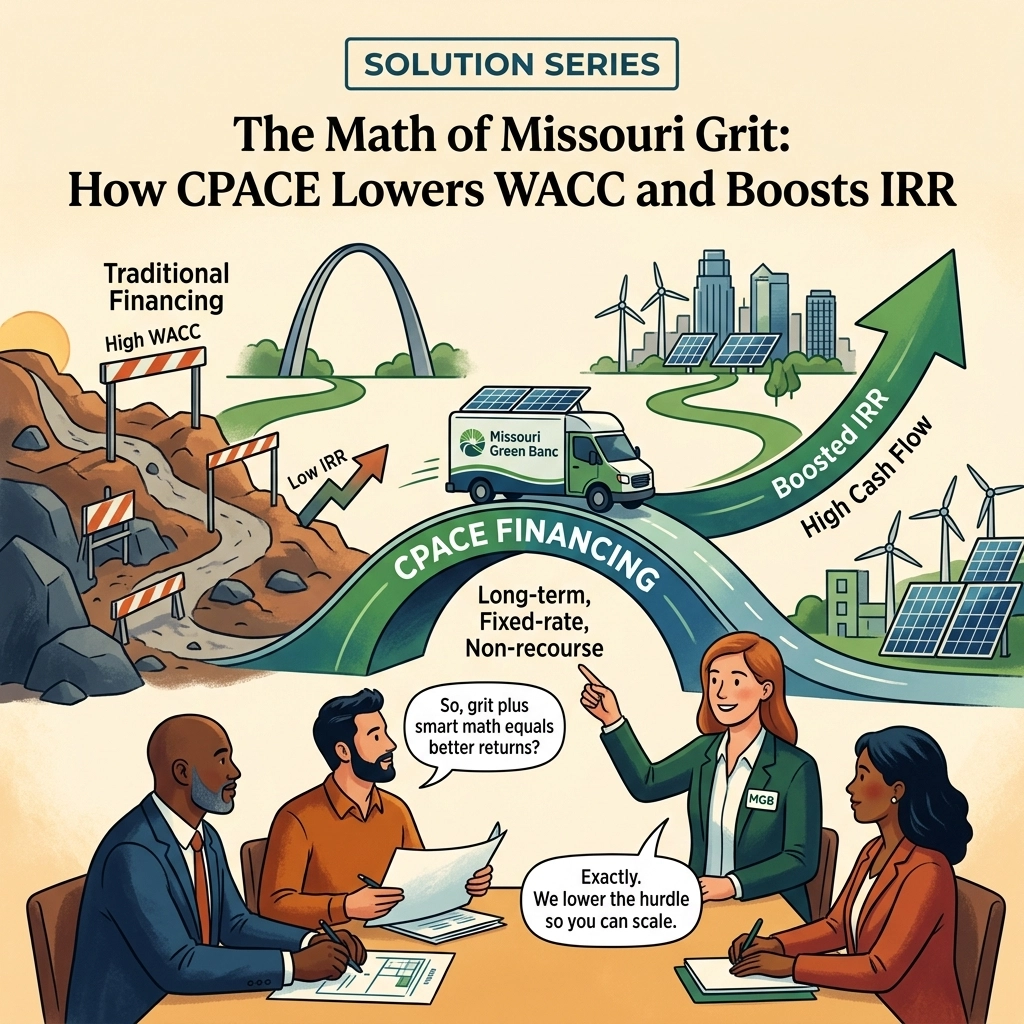
In the current economic climate, commercial real estate owners in Missouri face a unique set of challenges. Interest rates remain stubbornly high, traditional bank balance sheets are increasingly constrained, and new building performance mandates are rapidly approaching. Navigating this landscape requires more than just a standard strategy; it requires a level of persistence often described as "Missouri Grit."
Missouri Green Banc (MGB) provides the financial tools necessary to meet these challenges head-on. By utilizing the Missouri Green Banc PACE program, property owners can access a specialized form of financing that doesn't just fill a gap in the capital stack: it optimizes the entire financial structure of a project. Through Commercial Property Assessed Clean Energy (CPACE) financing, Missouri property owners are converting energy savings into property-backed assessments, resulting in measurable improvements to the bottom line.
Before diving into the complex financial mechanics of how these deals are structured, it is important to understand the roadmap for success. The process of upgrading a property through Missouri Green Banc is designed to be streamlined and transparent.
The MGB Property Owner Journey at a Glance
The path to a more efficient, high-performing building follows these six essential steps:
- Step 1: Initial Intake – Submission of basic project details to determine preliminary fit.
- Step 2: Eligibility & Financial Review – Verification of property qualifications and initial savings estimates.
- Step 3: Technical Project Development – Identifying specific energy efficiency and renewable energy upgrades.
- Step 4: Financing & Underwriting – Structuring the CPACE capital and securing necessary approvals.
- Step 5: Construction & Implementation – Execution of the retrofit or new construction elements.
- Step 6: Performance & Repayment – Realizing energy savings and repaying the assessment via the property tax bill.
For those ready to begin, the MGB Property Owner Journey provides a comprehensive framework for taking a project from concept to completion.
The Financial Mechanics: Lowering WACC and Boosting IRR
The primary appeal of CPACE financing lies in its ability to solve the "capital stack" problem. In a traditional financing model, an owner might rely on a senior mortgage covering 60% of the project cost, with the remaining 40% coming from expensive mezzanine debt or high-cost equity. In today’s market, that equity is not only hard to find but extremely costly.
Missouri Green Banc facilitates the injection of private capital into the capital stack through CPACE, which typically replaces that top-tier, high-cost capital. Because CPACE is structured as a long-term, fixed-rate property assessment, it functions more like a utility bill than a traditional loan.
Cutting the Weighted Average Cost of Capital (WACC)
When CPACE is introduced, the impact on the Weighted Average Cost of Capital (WACC) is significant. By replacing mezzanine debt or equity: which can cost anywhere from 12% to 18% or more: with CPACE financing (typically ranging from 7% to 9%), the overall cost of capital for a project often drops by 150 to 300 basis points.
This reduction is a game-changer for project feasibility. Lowering the WACC means the project becomes more resilient to market fluctuations and provides a wider margin of safety for the developer and the senior lender. This is the "Missouri Green Banc PACE" advantage: it makes projects that were previously "pencils down" viable again.
Increasing Internal Rate of Return (IRR)
The most compelling metric for many developers is the boost to the project's Internal Rate of Return (IRR). Because CPACE provides up to 100% financing for the energy-related portions of a project, it drastically reduces the amount of upfront cash or equity an owner must commit.
By minimizing equity dilution, the returns are concentrated across a smaller base of invested capital. On average, Missouri Green Banc has seen CPACE structures increase project IRR by 200 to 400 basis points. This allows owners to retain more ownership and see a higher return on every dollar they personally invest in the property.

Why the Missouri Green Banc PACE Program is Vital Right Now
The urgency for PACE solutions is driven by three converging factors:
- Capital Scarcity: Regional and community banks are facing regulatory and liquidity pressures, leading to tighter lending standards. While they may still want to support local developers, they often cannot provide the high loan-to-value (LTV) ratios they once did.
- Rising Interest Rates: The cost of traditional construction and bridge loans has skyrocketed. CPACE offers a fixed-rate, long-term alternative that provides stability in a volatile rate environment.
- Building Performance Mandates: Cities across the state and the country are implementing stricter energy codes and carbon reduction mandates. Deferring upgrades is no longer an option; it’s a liability.
Property owners are forced to either recapitalize using tools like CPACE or risk seeing their building value erode as it becomes obsolete or non-compliant. By using Missouri Green Banc's PACE program, owners can fund these mandatory retrofits using the energy savings the upgrades themselves generate.
A Win for Community Banks
It is a common misconception that CPACE competes with traditional banks. In reality, Missouri Green Banc works in a public-private partnership model that benefits local financial institutions.
CPACE creates long-duration, investment-grade assets. For community banks, participating in these structures provides a predictable cash flow backed by strong collateral: the real estate itself. Because the CPACE assessment is tied to the land and is collected via the tax bill, it carries a senior lien status that makes it a highly secure asset class. This allows community banks to maintain their relationships with property owners while offloading the risk of the high-leverage portions of a deal.

The Missouri Clean Energy District Difference
When evaluating options, it is essential to look at the track record. The Missouri Clean Energy District (a Missouri political subdivision), partnered with Missouri Green Banc is the first and largest PACE program in Missouri. With a membership of over 300 municipalities across the state, it offers the most robust and established framework for commercial PACE loans in Missouri.
Unlike newer or more localized programs, MCED provides the scale and legal certainty that sophisticated institutional investors and senior lenders require. This stability is a core component of the "Missouri Grit" ethos: building something that lasts and benefits the entire community.
Navigating the 6-Step Path to Implementation
To truly understand how these financial benefits manifest, let's look closer at the deep-dive details of the property owner's journey.
1. The Intake Phase
Everything starts with a simple conversation or an intake form. This phase is about determining if the project meets the basic requirements for PACE program eligibility. This includes verifying that the property is commercial (including multi-family, industrial, or non-profit) and located within a member community of the Missouri Clean Energy District.
2. Financial Assessment
During this stage, Missouri Green Banc looks at the project’s economics. We analyze the current energy spend and the projected savings. The goal is to ensure the "Savings-to-Investment Ratio" (SIR) makes sense. Ideally, the energy savings generated by the new HVAC, roofing, or solar installation should offset a significant portion of the assessment payment.
3. Technical Project Development
Working with engineers and contractors, the scope of work is finalized. This might include everything from LED lighting and high-efficiency windows to complex building automation systems. For projects involving major components like roofing, it’s about moving from reactive maintenance to strategic asset management.
4. Financing & Underwriting
This is where the "Math of Missouri Grit" happens. The capital stack is structured to maximize the WACC reduction. MGB coordinates with private capital providers to secure the best possible terms for the property owner. A key part of this step is obtaining "Lender Consent" from the existing mortgage holder, a process MGB is uniquely experienced in navigating.
5. Implementation
With funding secured, construction begins. One of the greatest advantages of Missouri PACE is that funding can be provided retroactively for projects completed within the last 36 months, or it can be drawn down during the construction phase to pay contractors.
6. Performance & Repayment
Once the upgrades are installed, the property begins to operate more efficiently. Operating expenses (OpEx) drop, and property value (CapEx) increases. The CPACE assessment is paid back over a term of up to 20 or 30 years, often matching the useful life of the equipment installed.
Conclusion: Securing the Future of Missouri Real Estate
The decision to utilize CPACE financing is ultimately a financial one. It is a strategic move to lower the cost of capital, increase investor returns, and future-proof assets against rising energy costs and regulatory mandates.
Missouri Green Banc is committed to providing inclusive, community-based solutions that benefit all Missourians. By channeling private capital into sustainable building retrofits, we are helping to build a more resilient state, one property at a time.
If you are ready to see how the math works for your specific property, we encourage you to apply for PACE financing or contact our team for a detailed consultation. Don't let high interest rates stall your progress: use Missouri Grit and CPACE to keep moving forward.
