
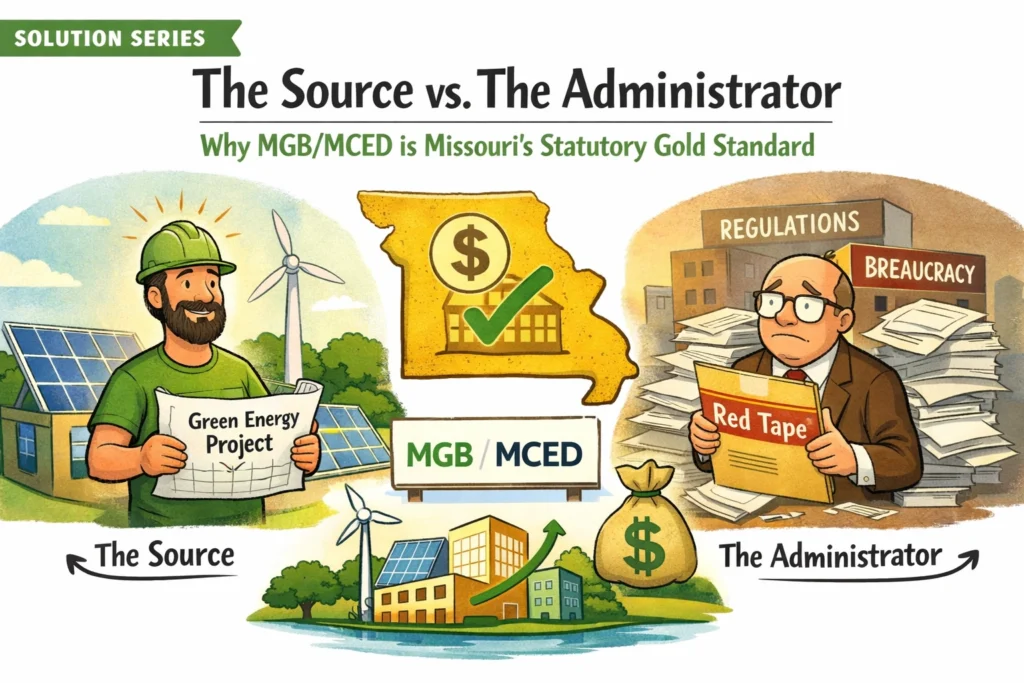
In the world of commercial real estate and project development, the phrase "Property Assessed Clean Energy" has become a common fixture in high-level strategy meetings. But as the popularity of CPACE financing Missouri grows, so does the noise in the marketplace. For property owners, architects, financial advisors, community banks, and institutional investors, the options can feel redundant. However, a fundamental distinction exists that separates a temporary administrative fix from a permanent statutory foundation.
Understanding the difference between an "administrator" and the "authority" is the key to choosing the best Missouri PACE program for long-term project success. While some programs operate as third-party vendors or localized pilots, the Missouri Clean Energy District (MCED) and Missouri Green Banc (MGB) provide the institutional stability of a statewide political subdivision—an attribute that matters directly to community banks and institutional investors evaluating long-duration assessment-backed structures and bank consent risk.
The Statutory Bedrock: More Than Just a Program
When a property owner evaluates commercial PACE loans, they are essentially looking for a reliable partner to facilitate a long-term assessment. This is not a standard bank loan; it is a voluntary tax assessment. Because of this, the legal framework matters more than the marketing materials—especially for community banks and institutional investors that must underwrite predictability over a 15–25 year horizon and assess how a PACE assessment may affect senior loan consent and servicing.
The Missouri Clean Energy District (MCED) is not simply a service provider. It is a statewide political subdivision of the State of Missouri. This status provides a level of statutory weight and institutional permanence that a private, third-party administrator or a city-specific program cannot replicate. Being a political subdivision means MCED operates under a specific legal mandate to serve the public interest, providing the "statutory gold standard" for property owners and capital providers that need to know their financing will not depend on the shifting priorities of a local administration, the term of a vendor contract, or the solvency and continuity of a private operator.

Scale Matters: 300+ Municipalities and Growing
In project financing, geography often dictates opportunity. Many localized PACE programs are restricted to specific city limits or county lines. This creates a fragmented landscape for professional services advisors who work on projects across the state.
MCED represents the largest network in the state, with over 300 cities and counties as members. This scale is not just about bragging rights; it is about reliability. For an advisor handling a portfolio of buildings in Kansas City, Springfield, and rural Missouri, the ability to use a single, unified framework is invaluable. It reduces the due diligence burden and ensures that the financing structure is consistent regardless of where the dirt is moving.
By choosing the Missouri Clean Energy District, owners gain access to a platform that is already vetted and operational in the vast majority of the state. This expansive reach is essential for building decarbonization efforts that aim to impact more than just a few urban blocks. It ensures that energy efficiency financing is available to the "middle class" of office space and industrial facilities that often get overlooked by smaller, boutique programs.
Missouri Green Banc: The Nonprofit Financing Engine
While MCED provides the legal and statutory authority, Missouri Green Banc (MGB) serves as the nonprofit financing arm that makes the capital accessible and inclusive. This partnership is what truly differentiates the MGB/MCED model.
Most PACE administrators act as "toll booths," collecting fees to connect owners with private capital. MGB functions as a mission-driven nonprofit. The goal is not to maximize fee revenue but to maximize project viability. This focus allows MGB to bridge gaps that private-only administrators might ignore.
Whether it is a small commercial building in a rural town or a major adaptive reuse project in an urban center, MGB ensures that the PACE piece of the capital stack is inclusive. This inclusivity is vital for community banks and clean energy partnerships and for institutional investors seeking stable, scalable deployment—supporting a market where local lenders can participate alongside long-term capital rather than being sidelined.

Why Advisors, Community Banks, and Institutional Investors Should Demand "The Source"
Architects, engineers, and CPAs are often the "silent partners" in project financing. While they may feel uncomfortable discussing the intricacies of high-finance, they are the ones who feel the pain when a project budget is slashed during value engineering.
For these professionals—and for community banks and institutional investors underwriting long-term performance—the MGB/MCED model offers a pragmatic solution to budget, design, and execution risk. When an advisor recommends CPACE financing, they are putting their reputation on the line. When a bank or institutional partner supports a transaction, the focus turns to enforceability, continuity, and the practical pathway to bank consent. In both cases, the underlying Missouri PACE program must be built on a foundation that is durable over decades.
- Risk Mitigation: Using a statewide political subdivision reduces the risk of legal challenges, program discontinuity, or administrative shifts that can stall a project or complicate servicing.
- Reliability: MCED’s standardized processes across 300+ jurisdictions mean that the rules don’t change when a portfolio crosses a county line—supporting repeatable underwriting and documentation.
- Security for Long-Term Capital: Statutory authority and institutional stability provide a more predictable operating framework than a third-party administrator model, which may rely on contract renewals, vendor continuity, and changing internal policies.
- Smoother Bank Consent Path: A consistent, statewide approach helps senior lenders evaluate consent requests with clearer expectations around process, documentation, and ongoing administration.
Advisors who understand the "advisors' edge" know that C-PACE is a tool to protect the integrity of a building’s design. It allows for high-performance HVAC systems, better windows, and resilient roofing without increasing the upfront capital requirement. You can read more about this in our guide on solving design and budget gaps.
Pragmatic Math vs. Environmental Fluff
Let’s be clear: Missouri business owners aren’t looking for "environmental fluff." They are looking for a hedge against rising costs. The decision to use Property Assessed Clean Energy is almost always a math-based one.
The MGB/MCED approach reflects this reality. We focus on the ROI, the long-term fixed rates, and the fact that PACE is a non-recourse, off-balance-sheet financing mechanism. It is a practical tool for adaptive reuse and building upgrades that increase the net operating income (NOI) of a property.
By lowering operating expenses through energy upgrades, owners increase the value of their assets. When you use the Missouri Clean Energy District, you are using a program designed to facilitate these financial outcomes with the lowest possible administrative friction.

Inclusion: From Rural Main Street to Urban Core
One of the most significant advantages of the MGB/MCED model is its commitment to serving all of Missouri. Private administrators often gravitate toward massive, $50 million projects in major metros because those are the most profitable to manage.
Because MGB is a nonprofit and MCED is a political subdivision, our mandate is statewide. We are just as focused on a small manufacturing facility in a rural county as we are on a skyscraper in St. Louis. This commitment to inclusivity ensures that Missouri's best PACE program is available to the entire building stock of the state, not just the high-profile outliers.
Conclusion: Go to the Authority
In any industry, there is a difference between the middleman and the source. In Missouri’s PACE landscape, private administrators serve as middlemen, often operating under the temporary permission of local governments.
The Missouri Clean Energy District and Missouri Green Banc represent the source. We provide the statutory authority, the statewide network, and the nonprofit mission that ensures stability, reliability, and inclusivity. For property owners and advisors, the choice is clear: don't just find an administrator; go to the authority.
If you are ready to see how the statutory gold standard can solve your project’s budget or design challenges, it’s time to look at the numbers. Whether you are planning a new build or looking to hedge against rising energy costs, MGB and MCED provide the most secure path forward in the Missouri market.

Next Steps for Your Project
- Check if your municipality is part of our 300+ member network.
- Review our financing criteria for commercial energy efficiency loans.
- Connect with an advisor to see how MGB/MCED can anchor your capital locally.