
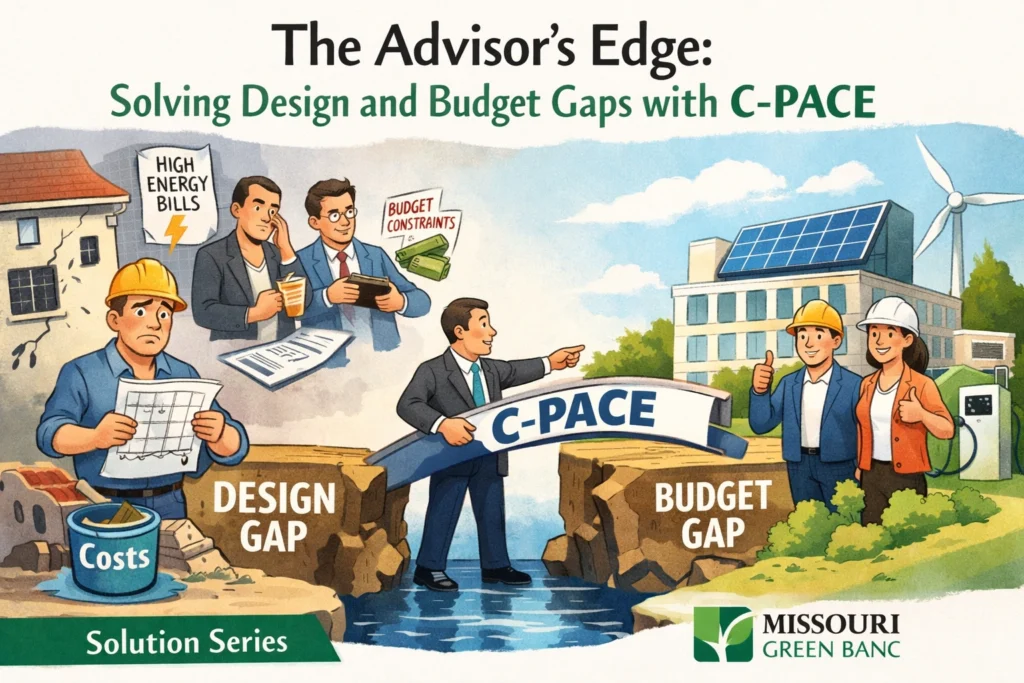
If you’ve been in the professional services world for more than a minute: whether you're an architect, an engineer, a CPA, or a real estate attorney: you know the heartbreak of the "Value Engineering" phase. It’s that painful moment in a project’s lifecycle where a brilliant, high-performance design meets the cold, hard reality of a traditional bank appraisal.
Suddenly, the high-efficiency HVAC system you specified is "too expensive." The high-performance building envelope gets downgraded to something mediocre. The solar array is scrapped. The project doesn't just lose its soul; it loses its long-term viability.
Even worse is the project that never breaks ground at all because the capital stack has a $2 million hole that the owner can't fill with equity and the senior lender won't touch.
As a professional advisor, it’s easy to stay in your lane. Architects do the drawings. Engineers do the calcs. CPAs do the tax strategy. Attorneys do the docs. But if the project stalls or gets gutted in the budget phase, everyone loses.
The good news? You don’t need to be a commercial banker to save the day. You just need to understand how CPACE financing can bridge the gap between a "no" and a "go."
The "Not My Lane" Fallacy
Most advisors avoid financing discussions because they don't want the liability or the complexity. That's understandable. However, ignoring the Missouri PACE program means leaving a powerful design and budget tool on the table.
Commercial PACE (C-PACE): provided through the Missouri Clean Energy District (MCED) and supported by Missouri Green Banc: is a unique financing mechanism that allows property owners to fund 100% of the upfront costs for energy efficiency, renewable energy, and water conservation upgrades.
The "magic" is in how it's structured: it's not a traditional loan. It’s a voluntary tax assessment. Because it’s a property tax assessment, it has different accounting and legal characteristics that solve the exact problems that keep advisors up at night.

For Architects and Engineers: Protecting the Specs
For the design community, C-PACE is essentially "Value Engineering Insurance."
When a project faces budget cuts, the "green" features are usually the first to go. Why? Because while they save money over 20 years, they can cost more on day one. A traditional lender often won't increase their loan-to-value (LTV) ratio to cover a more expensive, high-efficiency chiller, even if it saves the owner $50,000 a year in OpEx.
By introducing CPACE financing early in the process, you can protect your specifications:
- 100% Funding: C-PACE can cover 100% of the "green" delta. If the standard HVAC is $500k and the high-performance version is $700k, C-PACE can cover that $200k difference (or the whole $700k, depending on the stack).
- Extended Terms: While a bank loan might be 5–10 years, C-PACE matches the useful life of the equipment: up to 20 or 25 years. This makes the annual payment significantly lower, often resulting in a project that is cash-flow positive from day one.
- No Capital Request Needed: As we’ve discussed in The OpEx Squeeze, this moves the cost from a capital budget (CapEx) to an operating expense (OpEx) via the tax bill.
When you tell a client, "I can give you the high-performance building you want without increasing your out-of-pocket costs," you aren't just an architect anymore. You're a strategic partner.
For CPAs and Attorneys: Solving the Balance Sheet
If you’re a CPA or a real estate attorney, you’re looking at the project through the lens of risk, tax liability, and capital structure. You might see a client who is over-leveraged or a project that is hitting a "ceiling" with traditional debt.
This is where the Property Assessed Clean Energy model shines. Here is the technical breakdown you need to know:
- Non-Recourse: C-PACE is typically non-recourse to the owner. The security is the property itself, not a personal guarantee. For a developer with multiple projects, this is a massive advantage.
- Off-Balance Sheet Potential: Depending on how the CPA treats the assessment, C-PACE may be treated as an operating expense rather than debt on the balance sheet. This can keep the company’s debt-to-equity ratios in check.
- Transferability: Because it’s a tax assessment, the "loan" stays with the property. If the client sells the building in five years, the new owner takes over the assessment and the benefits of the lower utility bills.
- Filling the Gap: Often, C-PACE is used to replace expensive mezzanine debt or high-interest equity. We’ve covered this in detail in Fixing the Capital Stack.

Why Missouri Green Banc and MCED?
There are a lot of voices in the financing world, but when it comes to Missouri's best PACE program, the Missouri Clean Energy District (MCED) stands alone.
Created under Missouri's state statutes, MCED is a political subdivision of the state. It isn't a fly-by-night private lender; it’s a mission-driven entity with statutory authority. With over 300 municipal members across the state, it is the first and largest PACE program in Missouri.
Missouri Green Banc works in tandem with MCED to ensure that these projects aren't just "funded," but are actually built to benefit the community. As a non-profit organization, our goal isn't to maximize interest rates: it's to maximize the number of Missouri buildings that are efficient, resilient, and profitable.

Being the "Hero" Advisor
You don’t have to be an expert in the mechanics of tax assessments to recommend C-PACE. You just need to recognize the symptoms of a project in trouble:
- The client is complaining about the "gap" in their capital stack.
- The mechanical engineer is being told to "find 20% savings" by cutting the HVAC quality.
- The owner is worried about rising energy costs in an older building (see our take on rising energy costs here).
- A renovation project is stalling because the "old bones" of the building require too much upfront capital (check out our piece on Adaptive Reuse).
When you spot these signs, your advice should be: "Have you looked at C-PACE through Missouri Green Banc? It might allow us to fund these upgrades through the tax bill instead of our construction loan."
That one sentence can save a project, protect your design, and save your client millions over the life of the building.
Conclusion: Fixing the Math
At the end of the day, professional advisors are in the business of solving problems. Sometimes those problems are technical (how do we heat this 100,000 sq. ft. warehouse?) and sometimes they are financial (how do we pay for it?).
Commercial PACE loans bridge that divide. It is a design tool for the engineer and a budget tool for the CPA. By integrating it into your advisory practice, you’re ensuring that the projects you work on are higher quality, more sustainable, and: most importantly: actually get built.
Missouri Green Banc and the Missouri Clean Energy District are here to help you navigate the process. We provide the framework, the statutory authority, and the mission-driven capital to make Missouri buildings better for everyone.
Ready to see how the math works for your current project? You don't need to be a banker. You just need to be an advisor who knows where the "edge" is.
Missouri Green Banc is a non-profit organization dedicated to building decarbonization and clean energy financing across the state. In partnership with the Missouri Clean Energy District, we provide the state’s leading PACE program to help Missourians improve their buildings and their bottom lines.
