
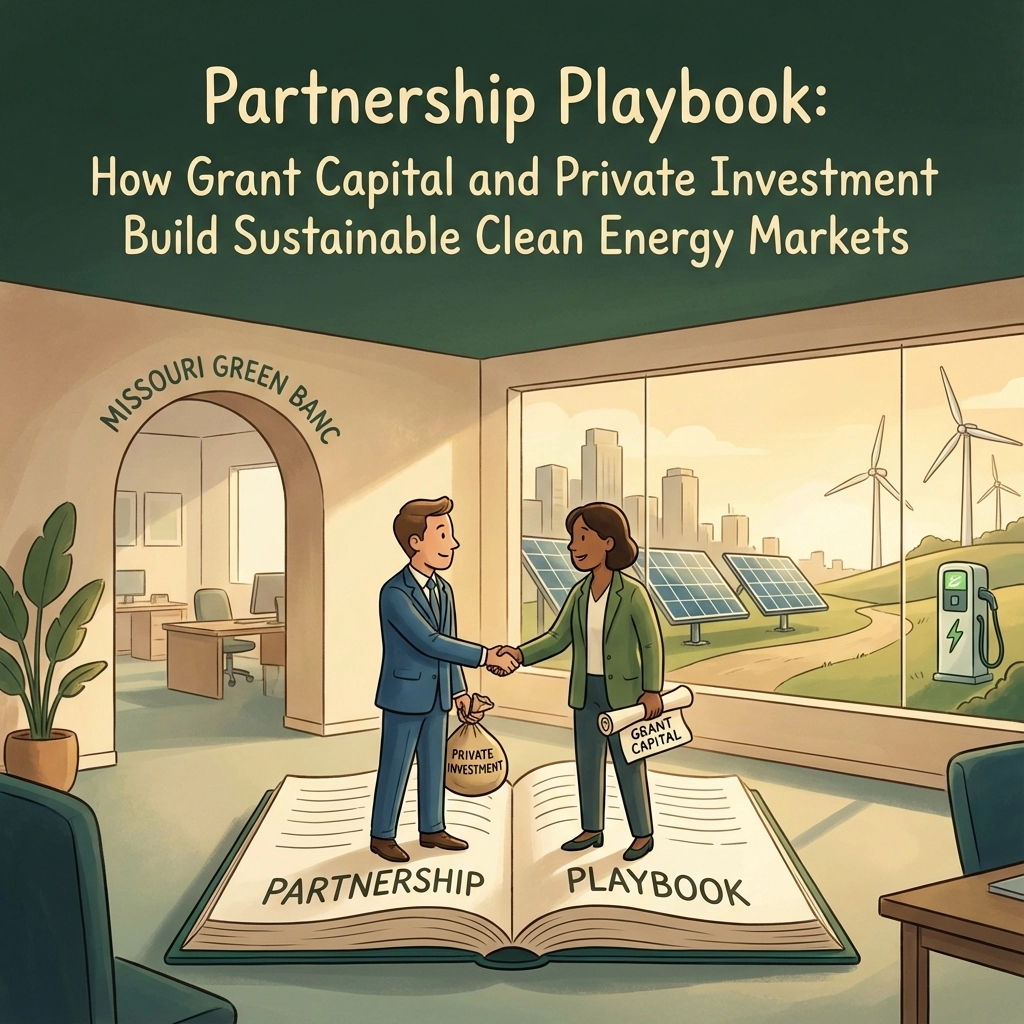
The clean energy financing landscape has evolved dramatically, with successful projects increasingly relying on sophisticated partnerships between grant capital and private investment. This strategic approach creates sustainable markets that function independently of ongoing subsidies while delivering measurable environmental and economic benefits. For municipal leaders, investors, and clean energy developers, understanding how to structure these partnerships represents the difference between isolated projects and scalable market transformation.
Missouri Green Banc has pioneered this approach within the state's clean energy sector, demonstrating how strategic grant utilization can attract substantial private capital while building permanent financing infrastructure. The organization's experience provides a practical framework for replicating these successes across diverse markets and project types.
The Foundation: Understanding Grant Capital's Role in Market Development
Grant capital serves as the catalyst that de-risks clean energy investments for private sector participants. Unlike traditional subsidy models that create ongoing dependence, strategic grant deployment creates self-sustaining market infrastructure designed to attract and retain private investment indefinitely.
The leverage effect proves substantial. Industry leaders consistently demonstrate that every dollar of strategically deployed grant capital mobilizes between nine and fourteen dollars in private sector investment. This multiplier effect transforms limited public resources into significantly larger investment vehicles capable of scaling clean energy deployment across entire regions.
Missouri Green Banc's approach exemplifies this principle through the Missouri Clean Energy District's PACE program, which has grown to include over 300 municipal members. By utilizing grant capital to establish program infrastructure and reduce initial transaction costs, the organization created a platform that now attracts substantial private investment for commercial energy efficiency projects and renewable installations.

Sourcing Grant Capital: Strategic Identification and Application
Successful grant capital sourcing requires systematic identification of funding opportunities that align with broader market development objectives. Federal programs increasingly prioritize initiatives that demonstrate clear pathways to private sector engagement and long-term sustainability.
The Greenhouse Gas Reduction Fund represents the most significant recent opportunity, with $27 billion allocated across three complementary programs designed to mobilize private capital. These programs specifically seek partnerships that can demonstrate multiplicative effects, making organizations with established track records in public-private collaboration particularly competitive.
State and regional opportunities often provide more accessible entry points for developing proof of concept. Missouri Green Banc's experience demonstrates how smaller-scale grant awards can establish credibility and operational frameworks that position organizations for larger federal opportunities. The key lies in structuring initial grants to create measurable outcomes that validate the partnership model for subsequent funders.
Effective grant applications emphasize three critical elements: demonstrated ability to attract private capital, clear metrics for measuring multiplicative effects, and sustainable institutional structures that will continue operating beyond the grant period. Applications that position grant funding as seed capital for permanent market infrastructure consistently outperform those seeking direct project subsidies.
Structuring Public-Private Partnerships for Sustainable Impact
The architecture of successful partnerships requires careful balance between public benefit objectives and private sector return expectations. Effective structures address risk allocation, governance mechanisms, and performance measurement while maintaining flexibility for diverse investment opportunities.
Missouri Green Banc's PACE program structure illustrates these principles in practice. The program utilizes grant capital to establish municipal assessment frameworks and provide credit enhancements that reduce private lender risk. Private capital providers finance the actual projects, benefiting from reduced risk profiles and standardized documentation while maintaining competitive returns.

Key structural elements include:
Risk Mitigation Mechanisms: Grant capital often functions most effectively when deployed to address specific risks that prevent private investment. This might include providing loss reserves, standardizing documentation, or establishing performance guarantees that allow private lenders to participate with confidence.
Governance Frameworks: Successful partnerships establish clear decision-making processes that respect both public accountability requirements and private sector efficiency needs. Missouri Clean Energy District's municipal membership model demonstrates how broad stakeholder participation can enhance legitimacy while maintaining operational effectiveness.
Performance Metrics: Partnerships must define success metrics that satisfy both public policy objectives and private sector return requirements. Effective frameworks measure both financial performance and environmental impacts, creating alignment between diverse stakeholder priorities.
Blending Capital Structures for Maximum Leverage
The most successful clean energy partnerships layer multiple capital sources to create financing packages that work for diverse project types and market conditions. This blended approach allows partnerships to address different project phases and risk profiles while maintaining overall portfolio performance.
Missouri Green Banc's experience demonstrates how CPACE financing can integrate with conventional commercial lending to create comprehensive capital solutions. The organization's approach combines grant-funded credit enhancements with private debt financing and, when appropriate, additional grant resources for specific project components.
Effective blending strategies typically include:
Subordinated Capital: Grant resources often function most effectively when structured as subordinated financing that improves senior debt terms for private lenders. This approach maximizes leverage while providing meaningful risk reduction.
Credit Enhancement: Grant capital can fund loan loss reserves, interest rate subsidies, or guarantee mechanisms that enable private lenders to offer more competitive terms. Missouri Green Banc's use of this approach through the Missouri PACE program has enabled community banks to participate confidently in clean energy lending.
Technical Assistance Funding: Partnerships often benefit from grant-funded technical assistance that helps borrowers develop bankable projects while building market capacity. This investment in market infrastructure pays dividends through increased deal flow and improved project quality.

Implementation Framework: From Concept to Operating Partnership
Successful partnership development follows a systematic progression that builds credibility and capacity while establishing sustainable operational structures. Missouri Green Banc's evolution from startup organization to established market leader provides a roadmap for replication.
Phase One: Proof of Concept: Initial grant funding should focus on demonstrating partnership viability through pilot projects that showcase the model's effectiveness. Missouri Green Banc's early PACE transactions established credibility with both municipal partners and private lenders while refining operational procedures.
Phase Two: Infrastructure Development: Subsequent grant funding builds permanent infrastructure that can support larger transaction volumes. This includes developing standardized documentation, establishing credit enhancement mechanisms, and creating operational systems that reduce transaction costs.
Phase Three: Market Expansion: With proven models and established infrastructure, partnerships can pursue larger grant opportunities that enable geographic expansion and product diversification. Missouri Green Banc's growth to over 300 municipal members illustrates this progression's potential.
Measuring Success: Metrics That Matter to All Stakeholders
Effective partnerships establish comprehensive measurement frameworks that demonstrate value creation for all participants. Financial metrics satisfy private sector requirements while environmental and social impact measures address public policy objectives.
Key performance indicators typically include:
Leverage Ratios: Measuring private capital mobilized per grant dollar deployed provides clear evidence of partnership effectiveness. Missouri Green Banc consistently demonstrates strong leverage ratios through its blended financing approach.
Market Development: Tracking the growth in participating lenders, municipalities, and project developers indicates market maturation and sustainability. The Missouri Clean Energy District's expansion to over 300 members demonstrates significant market development success.
Environmental Impact: Quantifying energy savings, emissions reductions, and renewable capacity additions validates environmental objectives while providing data for future grant applications.

Scaling Strategies: Building Beyond Initial Success
Sustainable partnerships develop expansion strategies that build on initial success while maintaining operational excellence. This requires balancing growth ambitions with capacity constraints while preserving the qualities that made initial partnerships successful.
Missouri Green Banc's approach emphasizes organic growth through demonstrated value creation rather than rapid expansion that might compromise service quality. The organization's focus on building strong relationships with municipal partners and private lenders creates a foundation for sustainable expansion throughout Missouri and potentially to other states.
Effective scaling strategies address geographic expansion, product diversification, and capital capacity growth simultaneously. This comprehensive approach ensures that partnerships can meet increasing market demand while maintaining the risk management practices that attract private capital.
Future Opportunities: Emerging Trends and Market Evolution
The clean energy financing landscape continues evolving, creating new opportunities for innovative partnerships. Federal policy developments, changing private sector priorities, and advancing technologies all influence partnership structures and market opportunities.
Missouri Green Banc's position within these trends reflects broader industry developments. The organization's emphasis on Property Assessed Clean Energy and building decarbonization aligns with federal priorities while addressing private sector demand for standardized, scalable investment opportunities.
Successful partnerships maintain flexibility to adapt to changing conditions while preserving core operational strengths. This balance enables organizations to capitalize on emerging opportunities while maintaining the credibility and performance that attracts ongoing private sector participation.
The partnership model pioneered by organizations like Missouri Green Banc demonstrates how strategic grant deployment can create permanent market infrastructure that operates effectively with minimal ongoing subsidy. For municipal leaders, investors, and clean energy developers, understanding and implementing these frameworks represents the pathway to sustainable market transformation that serves both environmental objectives and economic development goals.
