
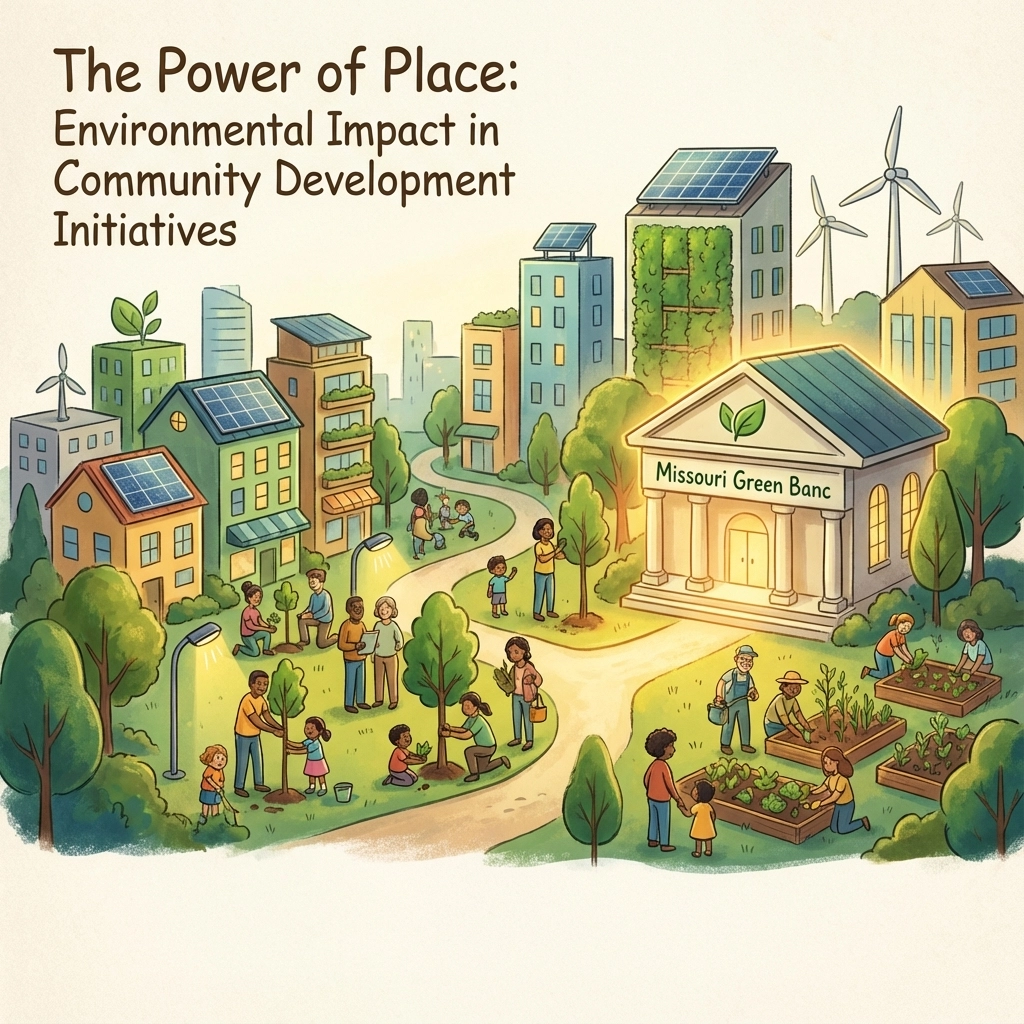
Community development and environmental sustainability converge most powerfully when initiatives recognize the unique characteristics of place. From urban corridors in St. Louis and Kansas City to rural townships across Missouri, place-based approaches to clean energy financing and environmental improvement deliver measurable outcomes that traditional top-down programs often miss. This convergence represents a fundamental shift in how banks, bank compliance officers, and community leaders approach their shared responsibility for economic development and environmental stewardship.
Understanding Place-Based Environmental Impact
Place-based environmental initiatives succeed because they address the specific needs, assets, and challenges of individual communities. Rather than applying one-size-fits-all solutions, these approaches recognize that a manufacturing district in St. Louis requires different clean energy strategies than a rural farming community in central Missouri. This recognition enables more targeted interventions, stronger community buy-in, and ultimately more sustainable environmental outcomes.
The Missouri Clean Energy District's PACE program exemplifies this principle. As the first and largest PACE program in Missouri with over 300 municipal members, it provides Property Assessed Clean Energy Missouri financing that adapts to local economic conditions and building stock characteristics. A downtown Kansas City office building pursuing energy efficiency upgrades faces different financing constraints than a rural hospital investing in renewable energy systems, yet both can access CPACE financing Missouri solutions tailored to their circumstances.

Research demonstrates that community-led environmental projects achieve superior outcomes across multiple metrics. Local ownership increases project completion rates, ensures long-term maintenance, and creates pathways for knowledge transfer within communities. When residents participate directly in developing and implementing environmental solutions, projects achieve both stronger technical results and broader social acceptance.
The CRA Connection: Banks as Environmental Stewards
The Community Reinvestment Act creates both opportunity and obligation for banks to support environmental initiatives that strengthen local communities. Forward-thinking compliance officers increasingly recognize that environmental improvement projects: particularly those focused on energy efficiency and renewable energy: deliver measurable community benefits that align directly with CRA objectives.
Energy efficiency financing Missouri programs reduce utility costs for low- and moderate-income households, improve indoor air quality in disadvantaged neighborhoods, and create local employment opportunities in growing green industries. When banks partner with organizations like Missouri Green Banc to provide commercial PACE loans Missouri, they simultaneously meet CRA requirements while supporting environmental progress that benefits entire communities.
Bank compliance officers find particular value in PACE financing because it addresses multiple CRA assessment factors simultaneously. PACE projects typically serve small businesses and community facilities in LMI areas, create construction jobs for local workers, and reduce ongoing operational costs for property owners. This multiplier effect enables banks to demonstrate substantial community impact through relatively focused lending activities.
Success Stories: Environmental Impact Through Partnership
Missouri communities provide compelling examples of place-based environmental initiatives that deliver both ecological and economic benefits. In Kansas City, partnerships between local banks, Missouri Green Banc, and community development organizations have enabled comprehensive building decarbonization Missouri projects that reduce energy costs while improving indoor environmental quality for residents and workers.

Urban agriculture initiatives demonstrate another powerful intersection of place and environmental impact. Community gardens and urban farming projects provide fresh food access in food desert areas while creating green spaces that manage stormwater runoff and improve local air quality. When these projects receive energy improvement loans Missouri for infrastructure like solar-powered irrigation systems or energy-efficient processing facilities, they multiply their environmental benefits while strengthening their economic sustainability.
Rural communities across Missouri showcase different but equally compelling approaches. Small towns leverage renewable energy funding Missouri to develop community solar projects that reduce electricity costs for municipal facilities while providing revenue streams through net metering. These projects succeed because they respond to specific local conditions: abundant solar resources, aging municipal infrastructure, and tight municipal budgets: while creating models that other similar communities can adapt.
Strategies for Maximizing Environmental Impact
Successful place-based environmental initiatives share several key characteristics that banks and community leaders can replicate across Missouri. First, they begin with comprehensive community assessment that identifies both environmental challenges and existing assets. This assessment process engages residents as partners rather than beneficiaries, ensuring that proposed solutions address actual priorities rather than assumed needs.
Second, effective initiatives layer multiple funding sources and partnership relationships to achieve comprehensive impact. Green building financing Missouri projects often combine PACE financing with federal tax credits, utility rebates, and foundation grants to maximize affordability while minimizing risk for all participants. This financing structure enables more ambitious projects while distributing risk across multiple stakeholders.
Third, successful initiatives include workforce development components that create pathways for local residents to participate in the growing clean energy economy. When PACE energy upgrades Missouri include training opportunities for local contractors and apprentices, they strengthen community capacity while ensuring that economic benefits remain local.

Future Trends: Scaling Environmental Impact
Emerging trends in community environmental initiatives point toward even greater potential for place-based impact. Climate resilience planning increasingly integrates environmental improvement with disaster preparedness, creating opportunities for banks to support projects that simultaneously reduce greenhouse gas emissions and strengthen community resilience against extreme weather events.
Public-private partnerships clean energy models continue evolving to enable more sophisticated financing structures. Missouri Green Banc's innovative approach to cycling donations into clean energy loans demonstrates how mission-driven organizations can bridge gaps between traditional banking products and community environmental needs. This model enables banks to participate in environmental financing without compromising their underwriting standards or regulatory compliance.
Technology integration offers additional opportunities for enhancing environmental impact measurement and community engagement. Digital platforms enable real-time tracking of energy savings, emissions reductions, and economic benefits, providing transparency that strengthens community support and enables continuous improvement.
Missouri Green Banc: Leadership in Place-Based Solutions
Missouri Green Banc has emerged as a national leader in developing financing models that recognize the power of place while addressing the practical constraints facing banks and communities. The organization's not-for-profit structure enables it to serve as an intermediary between banks seeking CRA-qualifying investments and communities requiring affordable clean energy financing.
The organization's FastPACE application process exemplifies place-based responsiveness by streamlining Commercial energy efficiency loans applications while maintaining rigorous underwriting standards. This approach recognizes that small businesses and community organizations often lack the resources to navigate complex financing processes, yet represent some of the most promising opportunities for environmental impact.

Missouri Green Banc's partnership network demonstrates how place-based approaches can achieve scale without sacrificing local responsiveness. By working with banks across Missouri's diverse regions: from urban centers to rural communities: the organization adapts its Missouri PACE program to local market conditions while maintaining consistent quality and impact standards.
Practical Steps for Banks and Community Leaders
Banks seeking to enhance their environmental impact through place-based initiatives should begin by conducting comprehensive community needs assessments that identify both environmental challenges and economic development priorities. This assessment process should engage multiple stakeholders: including community development organizations, local government officials, and resident leaders: to ensure that proposed initiatives address actual rather than assumed needs.
Compliance officers can maximize CRA benefits by developing relationships with organizations like Missouri Green Banc that specialize in bridging conventional banking products with community environmental needs. These partnerships enable banks to support ambitious environmental projects while maintaining prudent risk management and regulatory compliance.
Community leaders can strengthen their environmental initiatives by developing financing strategies that combine multiple sources and partnership relationships. Rather than relying on single funding sources, successful projects layer PACE financing with other incentives to maximize affordability and impact.
Click here to access MGB's Free CRA Practical Implantation Guide: "Positioning Community Banks as Leaders in Clean Energy Lending."
Looking Forward: Missouri's Environmental Leadership
Missouri's experience with place-based environmental initiatives positions the state to lead national conversations about community development and environmental sustainability. The Missouri Clean Energy District's success with PACE financing demonstrates how state-level policy innovation can enable local environmental action while supporting economic development objectives.

As federal climate policy continues evolving, Missouri's place-based approach to environmental initiatives provides a model for other states seeking to balance environmental progress with economic development. The state's emphasis on public-private partnerships and community-driven solutions offers pathways for achieving environmental goals while strengthening rather than constraining local economies.
Banks and community leaders across Missouri have unprecedented opportunities to lead environmental progress that strengthens communities while meeting financial and regulatory objectives. By recognizing the power of place and investing in initiatives that respond to local conditions and priorities, Missouri can demonstrate how environmental sustainability and community development create mutually reinforcing benefits that extend far beyond individual projects or programs.
The future of environmental impact lies not in choosing between economic development and environmental protection, but in recognizing how place-based approaches enable both objectives simultaneously. Missouri's leadership in this integration positions the state: and its communities: for continued success in building resilient, inclusive, and environmentally healthy neighborhoods that serve as models for the nation.
Click here for more information about MGB's perspective on "The Power of Place."
