
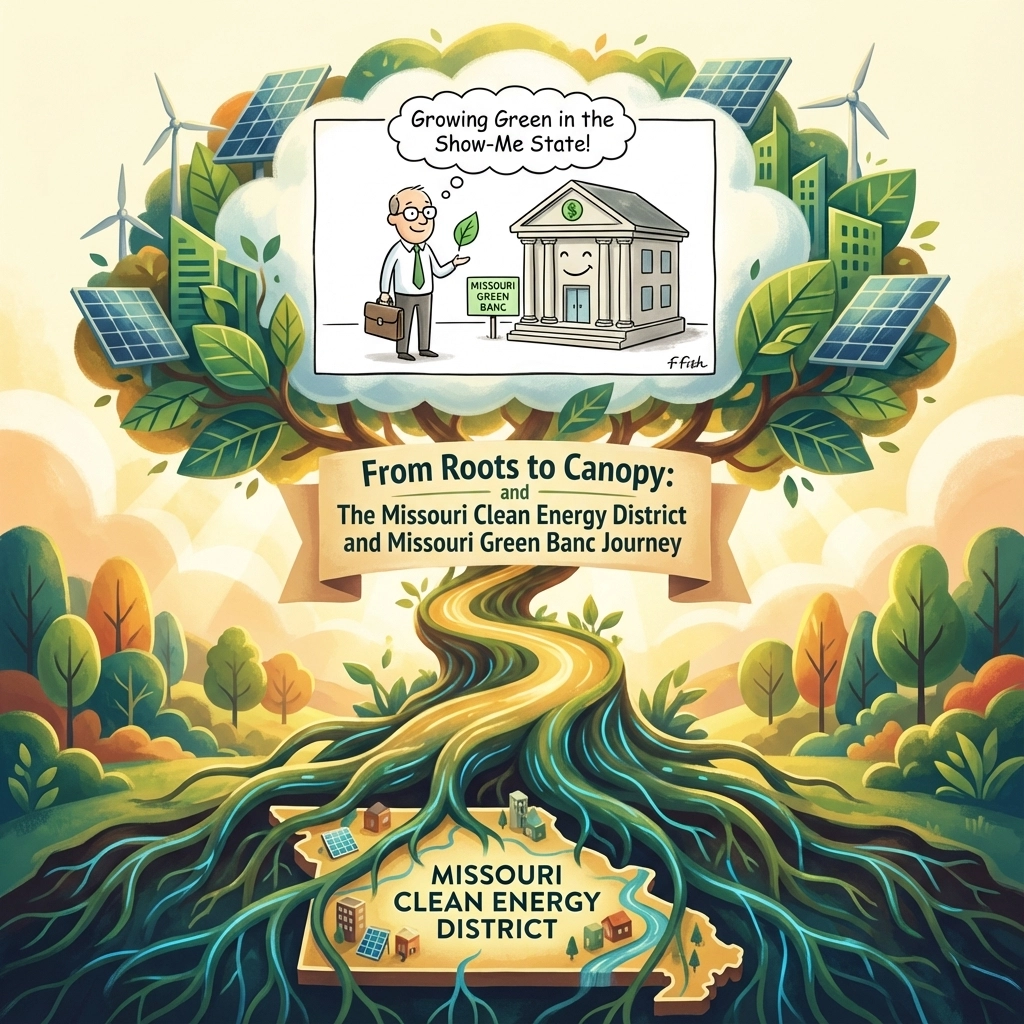
"Who knew in January 2011 what the district would become?" These words from the chairman of Missouri Clean Energy District capture the remarkable transformation of what began as a pioneering clean energy initiative into Missouri's most comprehensive sustainable financing ecosystem.
From humble beginnings as a response to inadequate traditional financing for energy improvements, the Missouri Clean Energy District (MCED) and its financial arm, Missouri Green Banc (MGB), have grown into a formidable force reshaping how communities across the Show-Me State approach building decarbonization and energy efficiency.
The Seeds of Change: MCED's Foundation in 2011

The story begins in 2010 when Missouri's legislature passed the groundbreaking Missouri PACE Act, creating the legal framework for Property Assessed Clean Energy financing. By January 2011, the Missouri Clean Energy District emerged as the state's first and most ambitious response to this new opportunity.
MCED was established as a statewide political subdivision with a clear mission: motivate and educate Missouri residents and businesses about energy management while providing access to innovative financing solutions. Rather than operating as fragmented municipal authorities, the District adopted a visionary intergovernmental compact approach that would prove crucial to its success.
This strategic decision recognized a fundamental truth: private capital providers required substantial transaction volumes to offer competitive CPACE financing Missouri rates to end users. By pooling multiple communities together under one umbrella, MCED could attract private capital and deliver more favorable financing terms than individual municipalities could achieve alone.
The early vision was bold yet practical: create a unified platform that could serve communities of all sizes across Missouri, from bustling urban centers to rural townships, ensuring that Missouri PACE program benefits reached every corner of the state.
Growth Through Partnership: Building Missouri's Largest PACE Network
What started as an innovative concept quickly gained momentum. MCED's intergovernmental compact model attracted municipal members at an unprecedented rate. Today, the District boasts over 300 municipal members, making it not just Missouri's first PACE program, but also its largest and most comprehensive.
This growth wasn't accidental: it reflected MCED's commitment to removing barriers and simplifying the complex world of Property Assessed Clean Energy financing. The District understood that for clean energy financing to truly transform Missouri's building stock, it needed to be accessible, reliable, and scalable.
The expansion strategy focused on education and demonstration. MCED worked tirelessly to show communities how PACE loans could drive local economic development while advancing environmental goals. Municipal leaders witnessed firsthand how PACE financing could unlock private investment in their communities without requiring public funds or adding to municipal debt.
Missouri Green Banc: The Financial Engine

As MCED's network expanded and transaction volumes grew, the need for a dedicated financial institution became clear. Missouri Green Banc emerged as the specialized financial arm, designed to serve as Missouri's premier clean energy finance institution.
Missouri Green Banc operates on a not-for-profit model, cycling donations and returns into additional energy efficiency financing opportunities. This mission-driven approach ensures that profits stay in Missouri, supporting more projects and creating a sustainable ecosystem for building decarbonization.
The relationship between MCED and Missouri Green Banc exemplifies effective public-private partnership design. MCED provides the regulatory framework, municipal relationships, and policy expertise, while Missouri Green Banc delivers sophisticated financial products, underwriting capabilities, and capital markets access.
Together, they've created a comprehensive platform serving diverse market segments:
- Large commercial properties through traditional renewable energy funding Missouri products
- Small businesses through innovative programs like FastPACE
- Rural communities through specialized USDA Intermediary Relending Program partnerships
- Community development projects through grant-leveraged financing structures
Measurable Impact: Numbers That Tell the Story

The economic and environmental impact of this partnership extends far beyond simple transaction statistics. Since 2011, MCED and Missouri Green Banc have arranged funding commitments exceeding $2 billion, but the true measure of success lies in the broader economic and environmental transformation.
Economic Impact:
- Thousands of construction and installation jobs supported across Missouri
- Millions of dollars in local contractor payments keeping economic benefits within communities
- Reduced operating costs for businesses and property owners, freeing capital for other investments
- Increased property values through green building financing improvements
- Enhanced local tax bases without requiring municipal investment
Environmental Benefits:
- Significant reduction in greenhouse gas emissions across Missouri's building stock
- Millions of kilowatt-hours of energy savings annually
- Water conservation through efficient building systems
- Improved indoor air quality in schools, offices, and residential buildings
- Advanced building performance standards setting new benchmarks for the state
The ripple effects extend beyond immediate project impacts. Missouri's best PACE program has catalyzed a broader clean energy ecosystem, attracting additional private investment, supporting local clean energy businesses, and positioning Missouri as a national leader in innovative energy finance.
Innovation in Action: Program Evolution

The journey from 2011 to 2026 has been marked by continuous innovation and adaptation. MCED and Missouri Green Banc haven't just grown larger: they've grown smarter, developing specialized programs to address market gaps and community needs.
Recent innovations include:
FastPACE Program: Streamlined financing for smaller commercial projects, making CPACE loan application processes accessible to main street businesses previously underserved by traditional PACE programs.
Community Development Integration: Partnerships with foundations and community development organizations to leverage grant capital alongside private investment, maximizing impact in underserved communities.
Rural Focus Initiatives: Recognition that sustainable building financing needs vary significantly between urban and rural areas, leading to specialized programs serving agricultural communities and small towns.
Technology Integration: Advanced platforms for project management, energy monitoring, and performance verification, ensuring that energy retrofit financing delivers promised results.
Looking Ahead: The Next Chapter
As Missouri Green Banc and MCED enter 2026, the foundation built over fifteen years positions both organizations for even greater impact. The next phase focuses on three strategic priorities:
Expanding Inclusion and Access
Future initiatives will prioritize reaching underserved communities and smaller property owners who have historically faced barriers to clean energy incentives. This includes developing micro-financing products, expanding contractor networks in rural areas, and creating pathways for residential participation in PACE programs.
Deepening Community Partnerships
The proven success of public-private partnerships will expand through new collaborations with community banks, credit unions, and local development organizations. These partnerships will ensure that community clean energy projects reflect local priorities and create lasting economic benefits.
Innovation in Financial Products
Missouri Green Banc is developing next-generation financing tools including performance-based contracts, resilience-focused improvements, and integrated financing for electric vehicle infrastructure alongside building improvements.
A Model for the Nation

The Missouri model: combining robust enabling legislation, comprehensive municipal participation, and mission-driven financial institutions: has attracted national attention. Other states study Missouri's approach as they develop their own low-interest PACE loan programs.
This recognition validates the original vision: that thoughtful public-private partnerships can create sustainable financing mechanisms that serve communities while advancing environmental goals. The model demonstrates how patient capital and community focus can achieve scale while maintaining local accountability.
The Canopy Spreads
From those uncertain first days in January 2011, Missouri Clean Energy District and Missouri Green Banc have grown into an expansive canopy providing shade and support for communities across Missouri. The chairman's reflection: "Who knew in January 2011 what the district would become?": captures both humility about the journey and pride in the destination.
Yet this canopy continues growing. Each new project, each community partnership, and each innovation extends the reach of Missouri's clean energy financing ecosystem. The roots planted in 2011 have grown deep, the trunk has strengthened through years of challenges and successes, and the branches now stretch across all 114 Missouri counties.
The story of MCED and Missouri Green Banc illustrates what becomes possible when vision meets persistence, when public purpose aligns with private capability, and when communities choose collaboration over competition. As Missouri faces the challenges and opportunities of the next decade, this partnership provides both the foundation and the framework for continued leadership in energy improvement investment initiatives.
For communities, businesses, and residents across the Show-Me State, the journey from roots to canopy represents more than organizational growth: it represents expanding opportunity for every Missourian to participate in and benefit from the clean energy future.
Learn more about Missouri Green Banc's programs and how your community can participate at missourigreenbanc.org.