
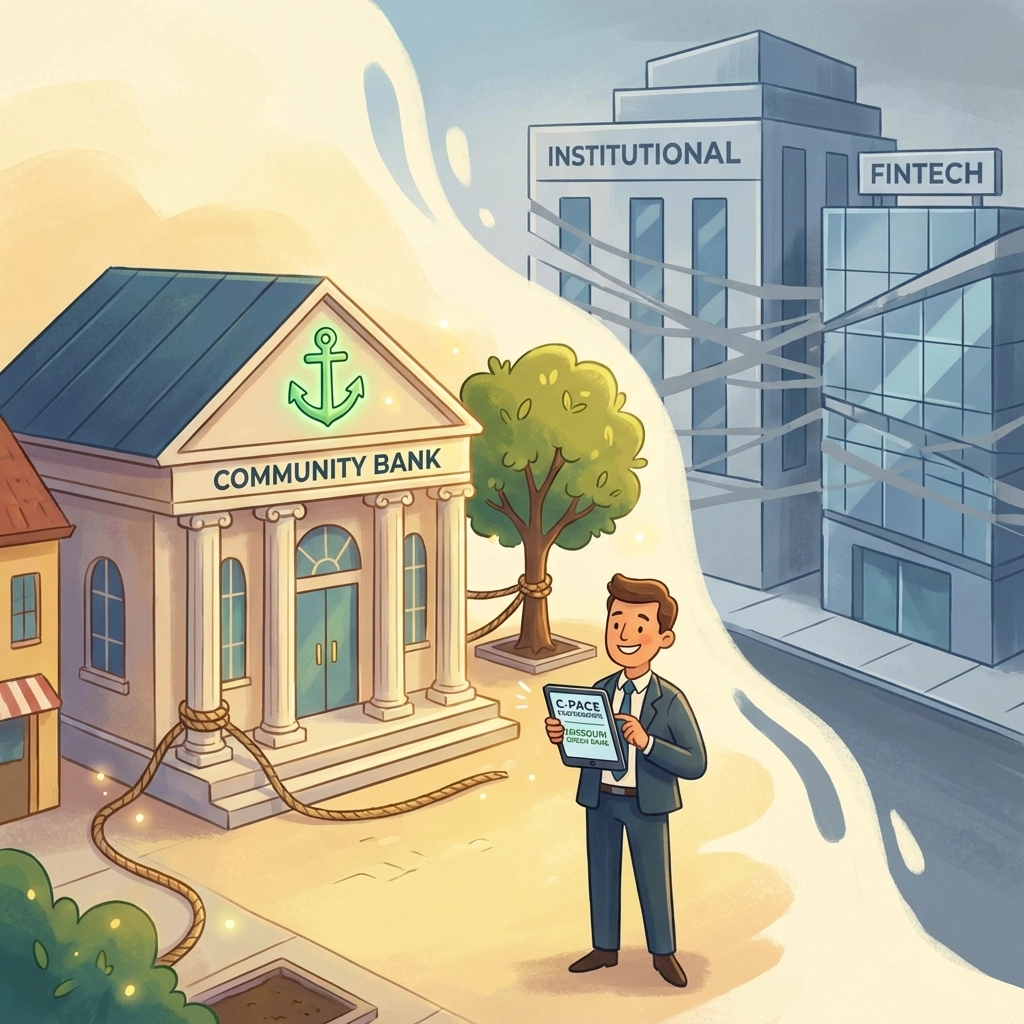
Community banks across Missouri face an unprecedented challenge. While they maintain strong local relationships and deep knowledge of their markets, they're increasingly losing high-quality commercial borrowers to institutional lenders and fintech platforms. This shift isn't temporary: it represents a fundamental change in how commercial capital flows.
The solution isn't to abandon what community banks do best. Instead, it's about adapting their capital strategies to compete effectively in today's market. Commercial Property Assessed Clean Energy (C-PACE) financing, coordinated through Missouri Green Banc and enabled by the Missouri Clean Energy District, offers community banks a strategic pathway to re-enter transactions that institutional capital increasingly dominates.
The Strategic Problem Facing Community Banks
Community banks are experiencing structural erosion of relevance in their own trade areas. The problem extends far beyond typical competitive pressures. Institutional lenders, private credit funds, and fintech platforms systematically capture high-quality commercial borrowers: often without maintaining deposits, building long-term relationships, or committing to local reinvestment.
This transformation is driven by several powerful forces. Scale economics favor standardized underwriting processes that larger institutions can deploy more efficiently. Long-duration capital vehicles, particularly those operated by insurance companies and pension funds, are naturally better matched to commercial real estate financing needs. Technology platforms increasingly bypass relationship banking entirely, connecting borrowers directly with capital sources.

The result creates a painful paradox for community banks: they retain deposits and relationships but lose participation in the capital stack for the very projects shaping their local economies. This dynamic undermines their fundamental value proposition as community financial partners.
Why Traditional Advantages Are No Longer Enough
Local knowledge and borrower relationships remain necessary advantages for community banks, but they're no longer sufficient. Community banks face increasing constraints that limit their competitive effectiveness.
Asset-liability mismatch concerns make long-dated fixed-rate loans problematic for institutions funded primarily through deposits. Regulatory caution around nontraditional structures creates additional hurdles. Perhaps most significantly, community banks often lack internal capacity to underwrite capital improvements whose value is realized through operating savings rather than rent increases alone.
Meanwhile, institutional capital operates with different constraints. These lenders are comfortable deploying 20- to 30-year assets secured at the property level. Without access to similar structures, community banks find themselves structurally disadvantaged in competing for substantial commercial projects.
What C-PACE Changes for Community Banks
Commercial Property Assessed Clean Energy financing fundamentally alters the competitive landscape for community banks. Missouri's PACE program, administered through the Missouri Clean Energy District and coordinated by Missouri Green Banc, is statutorily authorized financing that allows commercial property owners to fund long-life building improvements through voluntary property tax assessments.
The Missouri Clean Energy District has established the first and largest PACE program in Missouri, with over 300 municipal members representing approximately 96% of the state's commercial building stock. This extensive coverage creates significant opportunities for community bank participation.
C-PACE offers several strategic implications that directly address community banks' competitive challenges. The financing typically extends 20-30 years and is secured by the improved property itself, not solely by borrower cash flow. This structure provides long-duration, property-secured capital that matches institutional lending capabilities.

Critically, C-PACE capital stays local. The assessment runs with the land, anchoring investment in the community and reducing the likelihood of refinancing out to national lenders. This mechanism helps community banks maintain their local focus while accessing competitive financing structures.
Rather than diluting credit quality, C-PACE often enhances it. Improvements funded through Missouri's PACE program: including HVAC systems, building envelope upgrades, lighting improvements, and on-site renewable energy generation: lower operating costs, improve net operating income, and extend asset life. These changes strengthen overall collateral quality for community bank loans.
Why Missouri Green Banc Matters as a Market Intermediary
Missouri Green Banc functions as a market intermediary, not a competing lender. This distinction is crucial for community banks considering C-PACE participation. Rather than creating additional competition, Missouri Green Banc enables community bank participation in transactions they might otherwise lose to institutional lenders.
For community banks, Missouri Green Banc provides essential infrastructure services. The organization standardizes C-PACE underwriting, documentation, and processes, reducing the operational burden on individual banks. It coordinates with clean energy districts and contractors, managing complex multi-party transactions. Most importantly, Missouri Green Banc structures transactions to align with bank risk tolerances and regulatory requirements.
This intermediary role allows banks to access institutional-grade transactions without building internal C-PACE platforms. Community banks can participate in Missouri's PACE program through established processes rather than developing proprietary capabilities that may not reach sufficient scale.
Regulatory and Balance Sheet Considerations
From a safety-and-soundness perspective, C-PACE financing through Missouri Green Banc offers several advantages for community banks. PACE assessments are authorized by state statute and must be disclosed to all parties. Repayment occurs through established property tax mechanisms, providing predictable collection processes.
Bank exposure can be sized through participations rather than direct origination, allowing institutions to control their risk levels. Transactions are generally structured to avoid technology performance risk at the bank level, focusing instead on proven building improvement technologies.

Banks that engage early with examiners and frame C-PACE as a collateral and duration strategy: not an energy product: report smoother supervisory dialogue. The key is positioning Missouri's PACE program as a tool for accessing competitive financing structures rather than as a mission-driven initiative.
C-PACE financing frequently aligns with Community Reinvestment Act and community development objectives, though community banks should view this as an additional benefit rather than the primary justification for participation.
National Replicability of Missouri's Model
Missouri's approach demonstrates a replicable framework that other states are studying. The state's success stems from several coordinated elements: clear enabling legislation, local assessment authority through the Missouri Clean Energy District, an independent market intermediary in Missouri Green Banc, bank-friendly participation structures, and a focus on credit quality rather than policy advocacy.
States that lack one or more of these elements typically struggle to scale C-PACE programs effectively. Missouri's coherent approach, coordinating state legislation with local implementation and private market intermediation, creates its competitive advantage in clean energy financing.
Explicit Recommendations for Different Stakeholders
Community banks should treat C-PACE as a capital stack tool rather than a niche product. The most effective approach is beginning with participation-based exposure through Missouri Green Banc rather than attempting direct origination. Banks should educate credit committees using statutory mechanics and collateral analysis rather than focusing primarily on energy benefits.
Bank leadership should view C-PACE as a response to competitive encroachment rather than a sustainability initiative. Using pilot transactions to build internal comfort before scaling allows institutions to develop expertise gradually while managing risk.
For policymakers and bank advisors, preserving statutory clarity and lien mechanics remains essential for continued program success. Encouraging regulated bank participation as a local-capital strategy helps achieve broader economic development objectives while strengthening community financial institutions.
Strategic Adaptation, Not Mission Drift
Community banks are not losing relevance because they lack relationships or local knowledge. They are losing relevance because capital structures have evolved faster than balance-sheet strategies. Traditional advantages remain important but require new tools to remain competitive.
C-PACE financing executed through Missouri Green Banc offers a conservative, regulator-credible way for community banks to re-enter transactions increasingly dominated by institutional capital. This approach leverages existing strengths while addressing structural disadvantages in long-duration commercial lending.
This strategy represents strategic adaptation rather than mission drift. Community banks that embrace Missouri's PACE program through partnership with Missouri Green Banc position themselves to compete effectively while maintaining their essential role as community financial partners.
The Missouri Clean Energy District and Missouri Green Banc have created infrastructure that enables community bank participation in growing clean energy markets while preserving local capital relationships. For community banks willing to adapt their capital strategies, this partnership offers a practical pathway to renewed competitive relevance in commercial lending markets.