
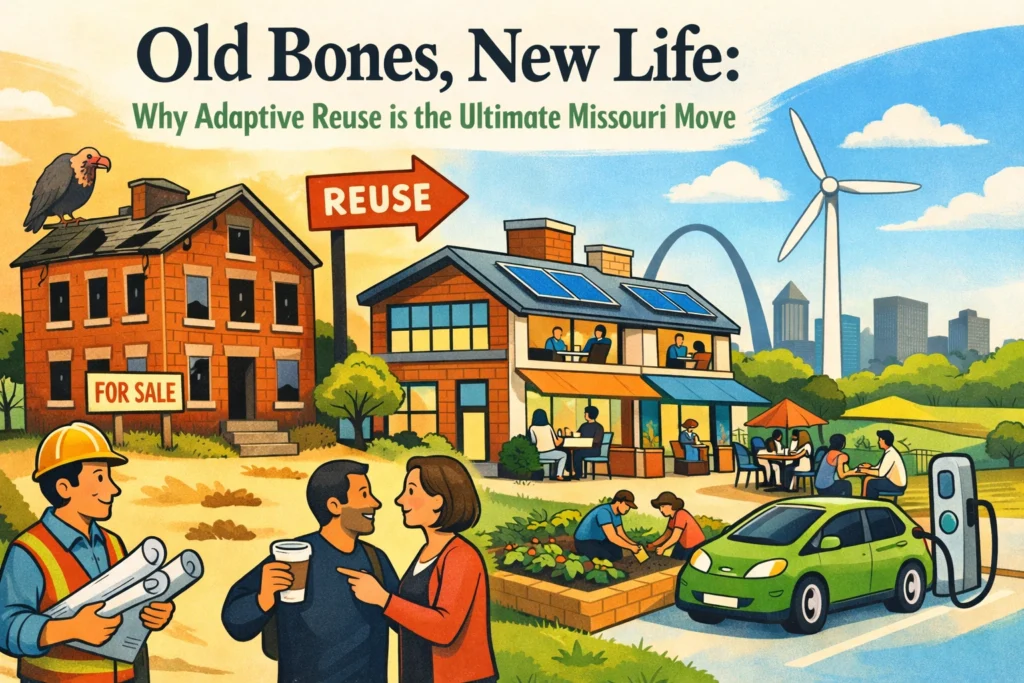
Missouri communities face a common challenge: vacant storefronts, underutilized warehouses, empty office towers. These aren't eyesores: they're opportunities. Adaptive reuse transforms existing structures into productive assets, preserving what's valuable while creating spaces that meet today's needs. It's pragmatic, financially sound, and quintessentially Missouri: making the most of what we've already built.

The Economics of Working with What You've Got
Demolishing and rebuilding from scratch carries predictable costs: unpredictable site conditions, supply chain delays, labor shortages, and escalating material prices. Adaptive reuse sidesteps many of these variables. The bones already exist: solid masonry, load-bearing walls, foundations that have proven their durability over decades. The financial unknowns shrink considerably.
From a capital deployment perspective, adaptive reuse projects often deliver faster returns. Existing buildings occupy established locations with infrastructure already in place: utilities, road access, transit connections. The timeframe from concept to occupancy compresses when renovation replaces ground-up construction. For property owners managing portfolios, this matters. Time is money, and adaptive reuse accelerates cash flow.
The materials themselves represent embedded value. Historic bricks, timber beams, industrial steel: these elements cost substantially more to replicate today than they did during original construction. Preserving them captures both aesthetic character and material worth. Buildings constructed before modern cost-cutting measures often feature craftsmanship and durability that new construction struggles to match at comparable budgets.
The Financing Gap: And How C-PACE Closes It
Despite clear economic advantages, adaptive reuse projects frequently stall at the financing stage. Traditional lenders can view renovations as riskier than new construction. Older buildings raise concerns about code compliance, asbestos remediation, structural unknowns. Conventional loans may impose higher interest rates or require substantial equity contributions that make projects financially marginal.
Commercial Property Assessed Clean Energy (CPACE) financing addresses these barriers directly. C-PACE provides long-term, fixed-rate capital for energy efficiency and renewable energy improvements tied to the property itself, not the owner. Repayment occurs through property tax assessments, aligning payment obligations with the building's useful life rather than arbitrary loan terms.

For adaptive reuse projects, C-PACE financing offers strategic advantages. Energy system upgrades: new HVAC, insulation, windows, lighting, solar arrays: represent substantial renovation costs. C-PACE covers 100% of these eligible improvements with no money down. The financing attaches to the property, transferring to subsequent owners if the building sells. This structure eliminates the split incentive problem: building owners invest in improvements while tenants benefit from reduced utility costs.
Missouri Clean Energy District operates the state's most established PACE program, with over 300 participating municipalities. This network provides property owners across Missouri with consistent access to commercial PACE loans Missouri that facilitate major building upgrades without depleting operating capital or equity reserves.
Missouri Projects Proving the Model
St. Louis demonstrates adaptive reuse at scale. City Foundry STL transformed a 15-acre former industrial complex into a mixed-use destination featuring retail, entertainment venues, residential units, and public gathering spaces. The project retained the site's industrial character while creating contemporary amenities that attract residents and visitors. The economic impact extends beyond the property lines: surrounding neighborhoods experience increased foot traffic, business activity, and property values.
Historic warehouses throughout Missouri's urban centers follow similar trajectories. A former printing factory in St. Louis converted to 164 loft-style apartments preserved the original brick head house, repurposing it as community conference space. Rooftop water tanks became outdoor seating areas. The conversion maintained architectural integrity while creating housing stock responsive to market demand.
Kansas City's Jazz Hill and Vine Street districts illustrate how adaptive reuse revitalizes entire neighborhoods. Individual building transformations accumulate into district-wide economic momentum. Property owners observe successful conversions and pursue their own projects. Retail follows residential. Services follow retail. The cycle compounds.
Smaller Missouri communities replicate this pattern at appropriate scales. Rural towns convert closed schools into community centers or affordable housing. Mid-size cities transform obsolete retail into office space or medical facilities. The principle remains constant: existing structures provide frameworks for new economic activity.
Infrastructure Modernization: The Core Challenge
Adaptive reuse succeeds or fails on infrastructure quality. Older buildings require substantial mechanical, electrical, and plumbing upgrades to meet contemporary standards and occupant expectations. HVAC systems designed for different uses: industrial heating versus residential comfort: need replacement. Electrical panels lack capacity for modern loads. Plumbing suffers from decades of deferred maintenance.
These improvements represent the largest capital requirements in adaptive reuse projects. Energy efficiency financing Missouri through C-PACE specifically targets these systems. Eligible improvements include:
- High-efficiency heating and cooling equipment
- Building envelope upgrades (insulation, air sealing, windows)
- LED lighting systems with controls
- Water conservation fixtures and systems
- On-site renewable energy generation
- Electric vehicle charging infrastructure
Property Assessed Clean Energy Missouri programs structure financing to match improvement lifespans. A new HVAC system with a 20-year service life receives 20-year financing. Monthly assessment amounts align with projected energy savings, creating cash-flow neutral or positive scenarios where utility cost reductions offset financing payments.
Missouri Green Banc partners with Missouri Clean Energy District to expand C-PACE availability statewide. This collaboration provides technical assistance, project underwriting, and capital access for property owners pursuing building decarbonization Missouri initiatives. The partnership reduces transaction costs and streamlines processes that traditionally discourage smaller adaptive reuse projects.
Asset Value Protection Through Strategic Investment
Real estate investors understand a fundamental principle: properties deteriorate without continuous investment. Deferred maintenance compounds. Building systems age past serviceable lifespans. Occupancy rates decline as spaces fail to meet market expectations. Property values erode.
Adaptive reuse represents proactive asset management. Strategic capital deployment arrests deterioration and repositions buildings for current markets. Energy system upgrades reduce operating costs, improving net operating income. Modern mechanical systems decrease vacancy rates: prospective tenants prioritize comfort, reliability, and manageable utility expenses.

From a portfolio perspective, adaptive reuse with energy efficiency upgrades protects against obsolescence risk. Buildings with updated infrastructure maintain competitiveness as energy codes tighten and tenant expectations evolve. Properties financed through Missouri PACE program structures benefit from long-term fixed rates that hedge against interest rate volatility affecting refinancing scenarios.
The assessment-based repayment mechanism provides additional asset protection. C-PACE assessments hold senior lien positions in most jurisdictions, signaling lender confidence in project viability. This structure facilitates additional conventional financing by reducing overall project risk profiles.
Community Revitalization Beyond Property Lines
Adaptive reuse generates economic multiplier effects extending throughout surrounding areas. Construction employment increases during renovation phases. Completed projects attract businesses and residents who patronize nearby establishments. Property tax revenues grow as assessed values rise. Municipal services improve as fiscal capacity expands.
These impacts prove particularly significant in communities facing economic transitions. Former manufacturing centers transform industrial buildings into innovation spaces attracting technology companies and entrepreneurs. Retail districts adapt obsolete big-box stores into community facilities serving changing demographics. Downtown cores convert vacant office buildings into residential units supporting street-level retail.
Community clean energy projects often emerge from adaptive reuse initiatives. Solar arrays on renovated warehouse roofs. Geothermal systems serving repurposed industrial campuses. These installations demonstrate clean energy integration at scales visible to residents and business owners, building familiarity and acceptance.
Public-private partnerships clean energy financing enables municipalities to participate in revitalization without assuming full financial burden. Missouri Clean Energy District's structure allows local governments to establish C-PACE programs without creating new agencies or dedicating staff resources. Property owners access capital. Buildings improve. Communities benefit. Tax bases strengthen.
The Path Forward: Scalable Solutions for Missouri Buildings
Missouri possesses substantial building stock suitable for adaptive reuse. Industrial heritage left warehouses, factories, and commercial structures throughout urban and rural areas. Changing retail patterns created vacant big-box stores and shopping centers. Office building vacancy rates increase as work patterns evolve. Each represents potential rather than liability.
Scaling adaptive reuse requires addressing financing barriers systematically. Renewable energy funding and sustainable building financing through C-PACE program provides capital specifically designed for building improvement projects. Low-interest PACE loans reduce carrying costs, improving project economics for marginal renovations that conventional financing renders infeasible.
Technical assistance proves equally critical. Property owners need guidance navigating energy audits, contractor selection, and program applications. Missouri Green Banc provides these services, reducing transaction friction that discourages participation. Streamlined processes convert interest into action.
The model works because it aligns incentives. Property owners access affordable capital for necessary improvements. Lenders receive secure, long-term investments. Communities gain revitalized buildings and strengthened tax bases. Tenants enjoy improved spaces with lower operating costs. Missouri retains architectural heritage while creating economic opportunity.
Taking the Next Step
Adaptive reuse represents practical problem-solving: matching existing resources with current needs. Missouri's building stock contains significant embedded value waiting for strategic investment. C-PACE financing provides the capital structure making these projects financially viable.
Property owners considering adaptive reuse projects can explore financing options through Missouri Green Banc's programs. The Missouri Clean Energy District offers resources and technical assistance for municipalities interested in expanding clean energy financing options to their property owners.
Working with what we've got: that's Missouri grit applied to infrastructure challenges. Old buildings don't need demolition. They need vision, capital, and practical financing structures that make renovation financially sensible. The tools exist. The opportunities await.
