
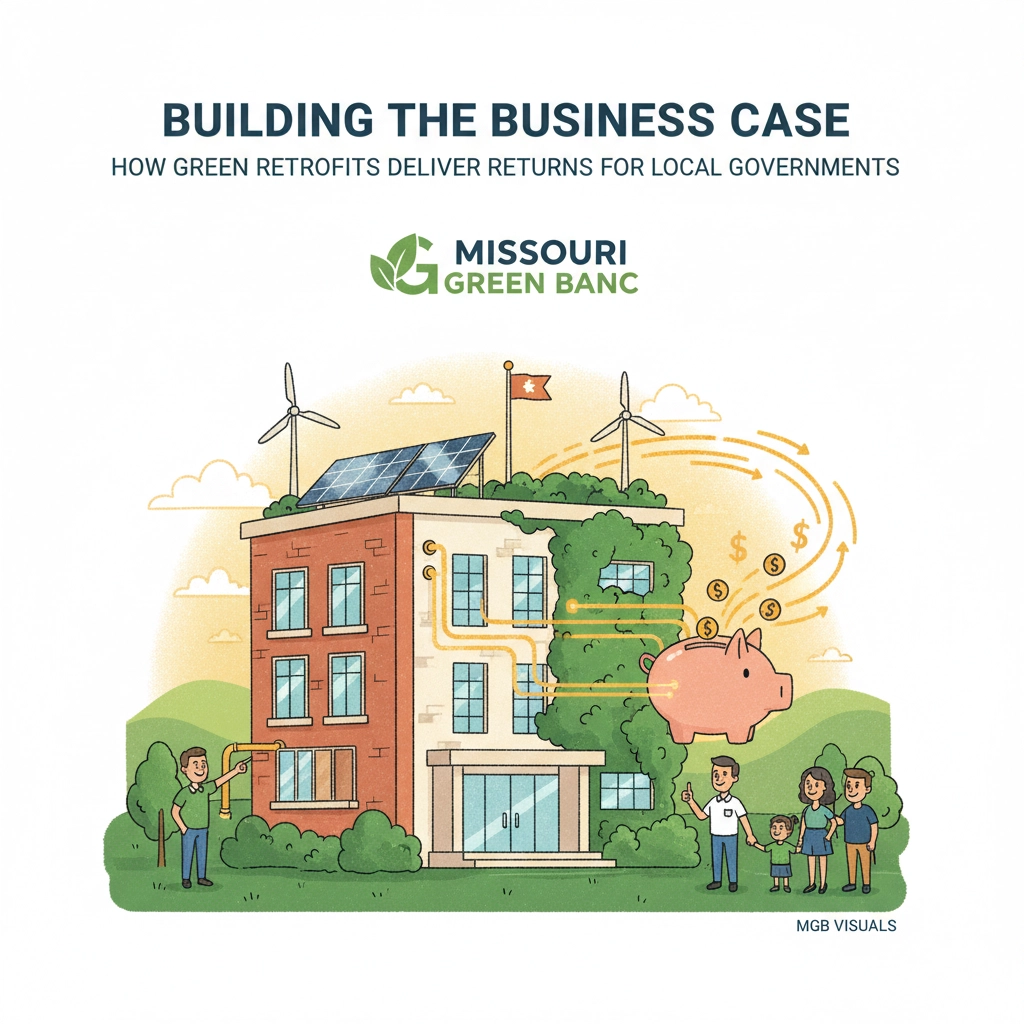
Missouri local governments face familiar pressures: escalating energy costs, aging buildings, constrained budgets, and evolving performance standards. Yet most of a community’s energy use and carbon footprint sits outside city hall—in small businesses, schools, houses of worship, nonprofits, multifamily housing, and commercial and industrial facilities. Focusing only on municipal buildings, as important as that is, leaves the majority of savings, jobs, and emissions reductions untapped.
Municipalities play a unique role as market organizers. By setting clear policies, coordinating outreach, and enabling inclusive financing, local governments can unlock upgrades across the community’s built environment. The returns include lower utility burdens, stronger local businesses, higher property values, improved resilience, and a more competitive place to live and work.
Why Promote Efficiency Across All Buildings
Municipal leadership across the entire building stock produces outsized value because:
- Municipal facilities represent a small share of total square footage; most opportunity lives in private, nonprofit, and commercial properties.
- Community-wide efficiency reduces energy burdens for households, especially in underserved neighborhoods, improving affordability and health.
- Lower operating costs help local employers stay competitive and expand.
- Market signals from policy and programs accelerate private investment and de-risk projects.
- Community emissions goals and air quality targets depend on broad participation, not municipal assets alone.
- Demand-side savings reduce peak load stress, supporting grid reliability and resilience.
The Numbers at Scale: Savings and Growth Across the Community
Buildings that undergo comprehensive upgrades commonly achieve 20–30 percent energy savings, depending on baseline conditions and measure mix. At community scale, that translates into:
- Persistent bill savings that recirculate in the local economy rather than leaving as utility expenditures.
- Investment and job creation in design, construction, and skilled trades, with multipliers across local suppliers.
- Higher-performing properties that command rental and valuation premiums, strengthening the tax base over time.
- Reduced exposure to energy price volatility, improving budget predictability for residents, businesses, and public agencies.

Federal and state incentives, along with utility rebates, can offset a significant share of project costs. When paired with inclusive financing, communities can mobilize upgrades without requiring large upfront capital outlays from property owners.
Community Benefits That Compound
Community-wide energy efficiency delivers measurable benefits:
- Economic development: project spending, local procurement, and workforce opportunities accelerate business activity.
- Small business support: lower operating costs free up cash for hiring, inventory, and expansion.
- Multi-family household affordability: lower utility bills reduce energy burden, particularly for low- and moderate-income families.
- Property value and neighborhood stability: upgraded buildings attract investment and improve market confidence.
- Environmental gains: reduced emissions and improved air quality support public health.
- Competitiveness: energy-smart communities attract families, talent, and employers seeking predictable costs and quality infrastructure.

Policies, Outreach, and Incentives: Linking Resilience to Long-Term Economic Health
A balanced program design aligns sustainability with economic outcomes:
- Clear policy signals: adopt enabling ordinances, voluntary benchmarking, stretch codes for new construction or major renovations, and expedited permitting for high-performance projects.
- Inclusive financing access: enable Property Assessed Clean Energy (PACE) through the Missouri Clean Energy District (MCED) to finance eligible improvements on commercial, industrial, nonprofit, multifamily, and public properties via property assessments repaid over time.
- Incentive stacking: help owners combine federal and state incentives with utility rebates to lower net costs.
- Targeted outreach: prioritize underserved neighborhoods and small businesses with tailored technical assistance and contractor support.
- Workforce and vendor readiness: collaborate with training providers to grow local, certified installer pools.
- Resilience integration: pair efficiency with load management, weatherization, and backup power strategies to reduce outage impacts and keep critical services operating.

Why MCED Membership Adds Strategic Value
Membership in the Missouri Clean Energy District expands a community’s toolkit:
- Access to the first and largest PACE program in Missouri, with over 300 municipal members and established administrative capacity.
- Inclusive, assessment-based financing for eligible public and private projects that does not require general obligation debt.
- Technical expertise for program design, contractor onboarding, and project underwriting.
- Support for leveraging grants and national opportunities, including alignment with federal programs that prioritize equitable decarbonization and Solar for All-style initiatives.
- A peer network of Missouri cities and counties that share practices, data, and vendor resources, accelerating learning and scale.
Missouri Green Banc, a 501(c)(3) nonprofit and affiliate of MCED, provides technical assistance and financing solutions that center underserved communities and help public and private partners structure viable, high-impact projects.
How to Join MCED and Activate a Community Program
City and county leaders can establish PACE and broader efficiency support with a clear, repeatable process:
- Review MCED materials and model documents to understand program scope and eligible improvements.
- Adopt an ordinance or resolution to join MCED and enable PACE within local jurisdiction.
- Execute the intergovernmental agreement with MCED; designate a local point of contact for coordination.
- Align local priorities (e.g., small business retrofits, multifamily housing, critical facilities) and set any supplemental local guidelines.
- Coordinate with Missouri Green Banc to structure inclusive financing pathways, stack incentives, and establish technical assistance for property owners.
- Launch outreach: engage chambers, neighborhood associations, trade allies, and community-based organizations; onboard local contractors.
- Track outcomes: monitor participation, energy savings, jobs, and investment; refine program elements based on data and peer feedback.

Practical Next Steps for Missouri Leaders
- Start with data: encourage or offer energy assessments to identify high-return measures across municipal, commercial, nonprofit, and multifamily buildings.
- Build partnerships: coordinate with utilities, workforce programs, lenders, and contractors to align incentives and delivery capacity.
- Leverage financing: use MCED’s PACE program to remove upfront cost barriers and synchronize repayments with realized savings.
- Communicate value: share case studies and results to build market confidence and spur broader participation.
Missouri communities that promote efficiency across all buildings strengthen fiscal stability, lower energy burdens, and enhance resilience while advancing environmental goals. Municipal participation in MCED connects local leaders to a statewide, intergovernmental network supporting energy-smart growth.
For technical partnership, program design support, and financing solutions that prioritize inclusive access, municipal leaders can learn more at Missouri Green Banc: https://missourigreenbanc.org. Teaming up with MCED and Missouri Green Banc helps translate sustainability goals into durable economic value and broad, lasting community impact.