
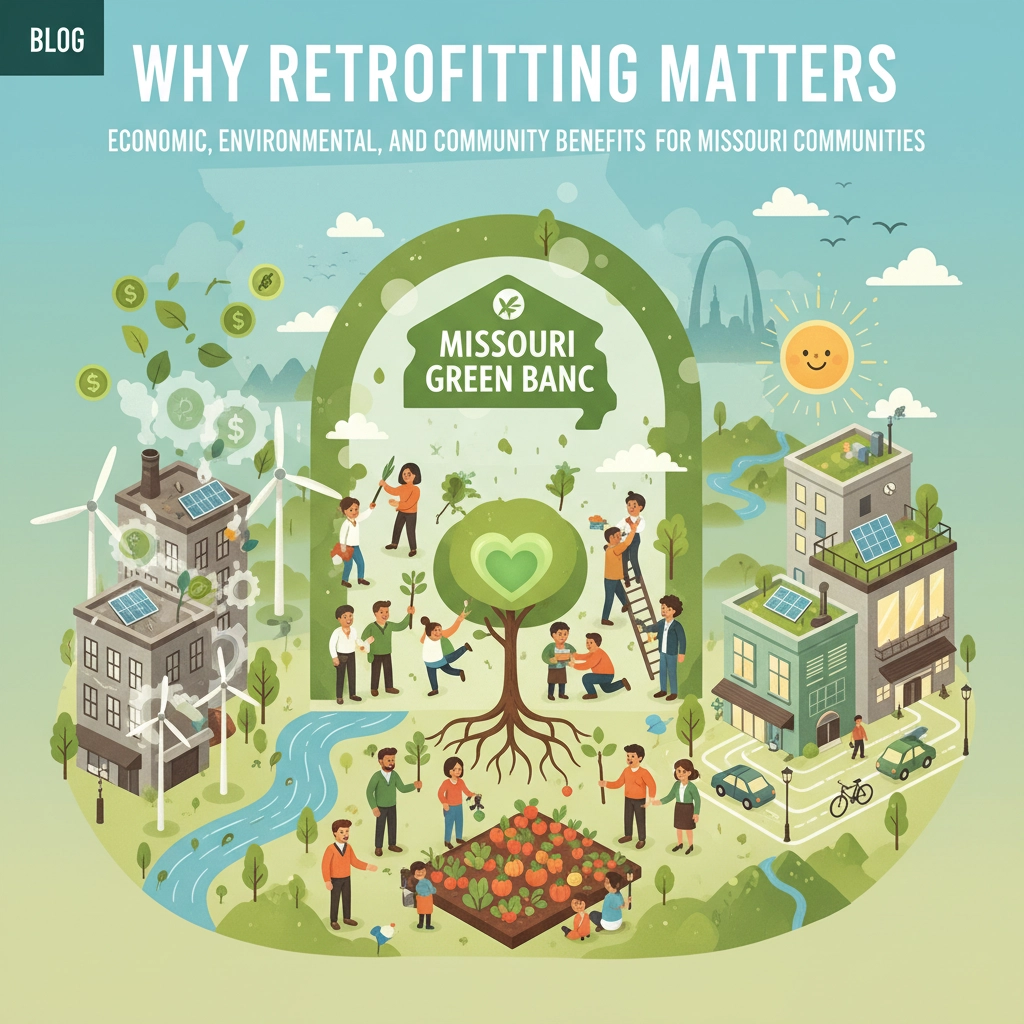
For Missouri's civic leaders, the challenge is clear: aging buildings across our cities and counties are draining budgets through high utility costs while failing to meet modern efficiency standards. Whether it's the city hall built in the 1970s, the county courthouse from the 1950s, or the numerous office buildings that house local businesses, these structures represent both a burden and an opportunity.
Retrofitting: the process of upgrading existing buildings with energy-efficient systems, improved insulation, modern heating and cooling equipment, and other performance enhancements: offers a practical path forward. Rather than the massive expense of demolition and new construction, retrofitting allows communities to transform underperforming buildings into assets that save money, reduce environmental impact, and strengthen local economies.
The Economic Case: Jobs, Savings, and Revenue
The numbers speak for themselves. Analysis of Missouri's Property Assessed Clean Energy (PACE) program demonstrates that every $4 million in retrofitting spending generates $10 million in gross economic output, $1 million in combined federal, state, and local tax revenue, and 60 jobs. More specifically, each $1 million in project expenditures creates between 13 to 15 jobs: work that cannot be outsourced because it requires on-site installation and local expertise.

Consider the statewide potential: if each Missouri municipality produced just five retrofitting applications annually, averaging $20,000 per project, the economic impact would translate into $75 million in gross economic output and over 1,000 jobs across the state. These aren't temporary positions: they represent sustained work for local contractors, electricians, HVAC specialists, and building professionals.
The savings extend far beyond job creation. By 2025, Missouri consumers can save a cumulative $6.1 billion in lower energy bills through energy efficiency measures. For local governments struggling with tight budgets, this represents real relief. A typical office building retrofit can reduce energy costs by 20-35%, freeing up funds for other community priorities like infrastructure, public safety, or parks and recreation.
Missouri communities have multiple financing tools at their disposal. The Missouri Saves program offers incentives up to $2,000 for retrofits achieving 20% or greater energy reductions, with higher incentives of up to $4,000 for projects reaching 35% savings. Low-to-moderate income properties can access double rebates. Additionally, federal tax credits cover up to 30% of qualified expenses, with an annual maximum of $3,200.
For property owners in earthquake-prone areas: which includes much of Missouri: retrofitting delivers another financial advantage: reduced insurance premiums over time. Modernized buildings with improved structural integrity and updated systems present lower risk profiles to insurers.
Environmental Impact: Leading Missouri's Climate Response
Missouri's environmental challenges require practical solutions, and retrofitting delivers measurable results. Renovating an existing building reduces embodied carbon emissions by 50-75% compared to demolition and rebuilding. This significant reduction avoids the massive carbon footprint associated with demolition waste and the manufacturing and transportation of new construction materials.

The operational benefits compound over time. Buildings constructed to meet the 2021 International Energy Conservation Code achieve substantial energy savings through improved efficiency standards. Statewide adoption of the latest model energy codes is projected to reduce greenhouse gas emissions by 20,391,969 metric tons over 30 years: equivalent to removing hundreds of thousands of vehicles from Missouri roads.
Retrofitting initiatives address multiple environmental priorities simultaneously: heating and cooling system upgrades reduce energy consumption, LED lighting conversions cut electrical demand, water-saving fixtures decrease municipal water treatment loads, and stormwater management improvements help communities meet regulatory requirements while reducing flood risk.
For Missouri communities working toward sustainability goals: whether formal climate action plans or informal commitments to environmental stewardship: retrofitting provides a clear pathway to measurable progress. Unlike some environmental initiatives that require significant behavior change or new infrastructure, building retrofits deliver immediate, quantifiable results.
Community Benefits: Preservation Through Progress
Retrofitting offers something many redevelopment approaches cannot: community preservation alongside improvement. Rather than displacing residents and businesses through demolition, retrofitting enables neighborhoods to maintain their character while gaining modern functionality and efficiency.

This approach proves particularly valuable in Missouri's smaller cities and rural counties, where historic buildings anchor downtown districts and provide community identity. Retrofitting allows these structures to meet contemporary needs while preserving architectural heritage and maintaining the social fabric that makes communities unique.
The economic activity generated by retrofitting projects extends beyond construction jobs. Revitalized areas attract street vendors, small businesses, and increased foot traffic, creating sustained economic vitality. Projects that combine infrastructure improvements with community programming: workshops, educational events, recreational activities: foster social cohesion and environmental awareness while building resident ownership and engagement.
Retrofitting also offers regulatory advantages. Retaining portions of existing structures can allow projects to bypass certain zoning, heritage, and planning restrictions that would apply to new construction, shortening approval timelines and reducing bureaucratic obstacles. This flexibility enables communities to pursue development that responds to local needs rather than conforming to generic approaches.
Missouri's Retrofitting Infrastructure
Missouri has established comprehensive support systems for retrofitting initiatives. The Missouri Clean Energy District's PACE program allows municipalities and counties to join a special financing district that helps property owners access capital for energy improvements. With over 300 municipal members, it represents the state's largest and most established clean energy financing mechanism.
The program creates economies of scale that benefit all participants. By pooling demand across multiple communities, the Missouri Clean Energy District reduces borrowing costs and administrative burdens while providing standardized processes that work efficiently across different jurisdictions.
Additional support comes through the Energy Efficiency and Conservation Block Grants program, which provides funding to cities and counties not eligible for direct federal assistance. HUD's Green and Resilient Retrofit Program focuses specifically on multifamily housing, addressing both carbon reduction and resident health and safety improvements.
Taking Action: Your Community's Next Steps
The evidence is clear: retrofitting delivers economic, environmental, and community benefits that strengthen Missouri cities and counties across multiple dimensions. The question for local leaders is not whether retrofitting makes sense, but how to implement it effectively within their communities.
Success requires understanding available financing mechanisms, identifying priority buildings and systems, and partnering with experienced professionals who can navigate the technical and regulatory requirements. The Missouri Clean Energy District provides a proven framework, while programs like Missouri Saves offer additional incentive funding to reduce project costs.
For Missouri mayors, county commissioners, and council members looking to advance their communities' economic development, environmental goals, and quality of life, retrofitting represents a practical investment with measurable returns. The infrastructure exists, the financing mechanisms are available, and the local workforce is ready to deliver results.
The communities that act first will gain competitive advantages in attracting businesses, residents, and investment. Those that delay risk falling behind as energy costs continue rising and sustainability becomes increasingly important to economic development.
Missouri Green Banc stands ready to help communities navigate retrofitting opportunities, from initial assessments through financing and implementation. Our expertise in clean energy finance, combined with deep understanding of Missouri's regulatory environment and community needs, ensures that retrofitting projects deliver maximum benefit with minimum risk.
Contact Missouri Green Banc to explore how retrofitting can strengthen your community's economic foundation while advancing environmental and social goals. The time for action is now; and the tools for success are within reach.