
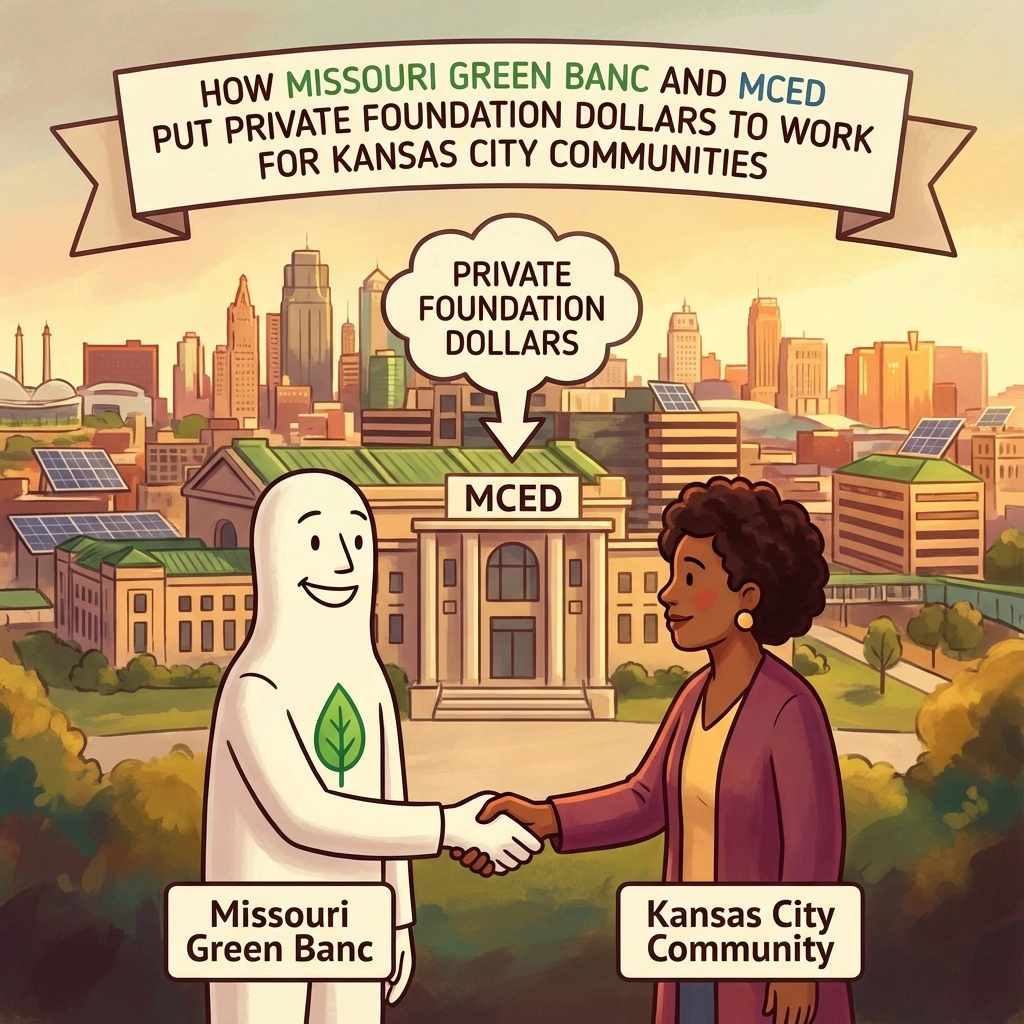
The collaboration between Missouri Green Banc and the Missouri Clean Energy District (MCED) represents a groundbreaking approach to mobilizing private foundation capital for clean energy infrastructure across Missouri's political subdivisions. This partnership has fundamentally expanded the authority of cities, counties, and other local governments to access and leverage foundation resources, creating unprecedented opportunities for communities across the state, including those in the Kansas City metropolitan area, to accelerate building decarbonization and energy resilience initiatives.
Expanding Municipal Authority Through Strategic Partnership
Missouri Clean Energy District operates as the state's first and largest PACE program, serving over 300 municipal members across the state. Through its affiliation with Missouri Green Banc, MCED has created an innovative framework that enables political subdivisions to tap into private foundation funding streams that were previously difficult to access or utilize effectively.

The partnership leverages MCED's established public-private partnership infrastructure, including its collaboration with private foundations and community lenders, to create pathways for foundation capital deployment in Kansas City and surrounding communities. This arrangement allows local governments to bypass traditional funding constraints while maintaining the fiscal discipline and accountability that foundations require.
Property Assessed Clean Energy Missouri programs through MCED provide the legal and administrative framework that makes foundation investments viable for municipal partners. Unlike traditional grant structures that often require complex reporting and limited flexibility, this model allows Kansas City area communities to integrate foundation resources that work with CPACE financing mechanisms for maximum impact.
Kansas City's Strategic Position in Foundation Capital Deployment
Kansas City's participation in MCED positions the metropolitan area as a primary beneficiary of expanded foundation funding authority. The region's diverse commercial building stock, combined with significant underserved communities that face disproportionate energy burdens, makes it an ideal laboratory for foundation-backed clean energy initiatives.
As Missouri's first and best PACE program, MCED enables Kansas City to access foundation capital for energy efficiency financing Missouri projects that address both environmental and social equity objectives. Foundation partners recognize that Kansas City's urban core contains numerous small and mid-scale commercial properties where traditional financing options remain inadequate for comprehensive energy retrofits.
The geographic distribution of MCED member communities throughout the Kansas City metropolitan area creates opportunities for coordinated foundation investment strategies. Suburban municipalities can collaborate with urban core areas to develop regional approaches to building decarbonization that maximize foundation dollars while addressing varying community needs and priorities.
Mobilizing Foundation Resources for Clean Energy Infrastructure
Private foundations increasingly recognize clean energy financing as essential infrastructure for addressing climate change and social equity simultaneously. Missouri Green Banc's role in structuring these investments ensures that foundation capital generates measurable outcomes while supporting long-term market development for renewable energy funding.

Foundation funding through this partnership typically supports credit enhancement mechanisms that make Commercial PACE loans Missouri more accessible to property owners in underserved areas. These enhancements can include loan loss reserves, technical assistance funding, and workforce development programs that build local capacity for energy upgrade implementation.
The structured approach also enables foundations to support energy retrofit financing projects that might not meet traditional commercial lending criteria but deliver significant community benefits. Kansas City area properties serving essential community functions – such as community centers, places of worship, and small business districts – become viable candidates for foundation-backed improvements.
Targeting Underserved Communities for Maximum Impact
Kansas City's demographic and economic diversity makes it particularly well-suited for foundation capital deployment focused on underserved communities. Many of these neighborhoods contain older commercial buildings that consume disproportionate amounts of energy while providing essential services to residents with limited economic resources.
Foundation-backed financing tools through the Missouri Green Banc and MCED partnership enable property owners in these areas to access green building financing without the upfront capital requirements that traditionally exclude them from energy improvement programs. The Property Assessed Clean Energy structure ensures that improvements are tied to properties rather than individual owners, reducing barriers for businesses with limited credit histories or collateral.
Energy efficiency improvements funded through this model deliver direct benefits to community members through reduced energy costs, improved indoor air quality, and enhanced thermal comfort. For Kansas City's underserved areas, these improvements translate into more stable small businesses, healthier community spaces, and increased economic resilience during energy price volatility.
Accelerating Decarbonization Through Integrated Financing
The partnership's approach to foundation capital deployment emphasizes comprehensive building decarbonization rather than piecemeal efficiency improvements. Kansas City properties participating in MCED's PACE program initiatives can access funding for integrated mechanical system upgrades, building envelope improvements, and renewable energy installations as coordinated packages.

Foundation resources specifically support the technical assistance and project development activities that ensure these comprehensive approaches deliver optimal outcomes. Missouri Green Banc coordinates with local contractors and energy service providers to build the implementation capacity necessary for successful project completion.
Clean energy incentives available through federal and state programs can be layered with foundation funding to reduce overall project costs and improve financial returns for property owners. This integrated approach makes ambitious decarbonization projects financially viable for Kansas City commercial properties that would otherwise require decades to justify efficiency investments.
Building Community Resilience Through Energy Infrastructure
Foundation capital deployment through MCED membership extends beyond individual building improvements to support community-wide resilience initiatives. Kansas City's membership participation enables coordinated approaches to energy infrastructure that strengthen the entire metropolitan area's capacity to respond to extreme weather events and energy supply disruptions.
Community clean energy projects funded through this partnership can include distributed energy resources, energy storage systems, and microgrid development that provide backup power during emergencies. These investments particularly benefit underserved communities that often experience disproportionate impacts during power outages and extreme weather events.
The public-private partnership clean energy model ensures that foundation investments complement rather than compete with municipal resources and planning processes. Kansas City can integrate foundation-funded energy improvements with broader infrastructure development, economic development, and community health initiatives for maximum synergistic benefits.
Measuring and Scaling Foundation Impact
Missouri Green Banc's systematic approach to tracking and reporting foundation capital deployment provides the documentation necessary for continued foundation engagement and program expansion. Kansas City area projects generate data on energy savings, emissions reductions, job creation, and community health improvements that demonstrate return on foundation investment.

This evidence base supports replication and scaling of successful models throughout Missouri and beyond. Foundation partners can point to specific Kansas City outcomes when developing similar programs in other metropolitan areas, creating a pathway for broader market transformation.
Low-interest PACE loans Missouri supported by foundation capital create revolving funding mechanisms that extend the impact of initial foundation investments. As property owners repay energy improvement assessments, those funds become available for additional projects, multiplying the leverage effect of foundation dollars over time.
Future Opportunities and Expansion
The successful deployment of foundation capital through Missouri Green Banc and MCED partnership in Kansas City establishes a model for expanded foundation engagement across Missouri's municipal network. Additional foundation partners are evaluating participation based on demonstrated outcomes and the proven infrastructure for effective capital deployment.
Kansas City's experience positions the metropolitan area as a hub for sustainable building financing innovation, attracting additional foundation investment and private sector partnerships. The region's success in integrating foundation resources with PACE financing creates opportunities for larger-scale initiatives that address regional energy and resilience challenges.
Funding energy upgrades through continued foundation partnership expansion could ultimately transform the state's approach to commercial building energy performance, creating a sustainable financing ecosystem that reduces dependence on traditional public funding sources while delivering superior community outcomes.
The Missouri Green Banc and MCED partnership demonstrates how strategic collaboration between mission-driven organizations can unlock previously inaccessible capital sources for community benefit. Kansas City's participation in this model provides a replicable framework for other metropolitan areas seeking to mobilize private foundation resources for clean energy infrastructure development, community resilience, and equitable economic development simultaneously.