
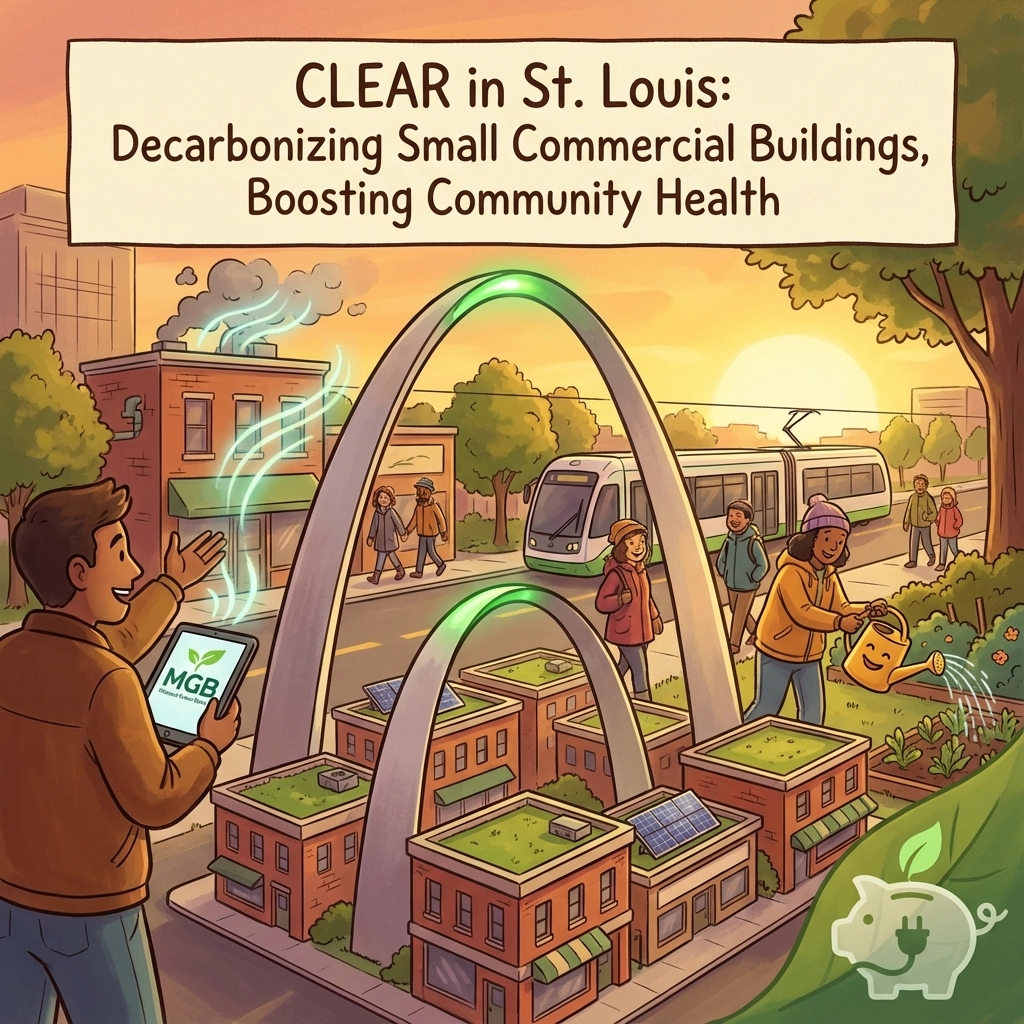
A new evaluation of Missouri Green Banc programs shows how targeted commercial building decarbonization can deliver measurable greenhouse gas reductions alongside substantial community health benefits. Evidence indicates that small and mid-scale commercial retrofits deliver more than energy savings: they strengthen neighborhood resilience, improve air quality, and enhance occupant health in areas where these benefits are most needed.
Understanding Missouri Green Banc’s Program Framework
Missouri Green Banc programs represent a strategic approach to mobilize capital and technical support for energy retrofits in small and mid-scale commercial properties across St. Louis City. Rather than prioritizing only large developments, the focus includes legacy commercial buildings that anchor neighborhood business districts, particularly in underinvested areas.
The methodology emphasizes quantifiable results using standard greenhouse gas accounting methods to measure annual and lifetime emissions reductions. Calculations incorporate modeled site energy savings, baseline fuel mixes, and regional emission factors to provide accurate assessments of climate impact. This rigorous, evidence-based approach supports accountability and demonstrates real progress toward building decarbonization Missouri goals while advancing energy retrofit financing Missouri and green building financing Missouri.

Quantifiable Climate Benefits Drive Program Success
Missouri Green Banc program impact extends beyond projections to documented reductions in site energy use, associated CO₂e emissions, and local air pollutants. The emphasis on measurable outcomes over aspirational targets provides a dependable foundation for policy decisions, program design, and scaling.
When standard greenhouse gas accounting protocols are applied to retrofit portfolios supported by Missouri Green Banc, the resulting emissions reductions align with peer-reviewed literature on building decarbonization. This consistency validates the measurement approach and situates results within established climate action frameworks.
Energy efficiency financing initiatives led by Missouri Green Banc demonstrate how targeted interventions can achieve substantial environmental benefits without massive infrastructure overhauls. Concentrating efforts on buildings with high improvement potential maximizes impact per dollar invested and creates replicable models for other communities seeking renewable energy funding.
Beyond Energy Savings: Comprehensive Co-Benefits
The most compelling findings center on co-benefits that often match or exceed direct energy bill savings in economic value. Health improvements, productivity gains, enhanced resilience, and equity outcomes create a comprehensive value proposition that extends beyond utility cost reductions.
Indoor environmental quality improvements are among the most immediate benefits. Retrofitted buildings consistently demonstrate better thermal comfort and indoor air quality—factors that correlate with improved health outcomes and higher productivity in commercial settings. These outcomes are documented widely in the literature and are especially relevant for small business environments.
Building decarbonization strategies also elevate resilience. MGB-supported retrofits improve passive survivability during extreme weather events and outages, helping buildings maintain habitable conditions when systems fail. This resilience functions as distributed, neighborhood-level infrastructure—particularly valuable in legacy buildings and underinvested neighborhoods in St. Louis City.

Addressing Underinvestment in Legacy Communities
Missouri Green Banc programs target legacy small commercial buildings in neighborhoods where underinvestment and disproportionate health burdens overlap. These properties rarely receive the same attention as newer or larger developments, yet they are critical to community stability and local employment.
Program impacts on air quality are particularly meaningful in these areas. Reductions in local pollutants extend beyond individual buildings to improve neighborhood conditions, addressing environmental justice concerns and broadening access to clean, healthy indoor environments.
Missouri PACE program initiatives recognize that community-level benefits require community-focused approaches. By prioritizing small and mid-scale commercial properties, Missouri Green Banc programs ensure that decarbonization benefits reach the businesses and neighborhoods that form the economic foundation of urban communities—advancing PACE energy upgrades and sustainable building financing.
Social Return on Investment: Core Climate Infrastructure
Comprehensive assessments indicate that the social return on Missouri Green Banc programs exceeds what traditional energy and financial metrics alone capture. When health, productivity, resilience, and equity are included, the value proposition supports treating these financing solutions and technical assistance as core climate infrastructure rather than supplemental support.
This broader understanding has clear policy relevance. Cost-benefit analyses that look only at utility savings consistently undervalue building decarbonization programs that deliver measurable community co-benefits. Property Assessed Clean Energy approaches that integrate these impacts into design and evaluation present a more accurate picture of total social value and help justify continued investment.

The Missouri Green Banc and MCED Connection
The program framework aligns with statewide initiatives led by Missouri Green Banc and the Missouri Clean Energy District (MCED). MCED administers the first and largest Missouri PACE program, with over 300 municipal members across the state. Through MCED, CPACE financing enables commercial property owners to invest in comprehensive efficiency, electrification, and renewable upgrades without upfront capital.
Missouri Green Banc focuses on inclusive Energy efficiency financing, pairing capital solutions with technical support to help small and mid-scale commercial buildings overcome common barriers to implementation. This approach complements MCED’s CPACE structure and expands access to Commercial PACE loans Missouri, low-interest PACE loans, and Commercial energy efficiency loans that fund energy upgrades and finance renewable projects.
Replication Potential and Scalable Impact
The use of standardized greenhouse gas accounting, transparent impact metrics, and attention to underserved market segments creates a replicable template for other Missouri communities. The same framework supports Energy improvement loans, Renewable energy funding, and Clean energy incentives that can scale with confidence.
Programs can leverage these findings to strengthen value propositions and resource allocation. By quantifying health, resilience, and equity outcomes alongside energy and cost metrics, stakeholders gain a robust basis for expansion, CPACE loan application processes, and Apply for PACE financing pathways that advance Community clean energy projects.

Building Stronger Communities Through Clean Energy Infrastructure
Results reinforce that effective climate action requires community-centered approaches that address local needs while achieving broader environmental goals. Success in legacy commercial buildings demonstrates how targeted decarbonization can strengthen neighborhood economic foundations and reduce emissions simultaneously.
Missouri's best PACE program—administered by the Missouri Clean Energy District—builds on this foundation with flexible financing mechanisms that support comprehensive building improvements. These structures recognize that sustainable communities need infrastructure investments that address multiple challenges at once: energy efficiency, health, resilience, and economic vitality.
Public-private partnership clean energy models, supported by Missouri Green Banc and MCED, create durable pathways for community development that align economic incentives with environmental and social benefits.
Moving Forward: Lessons for Missouri Communities
Documented results offer a practical roadmap for Missouri communities seeking to advance building decarbonization strategies. Emphasis on measurable outcomes, comprehensive co-benefits, and community-focused targeting provides actionable guidance for local leaders, property owners, and developers.
Clean energy incentive programs can incorporate this evaluation framework to strengthen impact measurement and stakeholder communication. Capturing benefits beyond energy savings supports broader policy backing and investment.
Coordination between community-led efforts supported by Missouri Green Banc and statewide resources provided by the Missouri Clean Energy District demonstrates how effective clean energy programs scale through aligned finance, technical support, and policy.
As Missouri communities pursue climate goals, targeted interventions in small and mid-scale commercial buildings continue to generate outsized benefits—especially in legacy buildings and underinvested neighborhoods in St. Louis City. The combination of rigorous measurement, comprehensive benefits assessment, and community focus offers a model suitable for replication statewide.
For Missouri communities ready to explore these approaches, resources and support are available through Missouri Green Banc and the Missouri Clean Energy District.