
The Causation Trap
Here's a hard truth that clean energy advocates often don't want to hear: insisting on winning the climate causation argument means losing half the audience before the conversation even starts.
The debate over what causes climate change has become so entrenched, so politically charged, that it functions less as a scientific discussion and more as a tribal loyalty test. And that's a problem, not because the science doesn't matter, but because it's become an unnecessary barrier to progress.
A productive alignment does not require agreement on climate causation. It requires agreement on outcomes that are independently defensible.
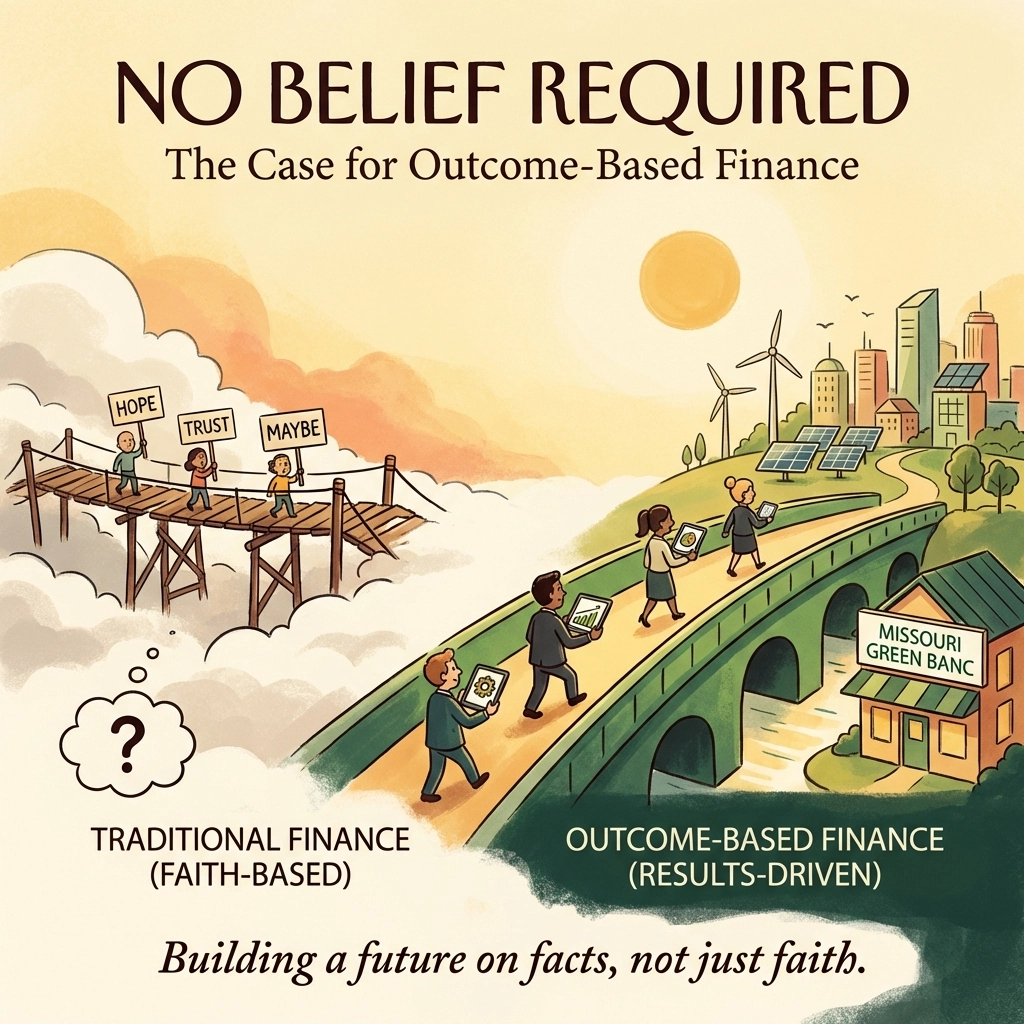
This is the foundation of outcome-based finance: a model that shifts the conversation from disputed theories to measurable, verifiable results. Rather than asking "Do you believe in climate change?" the better question becomes "Do you want lower energy bills, more resilient infrastructure, and local job creation?"
The answer to that second question tends to be universal.

Economic Rationality: Efficiency Pays Regardless of Climate Models
Energy efficiency and diversification are economically rational under any climate model. This isn't a controversial statement, it's basic arithmetic.
Reducing wasted energy lowers operating costs. It strengthens competitiveness. It increases resilience to price volatility. These benefits accrue whether temperatures are rising due to human activity, natural cycles, or not at all. No belief in anthropogenic climate change is required to justify eliminating inefficiency.
Consider a commercial property owner in Missouri evaluating energy efficiency financing. The calculus is straightforward:
- Lower utility bills translate directly to improved net operating income
- Reduced maintenance costs from modern, efficient systems
- Increased property value from upgraded building performance
- Protection against energy price spikes through diversified energy sources
Through the Missouri PACE program, property owners can finance these improvements with payments attached to the property tax bill, meaning the investment stays with the building, not the owner. The Missouri Clean Energy District, with over 300 municipal members, has established the framework that makes this financing accessible across the state.
The economic case stands entirely on its own merits. Belief not required.
Resilience as Governance: Prudent Management, Not Ideology
Power outages happen. Heat waves happen. Cold snaps, floods, and droughts, they've occurred throughout recorded history and will continue regardless of their ultimate causes.
Hardening grids, improving building performance, and decentralizing energy supply reduce exposure to known hazards. One need not attribute these hazards to human causes to acknowledge that societies benefit from being less fragile.
This is resilience as governance, not ideology.
CPACE financing Missouri offers a practical pathway for building owners to make resilience investments without the burden of large upfront capital outlays. Energy retrofit financing Missouri property owners can access through the Missouri Green Banc and Missouri Clean Energy District partnership enables:
- Backup power systems and battery storage
- Enhanced building envelope performance
- HVAC modernization for extreme temperature events
- Water efficiency measures for drought resilience

The brutal feedback here is simple: a building that performs well during a grid emergency doesn't care why the emergency happened. Neither should the financing that made the upgrade possible.
Technological Progress: Better Tools Don't Require Moral Consensus
Societies have historically adopted superior technologies, electricity, sanitation, insulation, automation, without resolving philosophical debates about their ultimate causes or implications.
Clean energy and efficiency can be treated the same way: as better tools, not moral statements.
The shift from incandescent to LED lighting didn't require consensus on environmental ethics. It happened because LEDs are objectively superior: longer-lasting, more efficient, better light quality, lower lifetime cost. The technology won on merit.
Property Assessed Clean Energy Missouri financing operates on this same principle. The question isn't whether an applicant believes the right things about climate science. The question is whether the proposed improvement will deliver measurable, verifiable results:
- Will it reduce energy consumption?
- Will it lower operating costs?
- Will it improve building performance?
- Can those outcomes be independently verified?
If yes, the project qualifies. Belief not required.
This is outcome-based finance in action: payments tied to achieving defined outcomes, results independently verified, and ideological alignment completely irrelevant to the transaction.

Local Co-Benefits: Tangible Wins That Don't Require a Crystal Ball
Long-range climate projections understandably invite skepticism. They involve complex models, uncertain variables, and timescales that exceed human intuition. Reasonable people can disagree about forecasts stretching decades into the future.
But cleaner air isn't a projection. It's measurable today.
Lower energy bills aren't theoretical. They show up on next month's statement.
Domestic job creation isn't an abstraction. It's the HVAC technician, the insulation installer, the solar electrician working in Missouri communities.
Reduced dependence on imported fuels isn't a climate talking point. It's basic energy security.
These local co-benefits dominate global abstractions because they're observable, verifiable, and immediate. Green building financing property owners can access through the PACE program Missouri delivers these tangible wins without requiring anyone to stake a position on contested scientific questions.
The philosophical error driving polarization is the assumption that motivation determines legitimacy. A policy justified by climate risk can also be justified by economic prudence, national security, public health, and basic engineering logic. Multiple justifications can coexist without contradiction.
Outcome-Based Finance: The Mechanism
Outcome-based finance shifts funding from paying for intentions and inputs to rewarding measurable, independently verified results. The structure is straightforward:
- Outcomes are collectively defined upfront : what specific, measurable results will the project deliver?
- Payments are tied to achieving those outcomes : funding flows based on performance, not promises
- Results are independently verified : third-party confirmation removes bias from the equation
This model eliminates assumptions about effectiveness. Traditional financing relies on predictions about what programs will accomplish. Outcome-based finance requires proof of what programs actually delivered.
For commercial PACE loans Missouri property owners, this translates to a financing structure where:
- Project scope is defined by engineering analysis, not ideology
- Energy savings are projected using established methodologies
- Building performance improvements are measurable and verifiable
- Repayment terms align with demonstrated project economics

The risk transfers appropriately. Property owners get access to capital for improvements that pencil out. The financing mechanism rewards projects that perform. Nobody needs to win an argument about climate science to participate.
No-Regret Investments: The Path Forward
If green programs insist on winning the causation argument, they will continue to lose half the audience. The stronger version drops the moralizing, stops litigating climate theory, and positions these measures as no-regret investments in efficiency, resilience, and sovereignty.
Missouri Green Banc operates on this principle. As a mission-driven partner working alongside the Missouri Clean Energy District: the first and largest PACE program in Missouri: the focus remains on outcomes that are independently defensible:
- Energy efficiency financing property owners can access without ideological gatekeeping
- Renewable energy funding for projects that make economic sense on their own terms
- Building decarbonization initiatives framed as infrastructure modernization
The alignment is possible. It requires abandoning the need for ideological validation and arguing from first principles that do not depend on belief.
Lower costs. Greater resilience. Better buildings. Local jobs. Energy independence.
These outcomes need no defense beyond themselves. And financing that delivers them requires no belief: just measurable results.
Property owners interested in exploring CPACE financing Missouri options can learn more about available programs or connect directly through the contact page to discuss project eligibility and next steps.