
Part 3 of The Retrofit Revolution Series
The language around commercial real estate has shifted. Property owners no longer discuss buildings as merely "green" or "not green." Instead, conversations center on a more practical question: Can this asset withstand what's coming?
Welcome to the era of resilience as capital preservation.
According to the Urban Land Institute's research on resilient retrofits, the most successful building owners have stopped treating sustainability as a compliance checkbox. Instead, they recognize energy efficiency upgrades as a defensive financial strategy: one that protects asset value against increasingly unpredictable operating conditions.
The data supports this shift in perspective. Organizations investing comprehensively in resilience grow revenues six percentage points faster than their peers and maintain profit margins eight percentage points higher, according to research from Accenture. In Missouri, where extreme weather events have intensified over the past decade, these numbers translate directly to the bottom line of commercial property portfolios.
The Real Cost of Unpreparedness
Midwestern property owners understand weather volatility firsthand. Missouri experienced record-breaking heat in 2023, catastrophic flooding along major river corridors in 2024, and unprecedented ice storms that stressed aging infrastructure across the state in 2025. Each event exposed the vulnerability of Class B and C office buildings constructed during an era when climate stability was assumed.

The financial consequences extend beyond immediate repair costs. Unexpected building failures create cascading expenses: lost tenant revenue during downtime, emergency contractor premiums, temporary relocation costs, and: most insidiously: the gradual erosion of property value as prospective tenants factor operational risk into lease negotiations.
A 2023 Forrester study quantified these risks by examining companies that implemented critical event management solutions. The result: a 358% return on investment over three years, primarily driven by reduced downtime costs and lower recovery expenses. For commercial real estate, this translates to HVAC systems that maintain operation during heat waves, building envelopes that prevent water intrusion during flooding, and electrical infrastructure that withstands grid instability.
Missouri's Weather Reality Check
The Show-Me State sits at the intersection of multiple climate zones, creating unique challenges for building resilience. Summer temperatures now regularly exceed design parameters established when many existing office buildings were constructed. Winter weather swings have intensified. Spring flood patterns have shifted, affecting properties that historically sat outside designated floodplains.
These aren't theoretical concerns. Property insurance premiums reflect the new reality, with commercial policies in Missouri increasing an average of 23% between 2022 and 2025. Underwriters now scrutinize building envelope integrity, HVAC capacity during extreme temperatures, and stormwater management systems when calculating risk.
The Missouri Clean Energy District's CPACE financing program has witnessed this shift firsthand. Property owners increasingly pursue energy efficiency financing not solely for operational savings, but as protection against weather-related business interruption. HVAC upgrades that once seemed optional now function as insurance policies. Building envelope improvements that would have waited for major renovations now receive immediate attention.
The Hidden Asset: Embodied Carbon as Capital
Here's where resilience strategy diverges from conventional "green building" approaches. The most sustainable building isn't necessarily a new construction with platinum certifications. Often, it's the existing structure that receives strategic upgrades to extend its useful life.

This perspective centers on embodied carbon: the greenhouse gas emissions associated with materials extraction, manufacturing, transportation, and construction. A typical commercial building contains decades of embodied energy in its structural steel, concrete foundation, and exterior facade. Demolishing that structure to build a "greener" replacement requires decades of operational energy savings just to break even on carbon emissions.
The ULI research on resilient retrofits emphasizes this point. Preserving existing building stock while upgrading mechanical systems and building envelopes delivers superior environmental outcomes compared to demolition and reconstruction. For property owners, this insight reframes capital allocation decisions. Money spent on strategic retrofits doesn't just improve current operations: it protects the substantial investment already embedded in existing structures.
Missouri office buildings constructed between 1960 and 1990 represent particular opportunities. These properties typically feature sound structural systems and favorable downtown locations, but suffer from outdated HVAC equipment and inefficient building envelopes. Strategic retrofits transform these assets from liability to competitive advantage.
Practical Resilience: HVAC and Envelope Upgrades
Resilient retrofits succeed by addressing specific vulnerabilities rather than pursuing comprehensive overhauls. Two interventions deliver disproportionate returns: mechanical system upgrades and building envelope improvements.
HVAC Modernization
Older commercial buildings often operate with oversized, inefficient HVAC systems designed for a different era. Modern variable refrigerant flow systems provide superior temperature control while consuming 30-40% less energy. More importantly, these systems maintain stable interior conditions during extreme weather events that would overwhelm legacy equipment.
During Missouri's 2023 heat wave, buildings with upgraded HVAC systems maintained tenant comfort and business continuity while neighboring properties faced system failures and emergency service calls. The operational savings mattered, but the avoided downtime and tenant retention proved more valuable.
Building Envelope Performance
Water intrusion represents the greatest threat to commercial property value. The ULI resilient retrofits framework emphasizes envelope improvements as foundational to climate adaptation. In Missouri's context, this means addressing roof systems vulnerable to ice dams and wind damage, upgrading windows that allow excessive heat gain, and improving foundation waterproofing against rising groundwater levels.
These upgrades deliver immediate benefits: lower utility costs, improved tenant comfort: while providing long-term protection against weather-related property damage. Property owners pursuing CPACE financing through the Missouri Clean Energy District frequently prioritize envelope improvements precisely because they address both operational efficiency and physical resilience.
Resilience as Competitive Positioning

The market increasingly values resilience as a tangible asset characteristic. Tenants evaluating office space now request information about building systems capacity, backup power availability, and historical operational stability during weather events. Properties that can demonstrate resilience command premium rents and experience lower vacancy rates.
This trend appears across Missouri's commercial markets. In Kansas City, St. Louis, Springfield, and Columbia, Class B buildings that complete strategic energy retrofits report leasing velocity that exceeds comparable properties by 30-40%. The Missouri PACE program has enabled property owners to make these improvements without depleting capital reserves, using Property Assessed Clean Energy financing to spread costs over 20-year terms that align with energy savings.
Highly resilient companies maintain an 82% predictive accuracy for superior financial performance three years ahead, according to comprehensive research examining organizational resilience factors. For commercial real estate, building resilience functions as a leading indicator of sustained property value and competitive positioning.
Financing Resilience Through Missouri Green Banc
Strategic retrofits require capital. Traditional commercial loans often fail to accommodate energy efficiency projects because lenders struggle to underwrite improvements that generate savings rather than revenue. This financing gap has historically prevented property owners from pursuing resilience upgrades despite clear long-term benefits.
Missouri Green Banc addresses this challenge through inclusive CPACE financing that makes resilience improvements accessible to properties across the commercial real estate spectrum. The Missouri Clean Energy District's PACE program: the first and largest in Missouri with over 300 municipal members: enables property owners to finance energy efficiency upgrades, renewable energy installations, and building envelope improvements through property tax assessments.
This financing structure aligns payment obligations with the useful life of improvements. A 20-year HVAC system receives 20-year financing. A building envelope upgrade that extends property life for decades receives corresponding payment terms. Most importantly, energy savings typically exceed financing costs, creating immediate positive cash flow while building long-term resilience.
The model works because it recognizes a fundamental truth: resilience investments protect and enhance asset value. They represent capital preservation, not operational expense. Property owners pursuing Missouri Green Banc's programs access financing that reflects this reality, enabling strategic retrofits that would otherwise wait indefinitely for available capital.
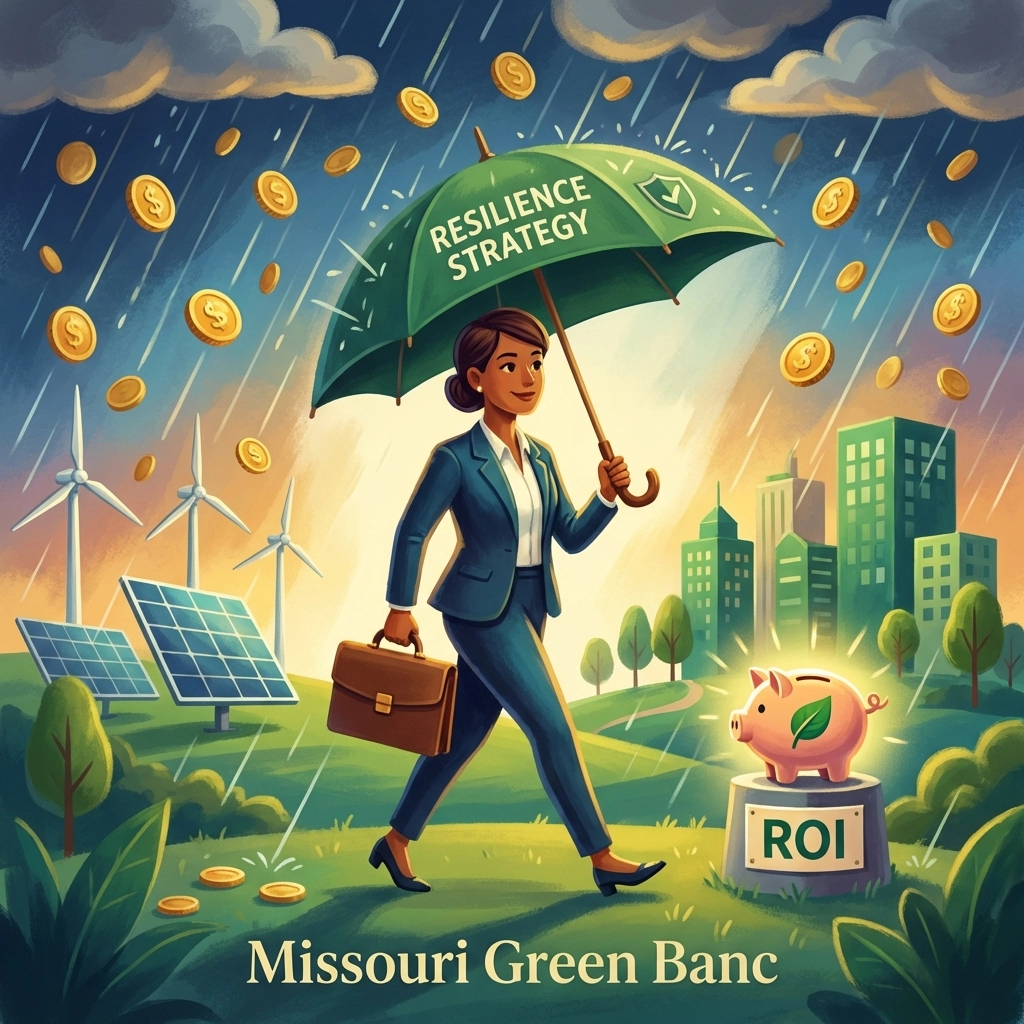
The Rainy Day Has Arrived
Missouri property owners no longer debate whether climate conditions have changed. The evidence appears in insurance premiums, tenant requirements, and property valuations. The relevant question becomes: Which buildings will withstand increasing operational stress, and which will gradually decline as deferred maintenance compounds with environmental challenges?
Resilient retrofits answer this question. By investing strategically in HVAC capacity, building envelope integrity, and energy efficiency, property owners transform existing assets into long-term competitive advantages. The approach preserves embodied carbon, protects capital investment, and positions properties for sustained performance regardless of external conditions.
The ROI of resilience isn't theoretical. It manifests in maintained occupancy during weather events, lower insurance premiums, premium lease rates, and sustained property values as peer properties gradually decline. Organizations that invest in resilience now multiply their chances of sustaining high performance by a factor of four.
For Missouri commercial property owners, the path forward runs through strategic retrofits financed by tools designed specifically for energy improvements. Contact Missouri Green Banc to explore how CPACE financing can enable resilience upgrades that protect your property's value while reducing operational costs.
The rainy day isn't coming. It's here. Prepared properties will thrive. The question is whether yours will be among them.