
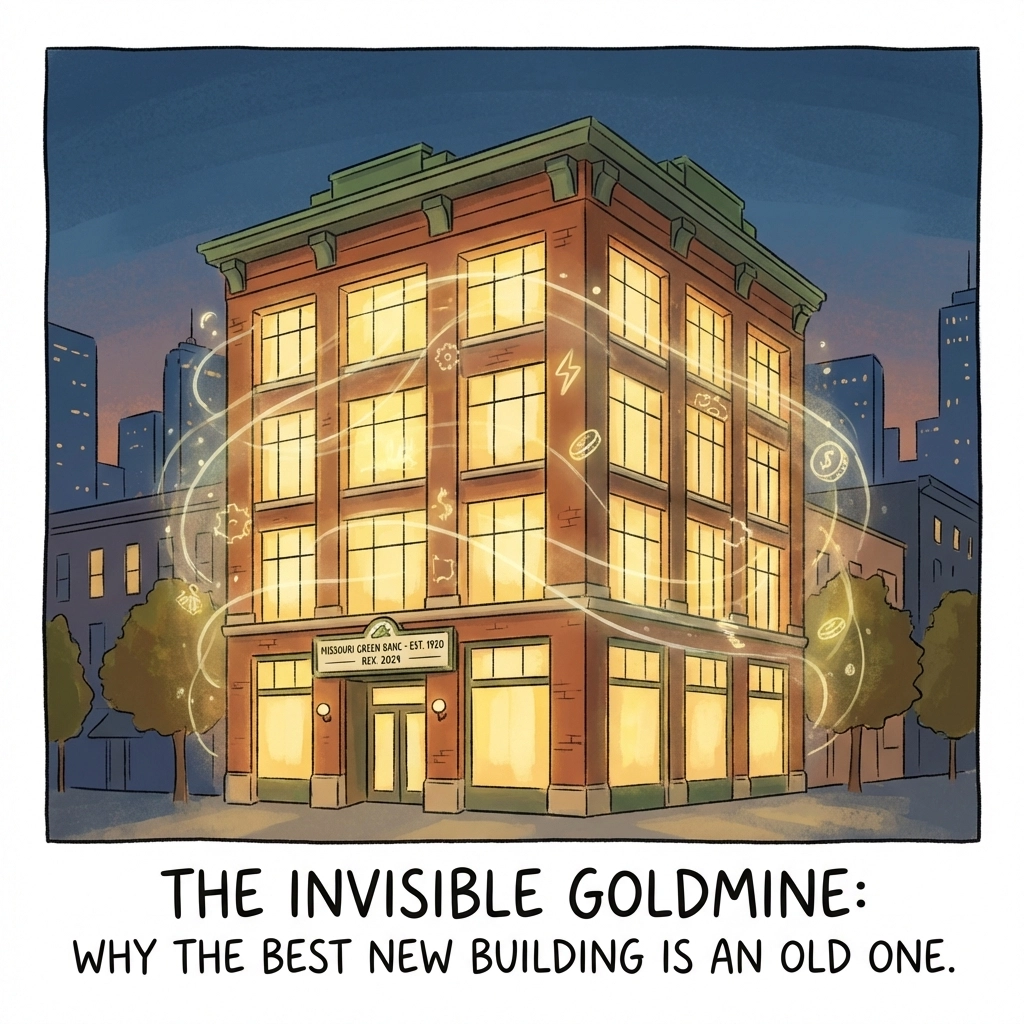
Here's a number that should stop every property owner, city manager, and developer in their tracks: 80% of the buildings we'll be using in 2050 are already standing today.
Not planned. Not on the drawing board. Already here. Already paid for. Already sitting on Main Street, Broadway, or that industrial corridor on the edge of town.
Which raises an obvious question: Why are we still acting like the solution to Missouri's aging building stock is to tear everything down and start over?
The Real Cost of "Starting Fresh"
There's a deeply embedded assumption in American real estate that newer is better. Shinier is safer. Tear it down, build it up, collect the ribbon-cutting photo op.
But the math tells a different story.
When a building is demolished and replaced, the upfront carbon footprint of that decision is staggering. Demolition, material manufacturing, transportation, and construction can generate 50–75% more embodied carbon than simply upgrading what's already there. That's not a rounding error, it's the environmental equivalent of lighting money on fire.
And speaking of money: Historic properties and well-maintained older buildings appreciate between 4% and 19% annually, according to studies tracking property values in historic districts. Meanwhile, new construction that doesn't pencil out in five years? That's what we call a stranded asset.

What Makes Old Buildings Worth Saving
The case for adaptive reuse and energy efficiency financing Missouri isn't sentimental. It's structural.
Older buildings, especially those constructed before the cost-cutting frenzy of the 1980s, were built with materials and engineering standards that often exceed today's minimums. Heart pine. Load-bearing masonry. Over-engineered foundations. These aren't liabilities. They're assets that modern construction rarely replicates.
Add to that the practical advantages of working with existing structures:
- Construction timelines shrink by a third or more when a building's bones are sound
- Material costs drop when you're reusing tile, metalwork, and millwork instead of sourcing everything new
- Regulatory pathways open up when adaptive reuse projects bypass zoning and planning restrictions that new construction can't
In Missouri, where municipal budgets are tight and infrastructure needs are growing, the ability to finance renewable energy for structures that already exist isn't just smart, it's essential.
The Stranded Asset Problem
Here's where things get uncomfortable.
Buildings that can't meet evolving energy performance standards aren't just inefficient, they're becoming uninsurable, unleasable, and unsellable. The market is beginning to price in long-term operating costs, and properties that bleed energy are bleeding value.
This is what financial analysts call the "stranded asset" risk. You own a building. It's paid off. But its operating costs are so high, and its energy performance so poor, that it can no longer compete for tenants or financing. You're stuck holding an asset that's worth less every year.
The alternative? Proactive building decarbonization Missouri through retrofits that lower operating costs, extend asset life, and protect long-term solvency. That's not a feel-good sustainability initiative. It's risk management.

How Missouri Green Banc and MCED Unlock the Goldmine
This is where Missouri Green Banc and the Missouri Clean Energy District (MCED) enter the picture.
MCED operates the first and largest Property Assessed Clean Energy Missouri program in the state, with over 300 municipal members. It's a public-private partnership designed to do one thing exceptionally well: provide long-term, low-cost capital for energy improvement loans.
This type of loan has been tricky for property owners to source because energy upgrades, new HVAC, insulation, lighting, controls, solar, don't fit neatly into traditional loan categories. They're infrastructure. They're improvements. They're capital investments that pay back over 10, 15, or 20 years.
That's exactly the timeline CPACE financing Missouri was built for.
Through MCED's Missouri PACE program, property owners can finance energy retrofit financing Missouri without upfront capital, repay through property tax assessments, and transfer the obligation to the next owner if the building is sold. The financing stays with the property, not the person.
For commercial properties, this is a game-changer. It means a Class B office building in a Missouri community can afford a full energy modernization without waiting for a refinance window. It means a community building can upgrade to LED lighting and high-efficiency HVAC without blowing the annual budget.
It means the 80% of buildings we're going to be using in 2050 can actually get there in decent shape.

The Numbers Don't Lie
Let's talk return on investment.
Historic tax credits can recoup a substantial portion of project costs, making restoration financially competitive with new construction. Heritage tourism, yes, even in Missouri: generates higher per-day spending than other visitor categories, revitalizing local economies in towns that invest in their building stock.
And then there's the straightforward operational benefit: Lower energy bills. A building that's been retrofitted with modern insulation, controls, and efficient mechanical systems doesn't just feel better: it costs less to operate. Month after month. Year after year.
For commercial operations and community institutions operating on fixed budgets, that savings isn't abstract. It's the difference between balancing the books and cutting services.
For commercial property owners, it's the difference between a competitive lease rate and watching tenants move to newer Class A space down the street.
Why This Matters Now
Missouri's building stock isn't getting younger. Federal grant programs that propped up energy upgrades over the past few years are winding down. And the market is starting to separate properties that can compete from those that can't.
The invisible goldmine isn't hidden. It's right here. It's the warehouse in Kansas City that could be a tech hub. It's the mid-century office building in Columbia that needs new windows and controls. It's the old bank building on the square that could anchor downtown revitalization: if someone can figure out how to pay for the mechanical upgrades.
Missouri Green Banc and the Missouri Clean Energy District exist to make that math work. Not through grants that disappear. Not through tax incentives that phase out. Through commercial PACE loans that align long-term capital with long-term assets.
Because the best new building in Missouri might just be the one that's been here all along.
Ready to unlock the value in your existing building? Learn more about how Missouri's best PACE program can finance your next energy upgrade at Missouri Green Banc or explore available financing programs.