
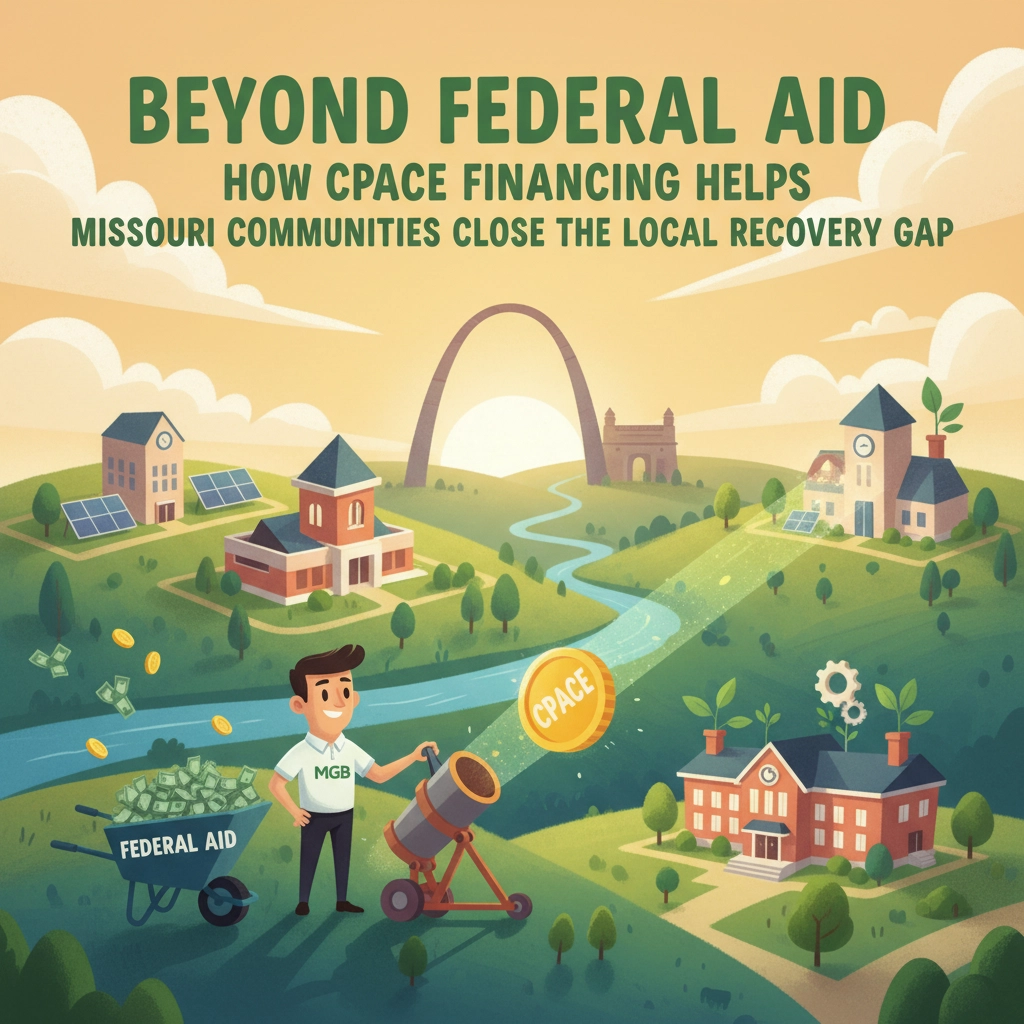
The recent St. Louis Business Journal report "Federal Aid Falls Short" by Samir Knox illuminated a critical challenge facing Missouri communities: substantial gaps remain even after federal disaster recovery funding arrives. When tornadoes, floods, and severe weather events devastate local areas, FEMA assistance: while essential: often covers only a fraction of the true recovery costs. This reality leaves communities, property owners, and local organizations searching for additional resources to rebuild stronger and more resilient structures.
Commercial Property Assessed Clean Energy (CPACE) financing emerges as a powerful tool to address these funding gaps, working alongside existing federal programs rather than competing with them. Missouri Green Banc, in partnership with the Missouri Clean Energy District, has positioned CPACE as a collaborative solution that complements community banks, local foundations, government agencies, and other recovery funding sources.
Understanding the Recovery Funding Landscape
Federal disaster relief programs, including FEMA assistance, typically focus on immediate needs and basic restoration. However, communities seeking to "build back better" with enhanced resilience features, energy efficiency improvements, and climate adaptation measures often discover significant financing gaps. Traditional lending may be limited due to post-disaster economic uncertainty, while property owners face the challenge of accessing capital for improvements that exceed basic replacement standards.
This is precisely where CPACE financing creates value within Missouri's broader recovery ecosystem. Rather than replacing federal aid, CPACE provides long-term, accessible capital specifically designed for energy efficiency, renewable energy, and resilience improvements that make buildings more resistant to future disasters.

How CPACE Complements Existing Recovery Efforts
The Missouri Clean Energy District's CPACE program operates as a public-private partnership that classifies clean energy and resilience upgrades as public benefits, similar to infrastructure investments like water systems or roads. This classification enables property owners to access 100% financing for eligible improvements without requiring upfront capital or traditional creditworthiness criteria that may be challenged in post-disaster scenarios.
Community banks across Missouri have embraced CPACE as a tool that allows them to support local recovery while managing risk effectively. The non-recourse nature of CPACE financing upon project completion means banks can participate in community rebuilding efforts without taking on long-term project performance risk. Local financial institutions report that CPACE enables them to offer comprehensive recovery solutions to their customers, combining traditional reconstruction loans with long-term resilience financing.
Private foundations and community development organizations have similarly found CPACE financing aligns with their mission-driven goals. The program's focus on energy cost reduction creates ongoing benefits for affordable housing providers, nonprofits, and community facilities: organizations that often serve the most vulnerable populations during recovery periods.
Filling Critical Infrastructure Gaps
CPACE financing addresses specific infrastructure needs that frequently fall outside federal disaster recovery scope. Eligible improvements include advanced HVAC systems designed for extreme weather resilience, building envelope enhancements that reduce energy costs while improving occupant safety, and renewable energy installations that provide backup power during future emergencies.
These improvements create what disaster recovery experts call "resilience dividends": ongoing benefits that reduce both operating costs and vulnerability to future events. Property owners utilizing CPACE financing report energy savings that typically exceed annual assessment costs from day one, creating positive cash flow while building community resilience.
The program's 15-20 year repayment terms, structured as property tax assessments, align financing costs with improvement lifespans. This approach reduces immediate financial pressure on property owners during recovery periods while ensuring long-term community benefits. When properties change ownership, CPACE assessments transfer with the building, maintaining resilience investments across ownership transitions.

Statewide Collaboration and Accessibility
Missouri's CPACE program operates statewide through the Missouri Clean Energy District, which represents over 300 municipal members: making it the first and largest PACE program in Missouri. This broad municipal participation creates consistent access to CPACE financing across urban and rural communities, ensuring that recovery resources reach areas regardless of local economic conditions.
The program supports diverse property types including multifamily housing, commercial buildings, industrial facilities, and nonprofit organizations. This flexibility enables comprehensive community recovery strategies that address residential, commercial, and institutional needs simultaneously. Local governments report that CPACE availability supports broader economic development goals by reducing long-term operating costs for businesses and organizations considering post-disaster relocation or expansion decisions.
Economic Development Through Partnership
Recovery efforts succeed when multiple funding sources work in coordination rather than isolation. CPACE financing strengthens these collaborative approaches by providing patient capital that supports private investment decisions. When property owners can access affordable, long-term financing for resilience improvements, they are more likely to commit to rebuilding in place rather than relocating to other markets.
Many municipalities have integrated CPACE into comprehensive recovery strategies that combine federal disaster relief, state economic development incentives, local tax increment financing, and private foundation grants. This layered approach maximizes the impact of each funding source while addressing different aspects of community recovery.
Local contractors and construction professionals benefit from CPACE-funded projects that create sustained economic activity beyond immediate disaster response. Energy efficiency and renewable energy installations require specialized skills and ongoing maintenance, supporting local workforce development and business growth.

Case Studies in Collaborative Recovery
Missouri communities have demonstrated the effectiveness of integrated recovery approaches that include CPACE financing. Following severe weather events, property owners have utilized CPACE to fund comprehensive building improvements that exceed pre-disaster conditions while maintaining positive cash flow through energy savings.
Multifamily housing providers have combined federal disaster recovery assistance with CPACE financing to upgrade aging buildings with modern HVAC systems, LED lighting, and improved building envelopes. These improvements reduce ongoing utility costs for residents while creating more comfortable and resilient housing stock.
Commercial property owners have used CPACE to install backup power systems, upgrade electrical infrastructure, and improve building automation systems that enhance both energy efficiency and operational resilience. These investments support business continuity planning while reducing long-term operating expenses.
Supporting Community-Based Organizations
Nonprofit organizations and community facilities often face unique challenges accessing traditional financing for building improvements, particularly during post-disaster recovery periods. CPACE financing addresses these challenges by focusing on property-based assessments rather than organizational creditworthiness.
Community health centers, houses of worship, and social service organizations have utilized CPACE to implement energy efficiency improvements that free up operational resources for mission-critical programming. The long-term nature of CPACE financing enables these organizations to plan sustainable improvements without compromising service delivery during recovery periods.
Building Forward Together
The integration of CPACE financing into Missouri's recovery ecosystem represents a collaborative approach to community resilience. Rather than creating competition between funding sources, CPACE enhances the effectiveness of existing programs by addressing specific infrastructure needs that support long-term sustainability.
Missouri Green Banc continues to work alongside community banks, local development organizations, and government agencies to ensure CPACE resources complement broader recovery efforts. This partnership approach recognizes that sustainable community recovery requires diverse funding sources working toward shared resilience goals.
The success of collaborative recovery strategies depends on clear communication between funding partners and shared understanding of community needs. CPACE financing provides a reliable tool that local organizations can incorporate into comprehensive recovery planning, knowing that long-term financing is available for resilience improvements that exceed immediate disaster response requirements.
As Missouri communities continue to face increasing weather-related challenges, the combination of federal disaster relief, local resources, and innovative financing tools like CPACE creates opportunities for building back better. The collaborative framework established through the Missouri Clean Energy District ensures that CPACE financing remains accessible and responsive to community needs across the state.
For communities and organizations interested in exploring how CPACE financing can support recovery and resilience planning, the Missouri Clean Energy District provides resources and technical assistance to help identify opportunities and develop implementation strategies. Working together, Missouri's communities can build resilience that protects both current residents and future generations.
