
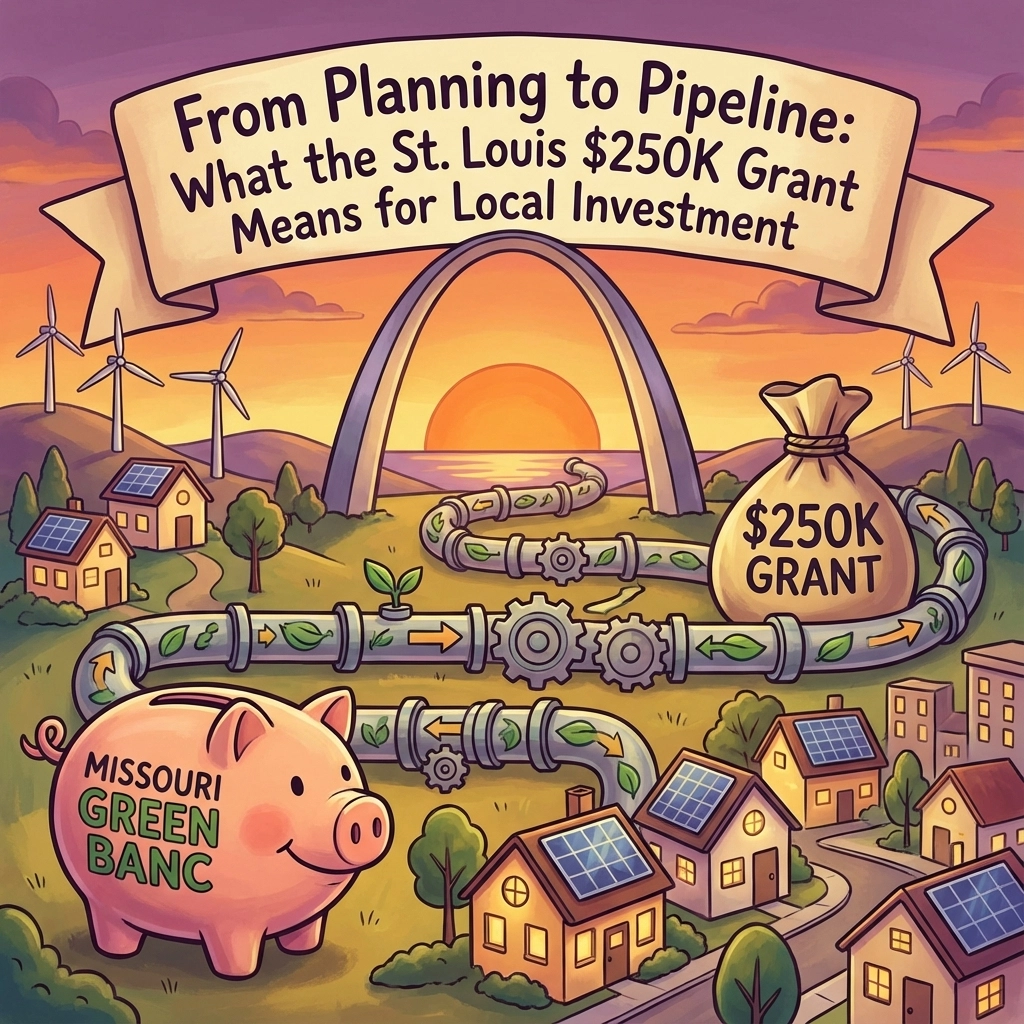
The City of St. Louis recently secured a competitive $250,000 grant from the Municipal Investment Fund through the Coalition for Green Capital, marking a pivotal moment for clean energy financing in Missouri. This initial investment represents far more than a simple funding announcement: it establishes a comprehensive framework for transforming municipal energy planning into actionable, finance-ready project pipelines that could unlock millions in follow-on capital.
Selected from 113 applicants across 48 states, the District of Columbia, Puerto Rico, and tribal nations, St. Louis demonstrated exceptional readiness for public-private energy infrastructure development. The grant's strategic focus on Phase 1 planning positions the city to leverage Missouri Green Banc's expertise in Clean Energy funding and community-focused investment strategies.
Strategic Framework: From Concept to Capital-Ready Projects
The $250,000 allocation functions as seed capital for developing sophisticated investment mechanisms rather than funding individual projects. This approach recognizes that sustainable clean energy transformation requires robust financial infrastructure capable of supporting long-term investment flows. Missouri Green Banc's partnership with St. Louis exemplifies how strategic planning phases can establish the foundation for scalable financing solutions.
The grant specifically targets the development of public-private partnership frameworks designed to reduce energy costs for residents and businesses while creating sustainable investment pipelines. This methodology ensures that initial planning investments generate exponential returns through structured financial products and enhanced project bankability.

Pipeline Development Process: Building Finance-Ready Infrastructure
Phase 1 planning encompasses comprehensive project identification, financial structuring, and stakeholder alignment processes essential for creating investable opportunities. The framework developed through this grant will establish standardized approaches for energy project evaluation, risk assessment, and capital deployment that other Missouri municipalities can replicate.
Missouri Green Banc's role in this initiative leverages their position as operators of Missouri's first and largest PACE program, serving over 300 municipal members across the state. Their expertise in CPACE financing ensures that St. Louis's planning process incorporates proven financial mechanisms capable of supporting diverse energy improvement projects.
The pipeline development process focuses on identifying projects that demonstrate both community benefit and investment viability. This dual-criteria approach ensures that resulting investments serve public interests while maintaining the financial discipline necessary for sustainable capital flows.
Financial Projections: The Path to $2 Million in Follow-On Capital
Successful completion of Phase 1 planning positions St. Louis to access approximately $2 million in additional funding for accelerating energy projects. This potential follow-on capital represents nearly ten times the initial grant amount, demonstrating the leverage effect of strategic planning investments.
The financial architecture established through the grant creates multiple pathways for capital deployment, including PACE program financing, traditional community lending, and innovative blended financing structures. These diverse funding mechanisms ensure that projects can access optimal financing regardless of their specific characteristics or risk profiles.
Missouri Clean Energy District's extensive municipal network provides additional capital access opportunities through collaborative financing arrangements and shared resource deployment. This interconnected approach amplifies individual investments through collective bargaining power and risk distribution.

Replication Model: A Blueprint for Missouri Municipalities
The St. Louis framework establishes a replicable model that other Missouri cities can adapt to their specific circumstances and energy infrastructure needs. This standardized approach reduces transaction costs and accelerates implementation timelines for municipalities seeking to develop clean energy investment capabilities.
Key components of the replication model include:
Assessment Protocols: Standardized methodologies for evaluating community energy infrastructure needs and investment opportunities that ensure consistent project quality and bankability across different communities.
Partnership Structures: Defined frameworks for establishing public-private partnerships that balance community interests with investor requirements, creating sustainable collaboration models.
Financial Mechanisms: Proven approaches for structuring Missouri's best PACE program financing alongside complementary funding and enhancement sources to maximize project feasibility and community benefit.
Implementation Timelines: Clear milestones and benchmarks that guide municipalities through planning phases while maintaining accountability to community stakeholders and investor partners.
Missouri Green Banc's Strategic Partnership Role
Missouri Green Banc's involvement in the St. Louis initiative demonstrates their capacity to bridge community planning processes with sophisticated financial execution. Their experience operating the Missouri Commercial PACE program provides essential expertise for structuring complex public-private energy investments.
The organization's not-for-profit model aligns naturally with municipal interests while maintaining the financial discipline necessary for successful investor partnerships. This balance enables creative financing solutions that prioritize community benefit without compromising investment viability.
Missouri Green Banc's statewide presence through the Missouri Clean Energy District creates opportunities for knowledge transfer and resource sharing among participating municipalities. This network effect amplifies individual municipal investments through collaborative learning and shared infrastructure development.

Implementation Timeline and Measurable Outcomes
The grant's implementation timeline extends beyond immediate planning activities to encompass long-term pipeline development and capital deployment phases. Initial planning activities focus on stakeholder engagement, project identification, and financial structure development, with measurable milestones established for each phase.
Success metrics include the number of projects identified, total potential investment capital mobilized, and community benefit measures such as energy cost reductions and job creation. These quantitative benchmarks ensure accountability while demonstrating the grant's broader economic impact.
The timeline also incorporates provisions for knowledge sharing with other Missouri municipalities, ensuring that lessons learned through the St. Louis initiative benefit communities throughout the state. This collaborative approach maximizes the grant's statewide impact while building collective capacity for clean energy investment.
Broader Impact on Missouri's Clean Energy Goals
The St. Louis grant represents a significant step toward achieving Missouri's broader clean energy objectives through innovative financing mechanisms and collaborative investment approaches. By establishing replicable frameworks for energy investment, the initiative creates pathways for statewide clean energy transformation.
The grant's emphasis on public-private partnerships aligns with Missouri Green Banc's mission to democratize access to clean energy financing while maintaining investment discipline. This approach ensures that clean energy benefits reach communities regardless of their individual financial capacity or technical expertise.
Building decarbonization initiatives benefit from the enhanced project pipeline development capabilities established through this grant. Standardized approaches to project evaluation and financial structuring reduce barriers to clean energy adoption while improving project success rates.

Next Steps for Municipal Partners and Developers
Municipal partners interested in replicating the St. Louis model should begin by assessing their energy infrastructure needs and identifying potential public-private partnership opportunities. Missouri Clean Energy District membership provides access to technical assistance and collaborative financing opportunities that can accelerate planning processes.
Developers seeking to participate in these emerging pipelines should familiarize themselves with PACE energy upgrades requirements and financial structures. Understanding the public-private partnership framework enables more effective project development and improved success rates in competitive procurement processes.
The grant's success in St. Louis creates momentum for similar initiatives throughout Missouri, with Missouri Green Banc positioned to support additional municipalities seeking to develop clean energy investment capabilities. This expanding network of municipal partners creates increasing opportunities for developers and investors focused on sustainable community development.
The transformation of a $250,000 planning grant into a multi-million-dollar investment pipeline demonstrates the power of strategic public-private collaboration in addressing Missouri's clean energy financing needs. Through careful planning, innovative partnership structures, and proven financial mechanisms, St. Louis has established a model that other communities can adapt to accelerate their own clean energy transformation while building stronger, more resilient local economies.
